
Canal: Breaking the Scalability Barrier of Sybil-Resilient Credit Networks
Canal: Scaling Social Network-Based Sybil Tolerance Schemes
The paper presents Canal, a high-performance system designed to scale social network-based Sybil tolerance schemes like Ostra, SumUp, and Bazaar. By leveraging a novel landmark routing-based approximation for credit payments, Canal achieves up to a 2,329x speedup in transaction processing compared to traditional max-flow-based methods while maintaining over 94% accuracy.
TL;DR
Social network-based defenses against Sybil attacks (multiple fake identities) are theoretically robust but practically slow due to their reliance on heavy Max-Flow computations. Canal is a high-speed system that approximates these payments using Landmark Routing, delivering a 3-order-of-magnitude speedup (down to microseconds) while maintaining 94%+ accuracy on networks with hundreds of millions of edges.
Problem: The "Max-Flow" Bottleneck
To prevent attackers from manipulating ratings or spreading spam, modern systems use Sybil Tolerance. Unlike detection (which tries to ban users), tolerance schemes treat social links as Credit Networks. If Alice wants to interact with Bob, she must "pay" credit along a path of trusted friends.
The catch? Finding if enough credit exists between two distant nodes is a Maximum Flow problem. On a graph like Orkut (3M nodes, 234M edges), a single max-flow calculation can take over 200 seconds. For a site like eBay or Digg, waiting 3 minutes to verify a bid or a vote is unacceptable.
Methodology: Routing through Landmarks
Canal's core insight is that we don't need the absolute maximum flow; we just need enough flow quickly. It borrows the concept of Landmark Routing.
1. Multi-level Landmark Universes
Canal randomly selects sets of nodes as "Landmarks" at different levels ( landmarks at level ). Every node in the network pre-calculates its shortest path to its nearest landmark at each level.
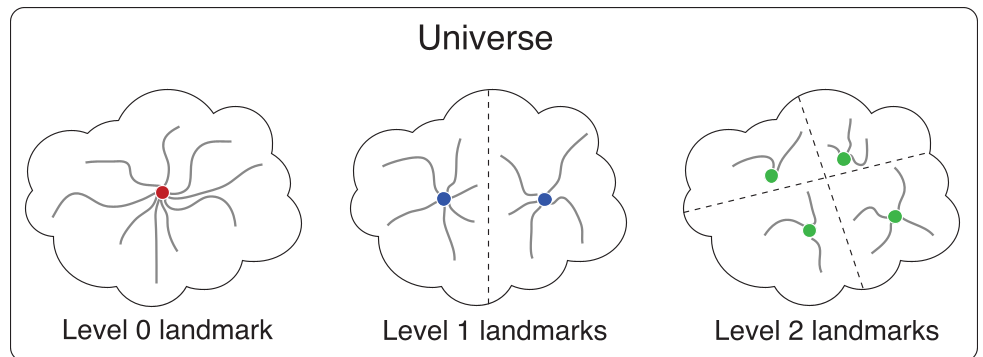 Figure: A 2-level landmark universe. Paths are "stitched" at shared landmarks.
2. Path Stitching & Multi-Pathing
When a payment request arrives between User A and User B:
- Canal finds shared landmarks in the pre-computed maps.
- It "stitches" a path: .
- Because one path might not have enough credit, Canal maintains a queue of recent universes, allowing it to find multiple disjoint paths to satisfy the total credit requirement.
3. Dynamic Adaptation
Credit networks change every time a payment is made. Canal handles this by continually regenerating universes in the background, ensuring landmarks don't become "hotspots" and routing around exhausted links.
Experiments: Speed vs. Accuracy
The authors integrated Canal into two existing frameworks: Bazaar (market reputations) and Ostra (anti-spam).
Massive Speedup
In the "Clothes" category of an eBay trace, the original Bazaar took 6.2 seconds per transaction. With Canal, the median latency dropped to 0.2 milliseconds—a staggering 2,329x speedup.
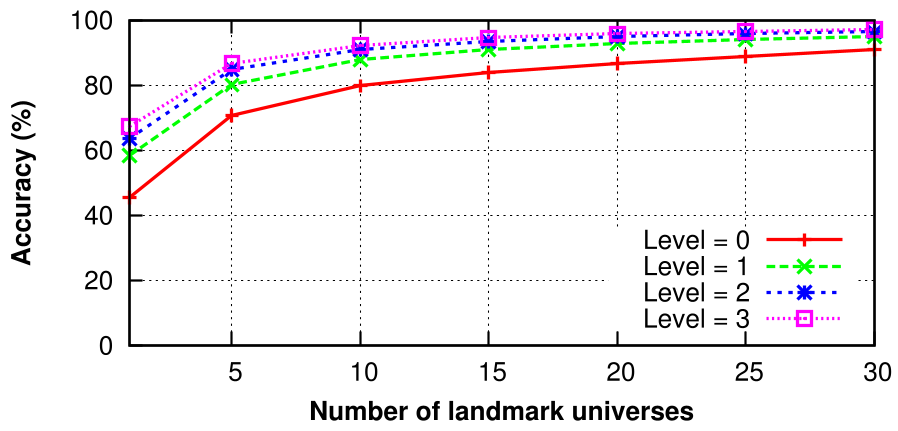 Table: Latency comparison showing Canal's sub-millisecond performance.
High Fidelity
One might fear that "approximation" means many legitimate payments fail (False Negatives). However, experimental results showed that with just a few cached universes, Canal achieved 94% to 98% accuracy. Most honest users never noticed the difference, while Sybil attackers remained strictly bounded by their limited honest links.
Critical Insight & Conclusion
Canal shifts the paradigm of Sybil defense from "expensive-but-perfect" to "efficient-and-sufficient." By moving the heavy lifting (graph traversal) to a background process (universe creation), it enables real-time credit-based security.
Takeaway: The "Landmark" approach turns a global graph problem into a local lookup problem. For researchers and architects building decentralized trust systems or social-based filtering, Canal provides the blueprint for making "transitive trust" scale to the size of the modern web.
Limitations
- Memory Footprint: Storing 30+ landmark maps for a 3M node graph requires significant RAM (approx. 20GB-40GB), though this is manageable for modern servers.
- Distributed Complexity: While designed for clusters, the current implementation is single-node. Distributed locking of credit links remains a known overhead challenge.