
Capacity of Wireless Social Networks: Bridging Physical Constraints and Human Logic
9721_Capacity of Wireless Networks with Social Behavior.
This paper investigates the throughput capacity of "composite networks"—wireless ad hoc networks where source-destination pairs are determined by social group behaviors rather than uniform selection. By introducing a modified power-law distribution for long-range social contacts, the authors derive the capacity scaling law as a function of node count , social group size , and social concentration .
TL;DR
Why does the capacity of traditional wireless ad hoc networks collapse as they grow larger, while social systems seem to scale effortlessly? This paper provides the mathematical missing link. By modeling "Composite Networks"—where wireless nodes follow human-like social patterns (power-law distance distributions)—the authors prove that the "Gupta-Kumar" capacity limit is only a worst-case scenario. If social groups are tight and localized, network capacity can actually remain constant regardless of network size.
The Motivation: Geography vs. Sociality
In the seminal work of Gupta and Kumar (2000), it was established that as a wireless network grows, the per-node throughput drops toward zero. The reason is simple: if everyone talks to a random person across the map, each bit consumes resources across many "hops," clogging the airwaves for everyone else.
The Insight: Real people don't talk to random strangers at the other end of the country as often as they talk to local social circles. This paper asks: If our communication is socially driven and distance-dependent, can we escape the "vanishing capacity" trap?
Methodology: The Composite Model
The authors define a network of nodes where destination selection follows a modified power-law distribution. Unlike previous models that assumed a fixed number of contacts, this framework allows the social group size to be a function of .
1. The Modified Power-Law Distribution
The probability of node being a contact is proportional to , where is the social group density.
- Small : Social contacts are spread out (Globalized).
- Large : Social contacts are nearby (Localized).
2. Theoretical Tool: Symmetric Polynomials
To handle cases where the number of contacts scales with , the authors use elementary symmetric polynomials to normalize the selection probabilities. This allows for a rigorous derivation of the "Average Hop Count" , which is the primary driver of capacity.
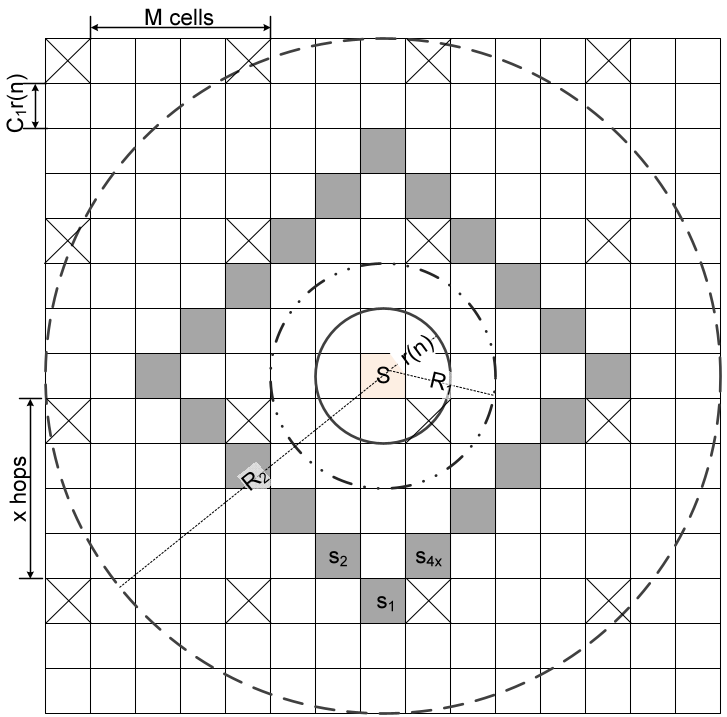 The figure above illustrates the cell-based TDMA structure used to manage interference and the rhombus-shaped search area for routing hops.
Scaling Laws: Three Reality Shifts
The paper identifies three distinct regimes for network behavior based on the social concentration :
-
The Communication-Dominant Regime ( or ): If your social circle grows as fast as the population, or if your contacts are widely distributed, you are essentially back to the Gupta-Kumar model. Per-node capacity vanishes as .
-
The Transition Regime (): Here, social logic starts to win. As increases (contacts become more local), the average hop count drops. The capacity improves significantly beyond the traditional bounds.
-
The Social-Dominant Regime (): When social groups are highly concentrated, the source and destination are often within a few hops of each other (). In this state, the wireless infrastructure is no longer the bottleneck. The capacity achieves its maximum possible order.
 Experimental results (solid) vs. Theoretical bounds (dash-dot). Note how higher values (steeper power-law) lead to significantly higher capacity plateaus.
Deep Insights & Critical Analysis
The most striking takeaway is the Phase Transition at . Most prior work viewed wireless capacity as an immutable physical property of the medium. This paper reframes it as a Social-Technical interaction.
The "q" Paradox: Interestingly, if the number of contacts grows even slightly with (even as slowly as ), the network eventually reverts to the local capacity limit. To maintain the "Social-Dominant" high capacity, social groups MUST remain finite or grow much slower than the network size—a finding that mirrors the "Dunbar's Number" in sociology.
Limitations
- Stationarity: The model assumes nodes are uniformly distributed in a unit square; it doesn't account for "social clusters" (clumping) where nodes themselves are physically closer in a social group.
- Traffic Patterns: The study assumes a simple unicast model. Multi-cast or content-centric traffic (popular videos) might change the scaling laws further.
Conclusion
This work is a cornerstone for understanding 6G and future IoT ecosystems. It suggests that by designing networks to align with human social structures—or by offloading local social traffic to D2D (Device-to-Device) layers—we can build massive wireless systems that don't choke on their own growth.
Future Outlook: Can we optimize "Content Popularity" to mimic high- social distributions? If so, we might finally solve the wireless capacity crisis for good.