
CAPTRA: Turning Wireless Eavesdropping into a Security Fortress
CAPTRA: coordinated packet traceback
The paper introduces CAPTRA, a Coordinated Packet Traceback mechanism for Wireless Sensor Networks (WSNs). By leveraging "Space-Time Bloom Filters" (STBF) and the broadcasting nature of wireless channels, it enables hop-by-hop identification of attack origins with a minimal memory footprint.
TL;DR
CAPTRA (CoordinAted Packet TRAceback) solves the "needle in a haystack" problem of tracing sporadic attacks in Wireless Sensor Networks (WSNs). By utilizing a novel Space-Time Bloom Filter (STBF), it allows resource-constrained sensors to collectively remember and testify to packet journeys without exhausting their tiny memory banks.
Problem & Motivation: The Traceback Paradox
In the world of WSNs, sensors are "bottlenecked" by design—often running on mere kilobytes of SRAM. When a Sybil attack or a "Ping of Death" occurs, the victim might detect the malicious packet, but finding the source is nearly impossible because:
- No Logs: Sensors cannot afford the storage for traffic logs.
- Dynamic Topologies: Traditional IP-based filtering fails as nodes join, move, or die.
- Open Medium: Anyone can inject packets into the airwaves.
The authors' key Insight: Since every packet transmission in a WSN is a broadcast, multiple neighbors "overhear" every hop. If we can store a tiny, probabilistic "fingerprint" of these events across the neighborhood, we can reconstruct the path retrospectively.
Methodology: The Space-Time Bloom Filter (STBF)
The core innovation is the Space-Time Bloom Filter. While a standard Bloom filter is a 2D bit-array (hash functions bits), CAPTRA adds a third dimension: Space (distributed nodes) and Time (asynchronous refreshing).
How it Works:
- Packet Tracking: When a node forwards or overhears a packet, it hashes a combination of the
Packet ID,Sender ID, andTransmitter ID. It then marks these bits in its local Bloom filter. - Majority-Vote Quorum: Unlike traditional filters that require a 100% match, CAPTRA uses a coordination protocol:
- TRACREQ: A request to find a predecessor.
- TRACVERD: Neighbors provide "verdicts" if they have a match.
- TRACCONF: If a node receives enough verdicts (reaching a quorum), it "confesses" to being the forwarder and continues the traceback.
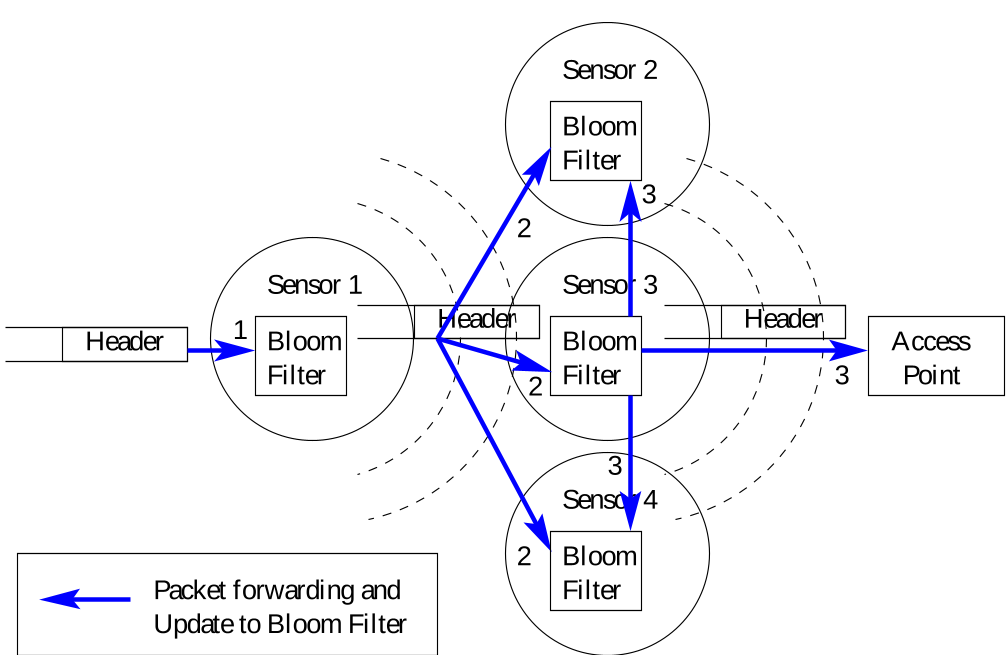 Figure: The coordination between tracking and tracing using neighbor witnesses.
The "50% Golden Rule"
To prevent the Bloom filter from becoming a "black hole" of false positives as more packets are recorded, CAPTRA applies the 50% Golden Rule. Once a filter reaches 50% saturation, it is reset. Because nodes reset their filters asynchronously, the network maintains a "gradually fading memory"—recent packets are remembered vividly, while older ones slowly vanish.
Experiments: Performance Analysis
Using J-Sim simulations with 20 nodes, the authors tested CAPTRA across different hop lengths (2, 4, and 8 hops).
Key Findings:
- Accuracy vs. Memory: 3 hash functions () offered much more stable performance and lower false rates than , but at the cost of filling the Bloom filter faster.
- Traceback Horizon: The system's "memory" of a packet is directly proportional to network density and the size of the Bloom filter (tested at 4096 bits).
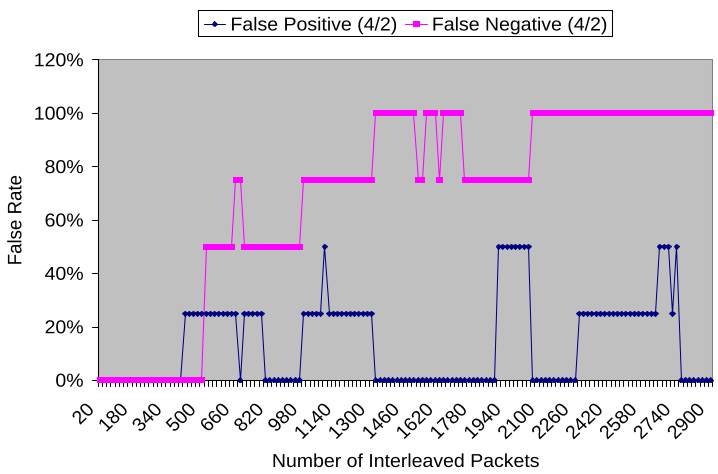 Figure: False Positive and False Negative rates across 4-hop and 8-hop configurations.
Critical Analysis & Conclusion
CAPTRA is a masterclass in Resource-Constrained Protocol Design. It effectively offloads the "burden of proof" from a single victim to the entire neighborhood.
Limitations:
- Mobility: While the paper claims tolerance to node loss, high-speed mobility would likely break the quorum faster than the STBF can adapt.
- Adversarial Awareness: If an attacker knows the specific hash functions used, they might craft packets to cause collisions, though the use of node IDs in the hash makes this difficult.
Future Outlook: The STBF concept is highly relevant today for Edge Computing and Mesh Networks, where provenance is required but centralized logging is prohibited by bandwidth or privacy concerns.