
Bridging the Semantic Gap: Leveraging Web Search to "Read" Your Social Media Interests
CAPTURING THE VISUAL LANGUAGE OF SOCIAL MEDIA EXPLOITING WEB IMAGE SEARCH FOR USER INTEREST PROFILING
The paper introduces a system for automated user interest profiling by analyzing images shared on social media like Instagram. It proposes a "search-to-annotate" framework that leverages web image search engines to translate visual content into noisy semantic text, achieving zero-shot-style classification without a manually labeled dataset.
TL;DR
Researchers have developed a system that automatically profiles your interests—ranging from "Cultural" to "Nightlife"—just by looking at the photos you post on Instagram. Unlike traditional AI that requires millions of hand-labeled images, this system uses web search engines to translate your photos into descriptive text, achieving 64.4% accuracy compared to a measly 15.2% using traditional visual features.
Background & Motivation: The "Silence" of Social Images
In the age of Instagram and Pinterest, we communicate through visuals. However, many of these photos are "silent"—they lack tags, or the captions are cryptic ("Vibes ✨"). For a machine, understanding that a photo of a museum belongs to a "Cultural" interest profile is difficult because low-level pixels don't easily map to high-level human concepts.
The authors identify a major bottleneck: Dataset Dependency. Creating a labeled dataset for every possible human interest is an impossible task. Instead of building a bigger database, they asked: Why not use the most comprehensive database ever created—the World Wide Web?
Methodology: From Pixels to Keywords via Web Search
The core innovation is a pipeline that treats the web as an unsupervised source of semantic truth.
1. The Translation Pipeline
Instead of analyzing the image directly to find a category, the system:
- Uses the image as a query in a Web Image Search engine.
- Crawls the pages containing visually similar results.
- Extracts the surrounding text, captions, and "alt-text" from these pages.
- Processes this "noisy" text into a TF-IDF (Term Frequency-Inverse Document Frequency) representation.
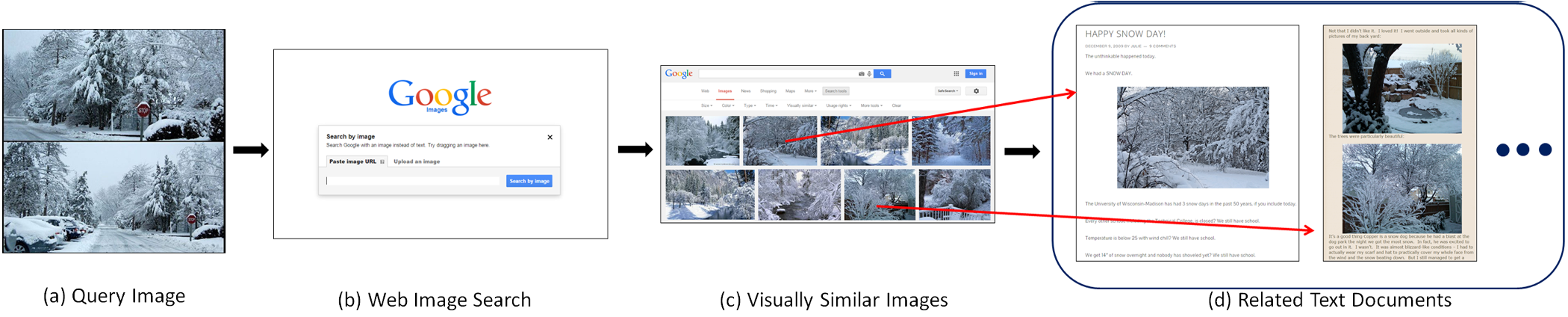 Figure 1: The pipeline illustrating how visual data is translated into semantic noisy text through web search.
2. Hierarchical Interest Ontology
To make classification manageable, they defined a two-level hierarchy:
- 9 Parent Classes: Animals, Cultural, Fashion, Food, Outdoor, etc.
- 40 Sub-classes: For example, "Cultural" breaks down into Museums, Art, and Architecture.
This hierarchical approach allows the model to first narrow down the general "vibe" of the user before pinpointing specific activities.
Experiments: Real-World Performance on Instagram
The researchers tested their system on 2,600 real Instagram photos from 50 different users.
The Semantic Gap Proof
The most striking result was the comparison between their text-based mapping and traditional visual features (GIST).
- Web-Search Text approach: 64.4% Accuracy
- Visual Features (GIST): 15.2% Accuracy
The reason for this gap is evident in Figure 7. Training images from the web are often "clean" (white backgrounds), while Instagram user photos are "messy" (cluttered backgrounds, filter effects). Low-level visual descriptors fail to see the similarity, but web-mined text captures the shared concept of "Kids" or "Monuments" regardless of the clutter.
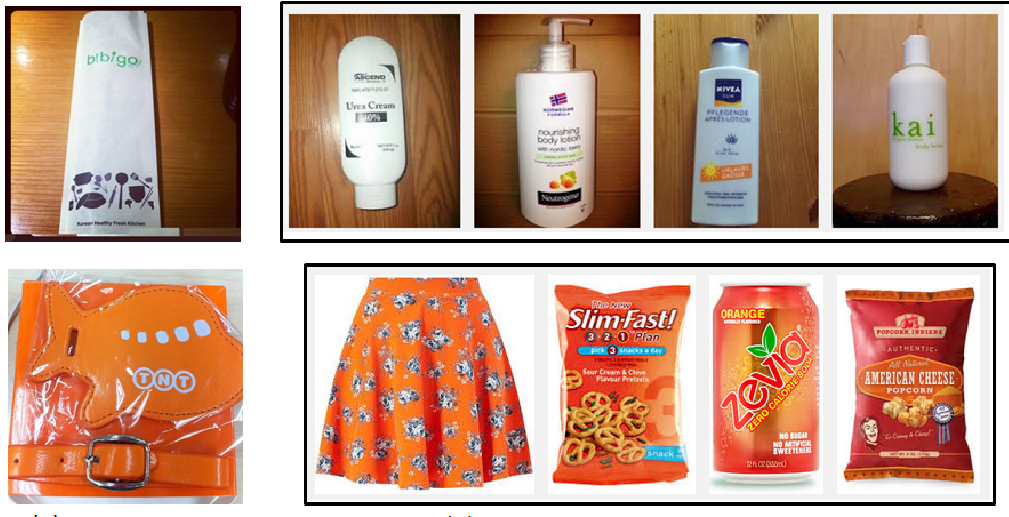 Figure 2: Comparison between clean "training" images and complex "test" social media images.
User Interest Profiling
By aggregating these classifications over a user’s entire feed, the system generates a "lifestyle fingerprint." This can tell a brand if a user is a "Foodie" or a "Nature Enthusiast" with high confidence.
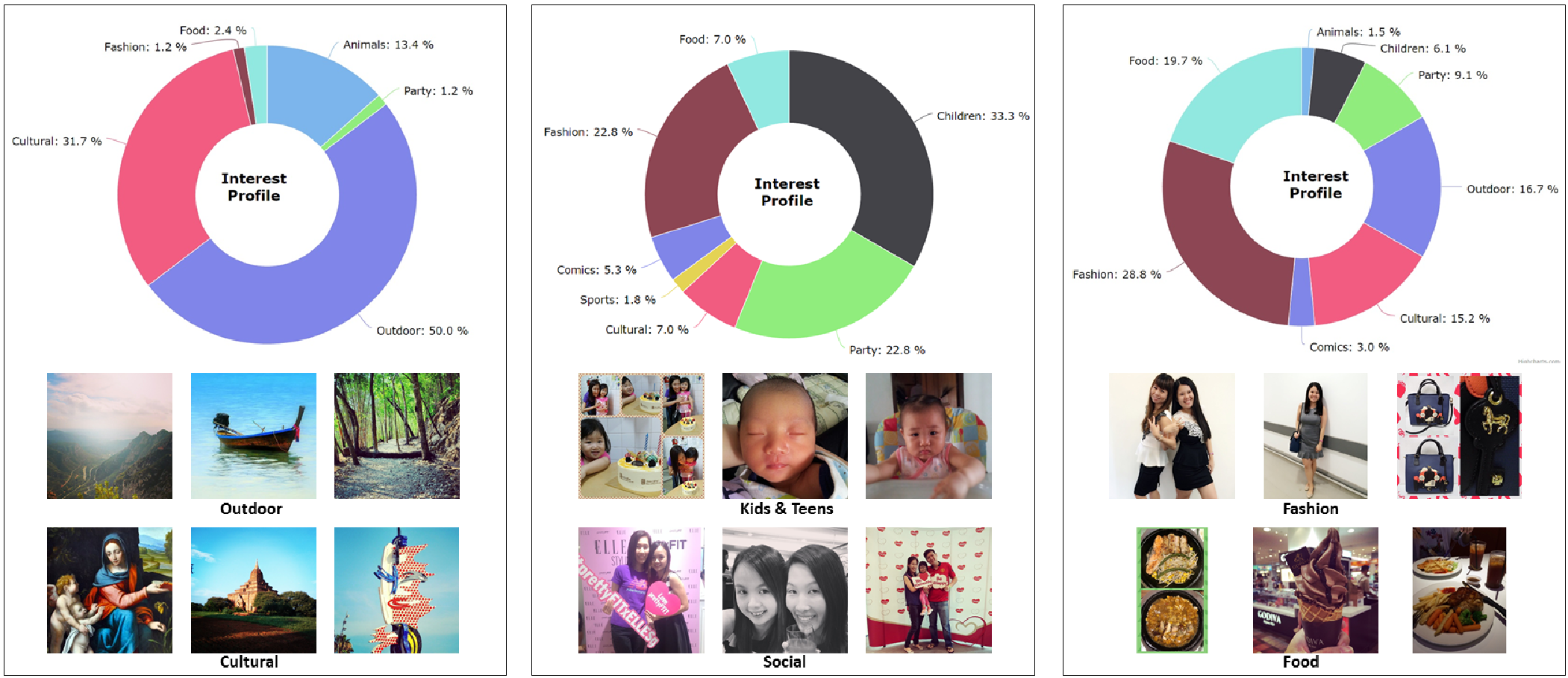 Figure 3: Automatic interest profiles generated for three different Instagram users.
Critical Insight & Future Directions
The beauty of this research lies in its unsupervised nature. It doesn't "know" what a pet is beforehand; it learns it from the collective wisdom of the web's descriptions.
Limitations:
- The system is only as good as the search engine's visual retrieval. If the search engine returns a "Food" image when given a "Cosmetic" query (as seen in the failure cases in the paper), the text extracted will be wrong.
- Future Work: Integrating modern Vision-Language Models (like CLIP or GPT-4V) could likely supercharge this concept, as they have already "pre-digested" the web's visual-textual relationships.
Conclusion
This paper effectively demonstrates that we don't need "clean" data to solve complex semantic problems. By leveraging the existing infrastructure of web search, we can capture the "Visual Language" of social media, providing a powerful tool for personalized marketing and social science research.