
From Sprints to Strolls: Reimagining Inclusive Design Through the Ethics of Care
Care-full Design Sprints, Online? Addressing Gaps in Cultural Access and Inclusion during Covid-19 with Vulnerable Communities in London and Tokyo
The paper introduces "Care-full Design Strolls," an adapted online co-design methodology aimed at addressing gaps in cultural access for vulnerable communities during the Covid-19 pandemic. By integrating feminist ethics of care and the concept of "thinking-with," the study facilitates cross-cultural prototyping between London and Tokyo, yielding twelve diverse remote cultural experience concepts.
TL;DR
As the Covid-19 pandemic disconnected global communities, cultural organizations faced a crisis of access. This paper moves away from the aggressive "Google Design Sprint" model toward a "Care-full Design Stroll." By slowing down the process and centering it on feminist ethics of care, researchers in London and Tokyo successfully co-created inclusive cultural prototypes with vulnerable communities, proving that empathy is a more powerful design tool than speed.
Context: The Breaking Point of Digital Inclusion
The pandemic didn't create the digital divide; it weaponized it. While museums and galleries rushed to launch virtual tours, the most vulnerable—elderly care home residents, low-income families, and isolated students—were left behind. The authors argue that current participatory design often pays "lip-service" to inclusion, assuming that making things "digital" automatically makes them "accessible."
The "Care-full" Insight: Why "Stroll" Instead of "Sprint"?
The core of this research lies in the physics of interaction. A sprint is about velocity and "minimal viable products." A stroll, however, allows for:
- Thinking-with: Treating the "vulnerable" not as broken subjects to be fixed, but as active co-designers.
- Relational Knowledge: Acknowledging that the designer and the user are part of the same "ecology of care."
- Phygital Connection: Bringing the sensory world back into the digital space (e.g., mailing physical tea samples to participants in both London and Tokyo to share a "virtual" tea party).
 Note: The project utilized a blend of Miro, Slack, and Zoom to maintain these care-full connections.
Methodology: Bridging London and Tokyo
The researchers conducted parallel workshops in two global hubs. The focus was not just on the "What" (the prototype) but the "How" (the atmosphere):
- Code of Care: Instead of a "Code of Conduct," participants co-created a "Code of Care" to define how they would support each other's mental well-being during the process.
- User Personas: Participants interviewed isolated individuals to build archetypes like the "overworked family" or "frustrated art student."
- Low-Tech Prototypes: Concepts like "Dial-A-Play" (using freephone numbers for theatre) intentionally avoided high-cost barriers like VR to reach those without high-speed internet.
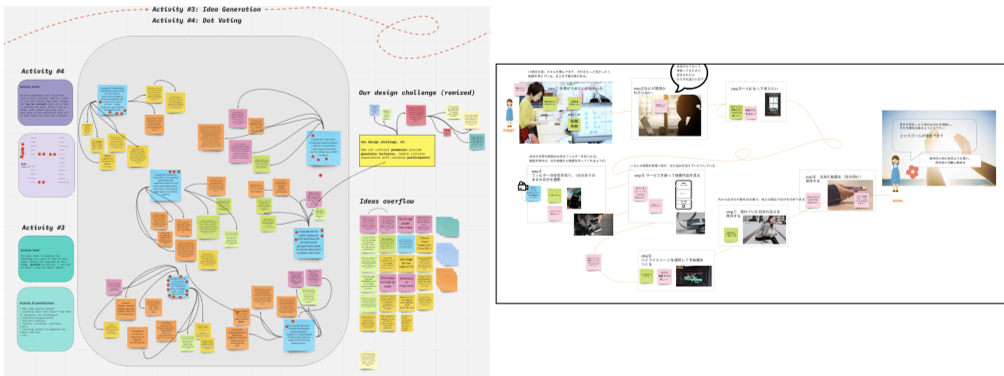 Above: Collaborative sessions on Miro where London and Tokyo teams brainstormed and voted on prototypes.
Key Successes and Prototypes
The output was a set of 12 "dreamed futures." Notably:
- Dial-A-Play (London): Addressing the "newly vulnerable" elderly who may have landlines but not smartphones.
- Online Atelier for Art (Tokyo): Creating a space for art students whose physical studios were closed, addressing "social death" in the younger generation.
- Remix the Hospital: Using augmented reality to overlay art on existing hospital infrastructure to nourish patients in isolation.
Critical Insight: The Value of "Making Kin"
The paper’s most profound contribution is the Six Design Principles for Care-full Co-design. It posits that in a digital-first world, we must set a "manageable pace—neither marathon nor sprint." The authors argue that the "by-products" of design—the friendship, the shared tea, the collective learning—are actually the most valuable outcomes for community resilience.
Conclusion & Future Outlook
The "Care-full Design Stroll" provides a blueprint for cultural institutions to act as "centers of community" rather than just static repositories of objects. As we move into a post-pandemic world, the lesson is clear: inclusive design requires us to stop sprinting and start walking alongside those we aim to serve.
Limitations
The authors candidly admit the difficulty of reaching the "most unreachable"—those without any digital access at all. Future work must continue to explore how purely offline infrastructures can be integrated into these "care-full" frameworks.