
Cars, Condoms, and Facebook: The Hidden Psychology of Privacy Risk
Cars, Condoms, and Facebook
This study applies the classic psychometric paradigm of risk perception to Online Social Networks (OSNs), specifically examining how users perceive privacy risks on Facebook. Utilizing Fischhoff's nine-dimensional risk model, the authors find that perceived privacy risks are significantly explained by qualitative characteristics like voluntariness, control, and severity rather than just a rational calculus of harm.
TL;DR
Why do we post sensitive information on Facebook despite claiming to care about privacy? This paper argues that our behavior online mirrors our behavior offline—specifically how we treat seatbelts and condoms. By applying classic risk perception theories to social media, the researchers discovered that perceived control and knowledge actually make us feel safer, leading us to share more, potentially negating the benefits of privacy tools.
The "Privacy Paradox" and Risk Compensation
In the world of physical safety, we are familiar with "risk compensation." When cars were equipped with seatbelts and anti-lock brakes, some drivers began driving more aggressively because they felt "safer." This paper suggests a similar phenomenon happens on Facebook.
The authors identify a major gap in current privacy research: most PETs (Privacy Enhancing Technologies) focus on making controls more usable. However, the authors argue that usability is not enough. Humans are "boundedly rational." We don’t perform a cold cost-benefit analysis before posting a status; instead, our willingness to share is driven by how "risky" the act feels.
Methodology: Mapping Offline Risk to Online Sharing
The researchers utilized Fischhoff’s Nine-Dimensional Model, a proven framework used for decades to study how people perceive hazards like nuclear power or smoking. They mapped these nine dimensions to 22 Facebook items (e.g., Sexual Orientation, DOB, Friend List):
- Voluntariness: Is the sharing forced or elective?
- Immediacy: Does the harm happen now or later?
- Knowledge (Exposed/Expert): How well is the risk understood?
- Control: Can I stop the negative consequences?
- Newness: Is this a new type of threat?
- Chronic vs. Catastrophic: Does it hurt just me or a whole group?
- Common-Dread: Is it a routine risk or a terrifying one?
- Severity: How bad is the ultimate harm?
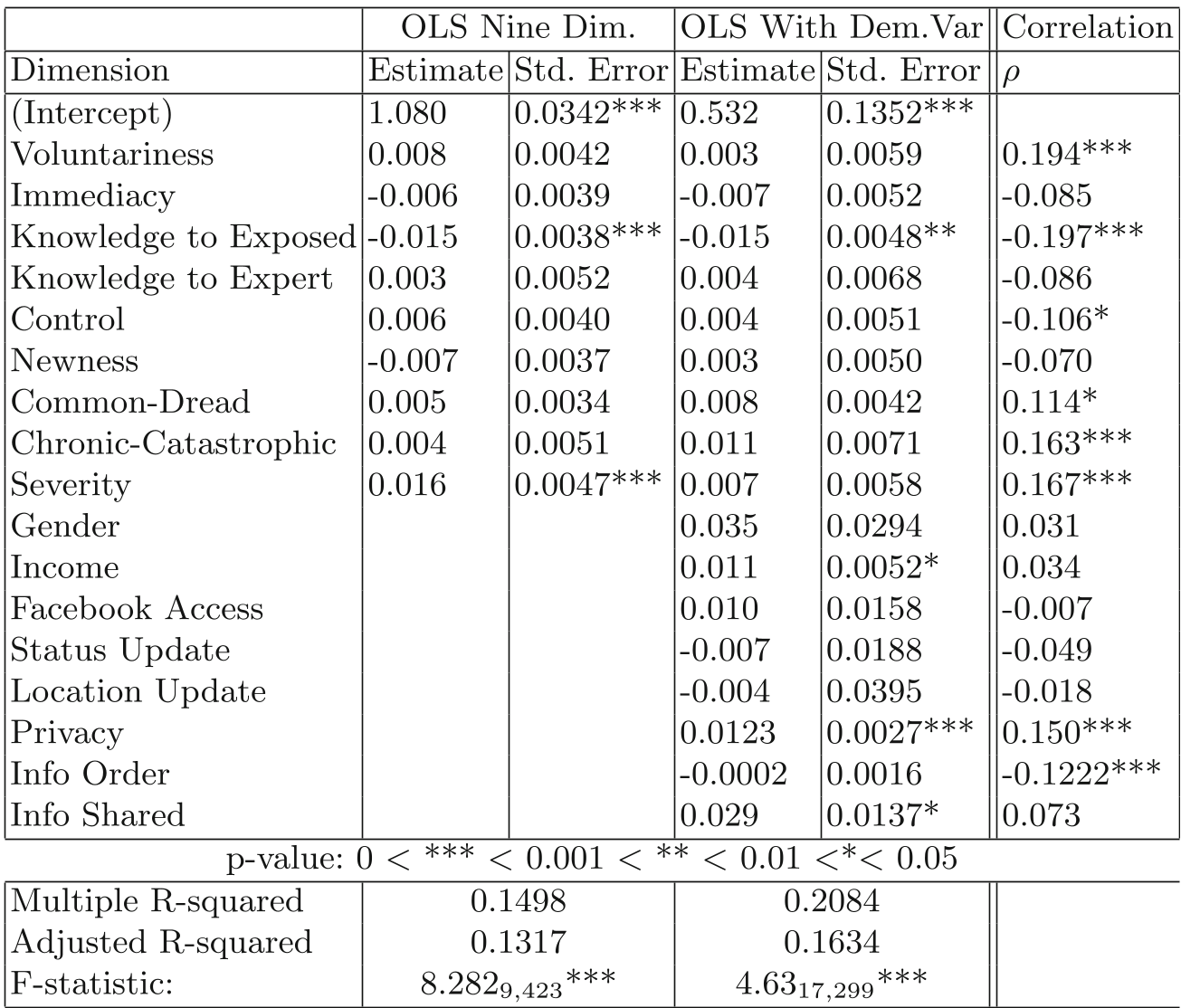 Table 1: OLS Regression showing how the nine dimensions and demographic variables correlate with perceived risk.
Key Insights: The Control Paradox
The study’s most striking find is the Rejection of Hypotheses 01 and 05.
- The Control Trick: When users feel they have more control over their data, their perception of risk drops. This leads them to share more information.
- The Education Irony: As users become more "educated" about privacy risks, they may develop a false sense of security. Because they "know" the risk, they feel they can navigate it, which paradoxically reduces their inhibitions.
The authors call this a "perverse incentive" for Facebook. By providing better privacy controls, Facebook isn't just protecting users; it is effectively lowering the "perceived risk" bar, which encourages users to pump more data into the platform.
Critical Analysis & Takeaways
The paper successfully bridges the gap between traditional psychology and modern HCI (Human-Computer Interaction). It proves that privacy risk is subjective.
Limitations
- Sample Bias: The study used a convenience sample of Computer Science undergraduates. These "expert" users might perceive risk differently than the general public.
- Small Sample: With only 71 valid responses, the results provide a "statistically significant explanation" but require broader validation.
- Hypothesis 14: Interestingly, unlike smoking or driving, the researchers found no correlation between perceived risk and perceived benefit on Facebook. This suggests people share data not because they’ve weighed the benefits, but simply because the "blanks" are there to be filled.
Conclusion: Beyond Technology
Technology alone (like condoms or seatbelts) cannot solve a behavioral problem. The paper concludes that if we want to fix online privacy, we must address the "Risk Thermostat."
Future privacy strategies shouldn't just focus on "better buttons" (PETs) but on broad communication campaigns—much like those used to fight drunk driving. We need to raise the baseline "privacy preference" of the population so that the "risk budget" isn't immediately spent the moment a new privacy feature is released.