
Cascaded Fusion: Masterfully Integrating Visual Cues for Robust Emotion Recognition
Cascaded Fusion of Dynamic, Spatial, and Textural Feature Sets for Person-Independent Facial Emotion Recognition
This paper introduces a multi-level cascaded fusion architecture for person-independent facial emotion recognition using a combination of dynamic, spatial, and textural features (PHOG, LBP-MCF, MHH, and Optical Flow). The system utilizes an adaptive weighting mechanism via Artificial Neural Networks (ANNs) to integrate complementary information from diverse visual descriptors, achieving SOTA results on the EmoRec 2 and GEMEP-FERA datasets.
TL;DR
Recognizing human emotions in the "wild" remains a major challenge due to head movements, lighting shifts, and individual differences. This paper presents a cascaded fusion architecture that doesn't just look at a face, but intelligently weights spatial textures (LBP), oriented structures (PHOG), and temporal motion (Optical Flow, MHH). By treating individual classifiers as "weak learners" and stacking them through Neural Networks, the authors achieved a 69.2% accuracy on complex, spontaneous interaction datasets.
Background: The Limits of Single-Channel Vision
In laboratory settings like the Cohn-Kanade database, emotion recognition is relatively solved. However, when you move to real-world scenarios—beards, glasses, sensor cables, and fast movements—single-feature descriptors fall apart. Spatial features might miss the "micro-expressions" found in motion, while motion features might be fooled by a simple head turn. The authors suggest that the answer lies not in a "perfect" feature, but in a superior fusion strategy.
The "Weak Learner" Philosophy: Motivation
The researchers argue that instead of building one massive, complex classifier, we should utilize the diversity of different feature families.
- PHOG: Captures spatial location and oriented structures.
- LBP-MCF: Captures texture changes over time.
- MHH: Robustly encodes motion history.
- Optical Flow: Provides precise per-pixel displacement.
By using SVMs with probabilistic outputs (Platt’s scaling) as base classifiers, they generate a "certainty measure" for every prediction, providing a much richer signal for subsequent fusion stages than a simple binary label.
Methodology: The Cascaded Fusion Architecture
The architecture is built on Fusion Nodes. Each node acts as a bridge between disparate signals, handling different sampling rates and compensating for class imbalances.
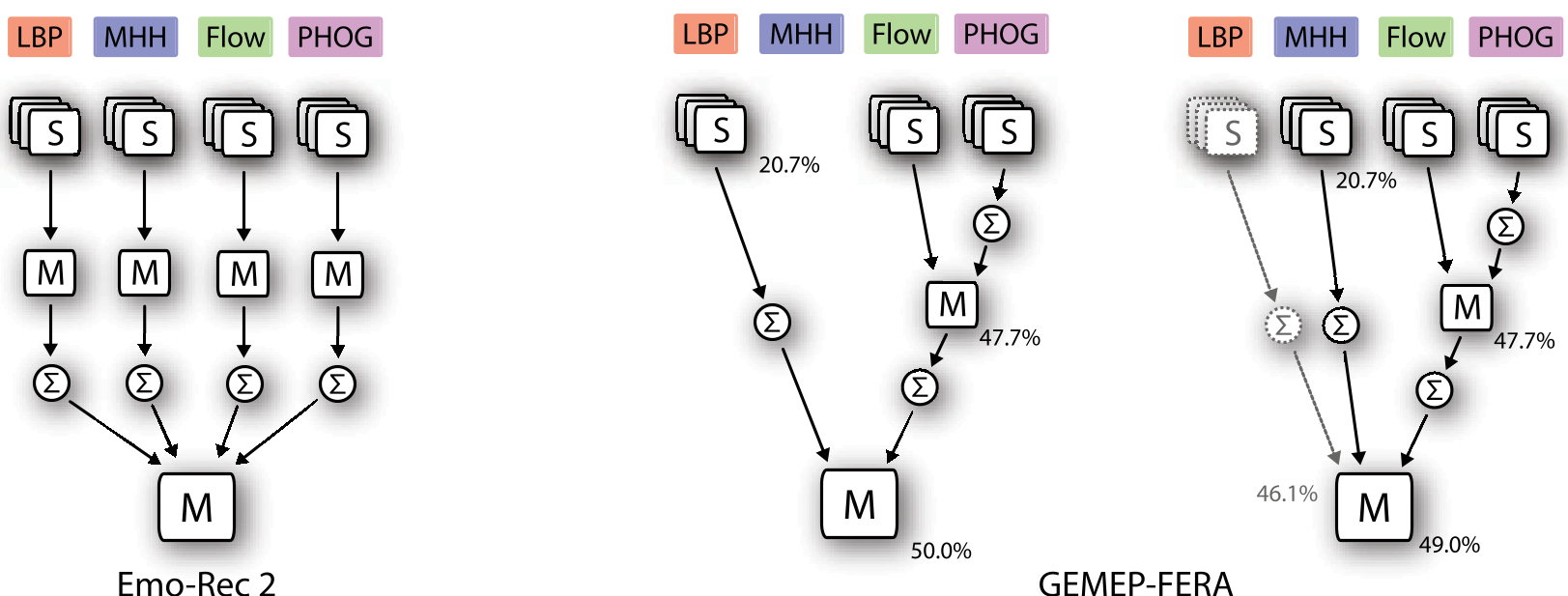
The process follows a rigorous hierarchy:
- Level 1 (Ensembles): Independent SVM ensembles process raw features.
- Level 2 (Intra-channel Fusion): MLPs map the ensemble probabilities into a more refined class estimation.
- Level 3 (Time Integration): Signals with different temporal resolutions (e.g., 5 frames vs. 20 frames) are synchronized into 2-second windows.
- Level 4 (Inter-channel Fusion): A final MLP weights the integrated signals to produce the ultimate emotional state prediction.
Insights from Results: Why It Works
The experiments on the EmoRec 2 and GEMEP-FERA corpora revealed several critical technical insights:
- Beyond Averaging: Simply averaging the outputs of multiple classifiers (standard committee voting) performed poorly. However, adding a trainable MLP layer on top improved accuracy by ~10%. This confirms that the relationship between different facial cues is highly non-linear.
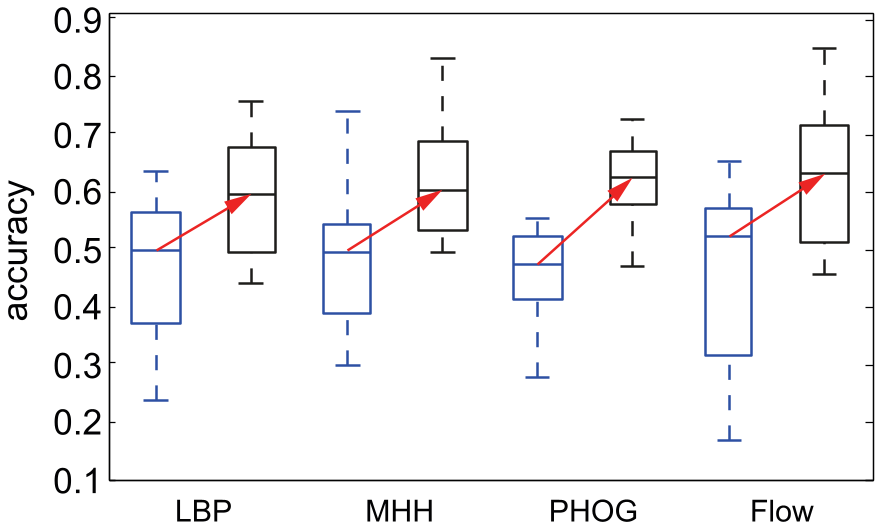
- Feature Complementarity: The highest performance (69.2%) was achieved only when combining all four distinct channels. Interestingly, combining different settings of the same feature (e.g., different LBP radii) did not help, suggesting that functional diversity (spatial vs. temporal) is more important than parametric variety.
Depth Analysis & Conclusion
This work demonstrates that the bottleneck in emotion recognition isn't necessarily the feature extractor, but the integration logic. By treating the fusion process as a learnable task rather than a fixed rule, the system can automatically ignore "noisy" features during fast movements while relying on them during static poses.
Limitations: The complexity of the architecture introduces a massive parameter search space. Choosing the right number of SVMs, MLP hidden units, and time-integration windows currently requires heuristic estimation or brute-force validation.
Future Outlook: The next logical step for this framework is "Automatic Architecture Search" (NAS) to optimize the fusion nodes, and the inclusion of multimodal inputs (audio/physiology) to further stabilize the recognition in highly occluded environments.