
Cascaded WLAN-FWA: Bridging the Gap Between Smart Homes and Life-Saving Healthcare
Cascaded WLAN-FWA Networking and Computing Architecture for Pervasive In-Home Healthcare
This paper introduces a cascaded WLAN-5G Fixed Wireless Access (FWA) architecture specifically designed for pervasive in-home healthcare, focusing on severe epilepsy. The core method utilizes IEEE 802.11ax and 5G network slicing coupled with local edge computing to prioritize life-critical data, achieving significant performance gains in emergency scenarios.
TL;DR
Pervasive healthcare, especially for chronic conditions like epilepsy, demands extreme reliability and low latency that standard "best-effort" home networks cannot provide. This paper presents a cascaded WLAN (802.11ax) and 5G-FWA architecture that leverages Dynamic Network Slicing and Elastic Resource Scheduling to prioritize medical data. By introducing a local Gateway Computing Server (GCS), the system can transition from routine monitoring to emergency mode in real-time, ensuring that life-critical signals reach the hospital regardless of background network congestion.
Problem & Motivation: The "Best-Effort" Bottleneck
In the context of Sudden Unexpected Death in Epilepsy (SUDEP), every millisecond counts. However, current smart home environments are crowded. A patient’s vital signs (EEG, ECG) often share the same wireless medium as 4K video streaming or online gaming.
The authors identify a critical gap: standard 5G slicing often ends at the base station (gNB), leaving the "last-hop" WLAN (Wi-Fi) unmanaged. If the home Wi-Fi is congested, the high-priority 5G slice is useless. To solve this, we need a system that treats the entire path—from the wearable sensor to the hospital cloud—as a single, orchestrated entity.
Methodology: The Cascaded Slicing Architecture
1. The Multi-Tier Hierarchy
The architecture relies on three distinct layers of intelligence:
- Wearable/IoT Layer: Collects EEG, ECG, and 3D video.
- Gateway Computing Server (GCS): Integrated into the 802.11ax router. It acts as a "Local MEC," making split-second decisions to trigger emergency slices.
- 5G Core & MEC: Handles wide-area orchestration and complex AI analysis for seizure prediction.
2. Dual-Slice Strategy
The paper introduces two novel slice types:
- Regular Monitoring Slice: High efficiency for continuous data (standard EEG/Video).
- Emergency Slice: Pre-emptive priority, activated only during an event, triggering higher sampling rates and additional sensor data (Oximetry, SpO2).
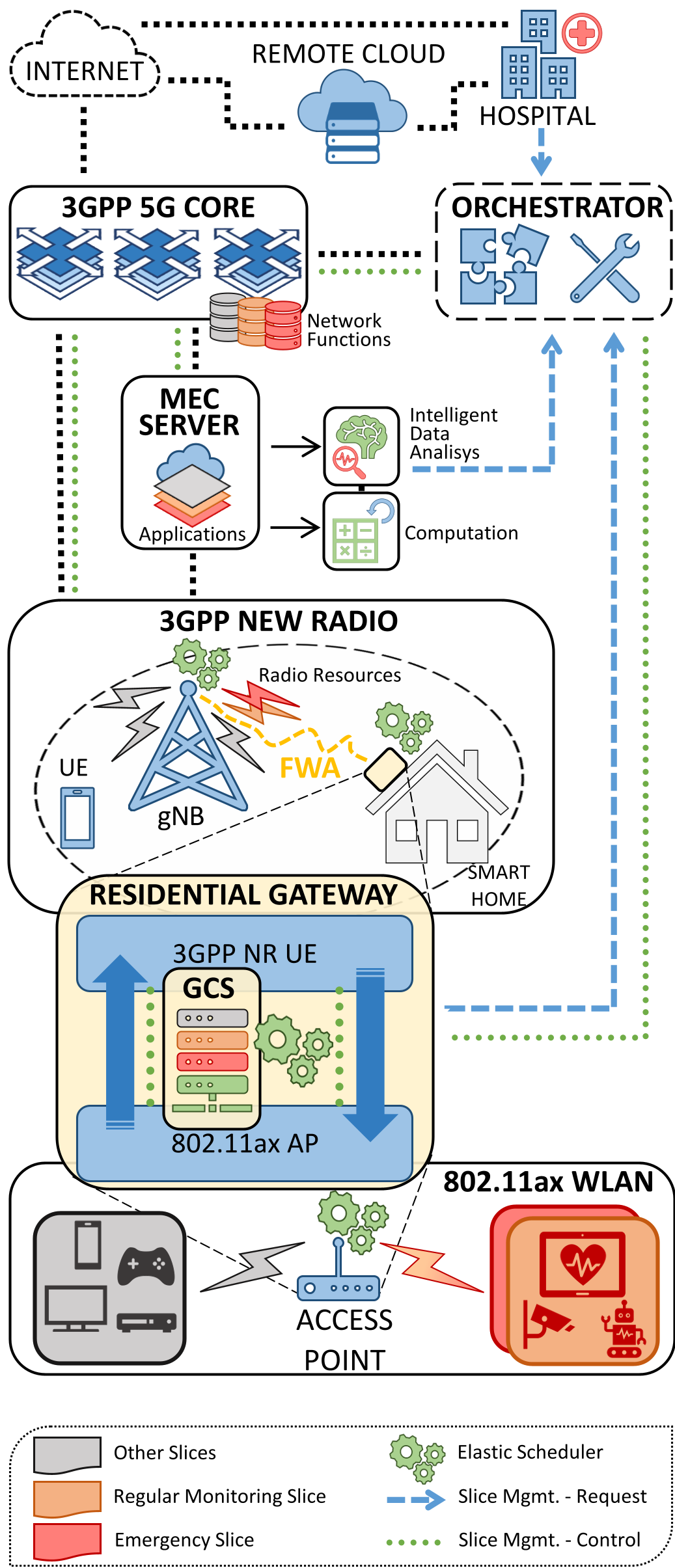 Fig 1: The proposed connectivity architecture showing the GCS-enhanced WLAN router cascaded with the 5G FWA link.
3. Elastic Resource Scheduling
The "secret sauce" is the Elastic Scheduling Policy. Unlike standard proportional fair scheduling, this method:
- Tracks Accumulated Delay: It counts the time a packet has spent in both the WLAN and 5G queues.
- Proactive Dropping: Instead of wasting bandwidth on stale data, it drops packets that have exceeded their "Survival Time."
- Dynamic Scaling: If the network is overloaded, it proportionally reduces resources for eMBB (mobile broadband) to guarantee the healthcare slice.
Experiments & Results: Performance under Pressure
The authors benchmarked three scenarios: Basic (No slicing), E2E (Static Slicing), and Elastic (Proposed).
SOTA Comparison: Latency Stability
In high-traffic scenarios (50% active residential gateways), the Basic and E2E methods saw latencies spike as medical data was forced to wait for broadband packets. The Elastic method kept latency flat for emergency data by enforcing strict priority and scaling back non-critical traffic.
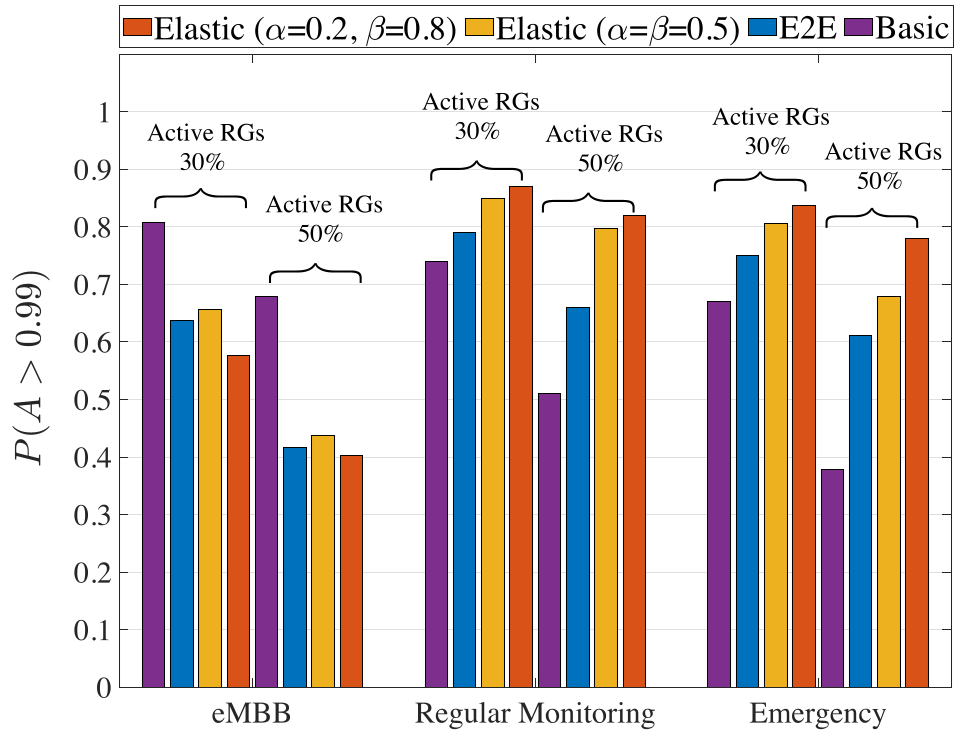 Fig 2: Average end-to-end latency. Note how the "Elastic" approach (green/yellow bars) maintains low latency even as network load increases.
Reliability: Meeting the "Survival Time"
As shown in the table below, different medical signals have strict "Survival Times." The Elastic scheduler ensures that even when the network is at 100% load, 80% of emergency packets still meet their deadlines, compared to a disastrous 11% in standard configurations.
 Table 1: Stringent QoS requirements for epilepsy monitoring, highlighting the need for low jitter and specific aggregated data rates.
Critical Analysis & Conclusion
Summary (Takeaways)
This research successfully moves the needle for Telemedicine from "useful but unreliable" to "mission-critical." By extending slicing into the Wi-Fi domain and using a local GCS to manage the interface, the authors provide a viable blueprint for 5G-enabled smart homes.
Limitations & Future Work
While robust, the current model assumes 802.11ax (Wi-Fi 6) centralized scheduling. In real-world environments with legacy Wi-Fi devices (Wi-Fi 4/5) using contention-based access (CSMA/CA), the GCS's control over the wireless medium might be less precise. Future research should explore how Wi-Fi 7's Multi-Link Operation (MLO) could further enhance this cascaded reliability.
The architecture paves the way for a future where "The Network" is not just a pipe, but an active participant in patient care.