
Decoding Aesthetics: A Fuzzy AI Approach to Product Style Extraction
Case-Based Reasoning for Product Style Construction and Fuzzy Analytic Hierarchy Process Evaluation Modeling Using Consumers Linguistic Variables
This paper proposes an integrated framework for product style extraction and evaluation by combining Fuzzy Case-Based Reasoning (FCBR) and Fuzzy Analytic Hierarchy Process (FAHP) with Linguistic Variables. The methodology aims to quantify subjective "Kansei" (affective) design knowledge, successfully identifying 9 key form features of high-heel shoes with a 93.2% validation rate.
TL;DR
Quantifying "style" has long been the Holy Grail of industrial design. This paper introduces a robust framework that combines Fuzzy Case-Based Reasoning (FCBR) and Fuzzy Analytic Hierarchy Process (FAHP) to turn vague consumer adjectives into precise design parameters. By focusing on high-heel shoes as a case study, the researchers demonstrate how to bridge the gap between human "gut feeling" and engineering precision.
The "Black Box" of Design Intuition
Industrial designers often operate in a "black box" during the conceptual phase. Decisions about the "sexiness" of a curve or the "aristocracy" of a material are typically based on tacit knowledge—experience that is hard to write down or program into a computer.
The core challenge is two-fold:
- Non-linearity: Aesthetic appeal doesn't scale linearly with physical dimensions.
- Linguistic Ambiguity: Consumers use words ("Simple", "Modern", "Retro"), not coordinates, to describe what they want.
Methodology: The Fusion of FCBR and FAHP
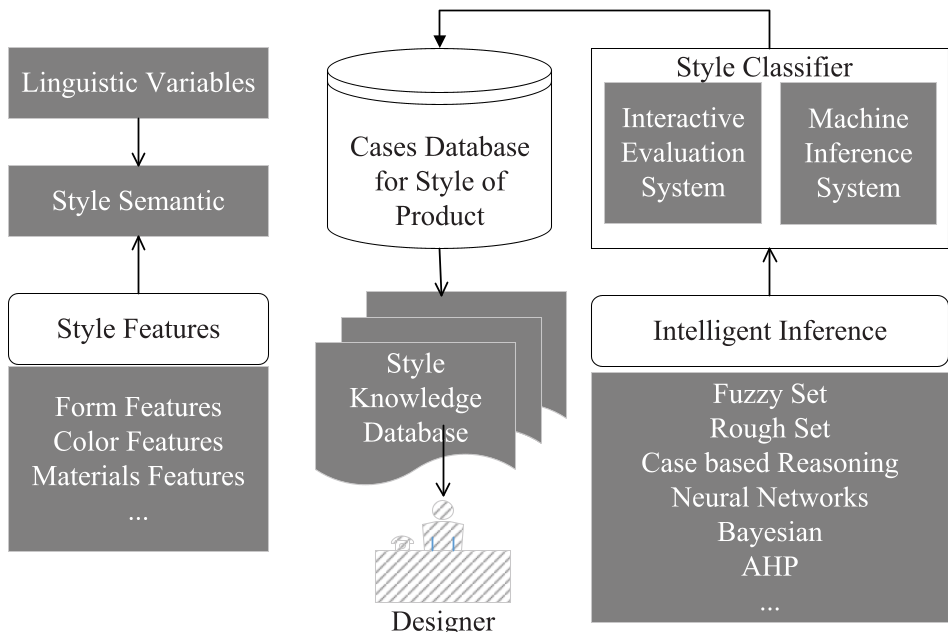
The authors propose a dual-engine architecture to break open this black box.
1. Style Retrieval via Fuzzy CBR
Instead of hard-coded rules, the system uses Case-Based Reasoning. When a new design challenge arises, the system looks at past "cases" (successful products) and uses a Fuzzy Nearest-Neighbor algorithm to find the most relevant stylistic matches.
2. Weighting Intuition with FAHP
How do you know if the heel height or the toe shape is more important for a "Rock" style? The researchers utilize Linguistic Variables (LV) to let consumers rank features. These LVs are then converted into Triangular Fuzzy Numbers, which feed into an Analytic Hierarchy Process. This allows the researchers to calculate a "Consistency Ratio" (CR)—ensuring that the subjective feedback isn't just random noise.
Case Study: High-Heel Shoe Engineering
To validate the theory, the researchers decomposed high-heel shoes into 9 critical components, creating a library of 108 form features.
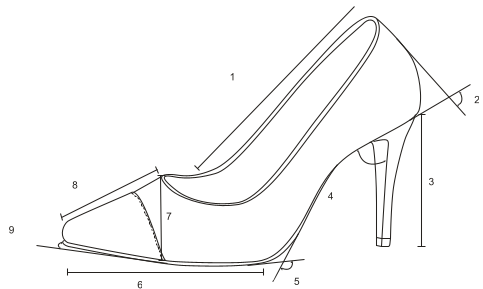
By running surveys and expert evaluations, they mapped styles like "Classical", "Bohemia", and "Metal" to specific feature codes. For example, a "Love" style shoe was identified by a specific matrix of features (C[6,3,2,6,10,11,2,1,8]), where each index represents a specific physical iteration of a component (like the heel or vamp).
Experimental Results
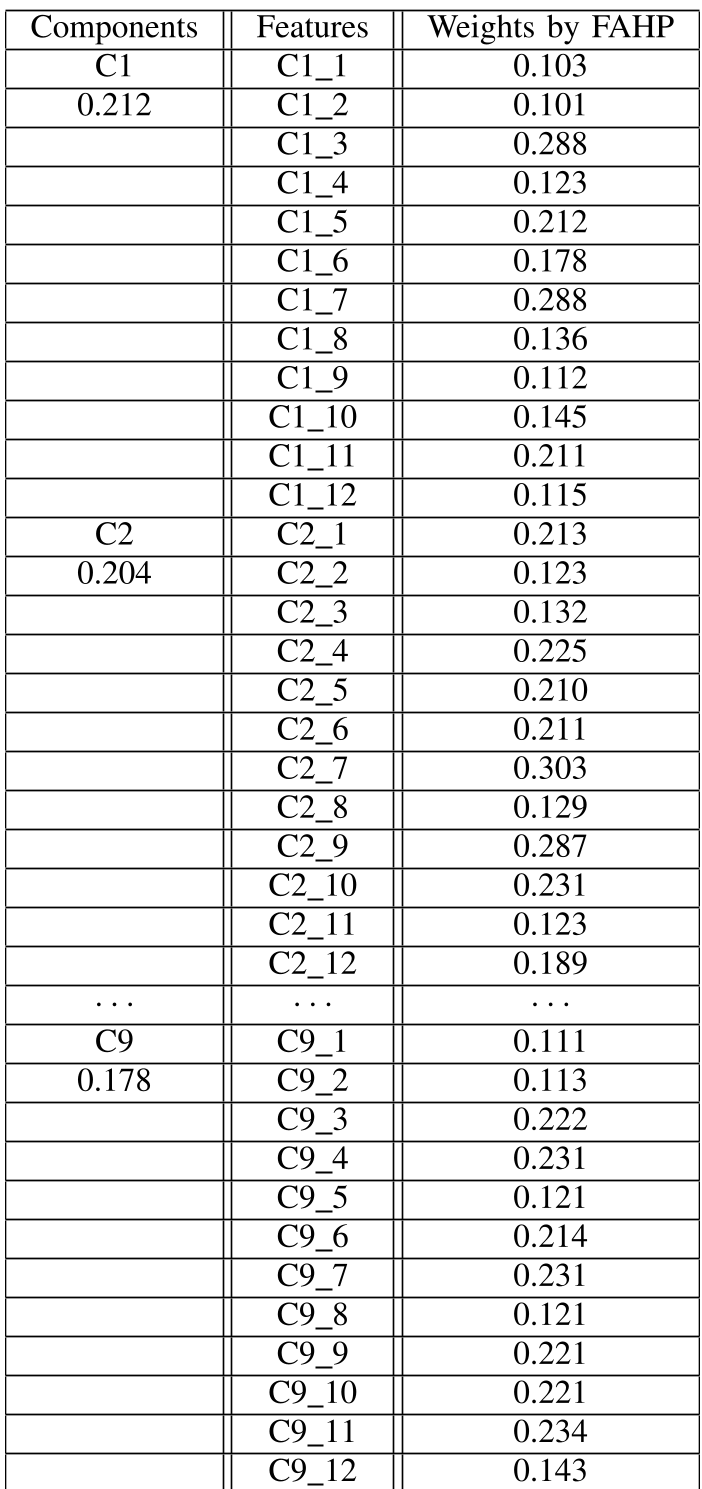
The study achieved a 93.2% validation rate for their survey data. The FAHP weights (shown below) provided a clear mathematical hierarchy of which components drive the overall style image.
Critical Insight: Why This Matters
The brilliance of this work lies in its acknowledgment of Inductive Bias. Most AI systems try to strip away human fuzziness; this system embraces it.
- Academic Impact: It moves Kansei Engineering from simple statistical correlation (like Likert scales) to a reasoning-based system that can handle "cases" and "exceptions."
- Industry Impact: This provides enterprises with a tool to maintain "Brand DNA." By quantifying style, a company can ensure that even as designers change, the stylistic "soul" of their product line remains consistent and data-driven.
Future Outlook
While the current model relies on manual feature coding, the next logical step is the integration of Computer Vision. Imagine a system where a Neural Network automatically extracts these 108 features from a 3D model, and the Fuzzy logic engine immediately predicts its market reception based on linguistic trends.
The "Black Box" is finally starting to turn transparent.