
Beyond Linearity: Using Machine Learning to Decode the Satisfaction-Loyalty Nexus
A case study in loyalty and satisfaction research
This paper introduces a machine learning-based framework to analyze the non-linear relationship between customer satisfaction and loyalty in the automobile industry. By utilizing concept-sensitive discretization and contextual merit measurements, it categorizes satisfaction factors into satisfiers, dissatisfiers, and performers, surpassing traditional linear regression models.
TL;DR
This study challenges the long-standing reliance on linear regression in marketing research. By applying machine learning techniques—specifically concept-sensitive discretization and classification rules—the authors reveal that the link between customer satisfaction and loyalty is far from a straight line. They distinguish between factors that merely prevent defection (dissatisfiers) and those that actively drive brand advocacy (satisfiers).
The Flaws of the Linear Mindset
In the world of CRM and market research, the Two-Stage-Least-Squares (2SLS) method has been the gold standard. However, the authors point out three fatal flaws in this approach:
- Skewed Distributions: Most customers rate themselves as "satisfied," making standard statistical distributions unreliable.
- Assumption of Linearity: It assumes a 1-unit increase in satisfaction always leads to a fixed increase in loyalty.
- Threshold Blindness: It cannot detect "thresholds" where behavior drastically shifts—for instance, the idea that only extremely satisfied customers stay loyal.
Methodology: The ML Framework
The researchers from Limburgs Universitair Centrum introduced a three-tier analytical pipeline to solve these issues.
1. Concept-Sensitive Discretization
Instead of arbitrary grouping, the model uses an Entropy-based heuristic to find "cut points" in satisfaction data that maximize the difference in loyalty behavior. This allows the model to identify specific thresholds (e.g., at what exact point does a customer transition from "likely to switch" to "brand advocate"?).
2. Contextual Merit
The model calculates the "merit" of an attribute (like satisfaction with after-sales service) within the context of others. This is critical because it identifies whether an attribute is a:
- Dissatisfier: A "penalty" factor. If you fail here, loyalty drops, but succeeding doesn't necessarily increase it.
- Satisfier: A "reward" factor. High performance here drives high loyalty.
- Performer: A linear driver affecting both ends of the spectrum.

Experimental Results: Brand A vs. Brand B
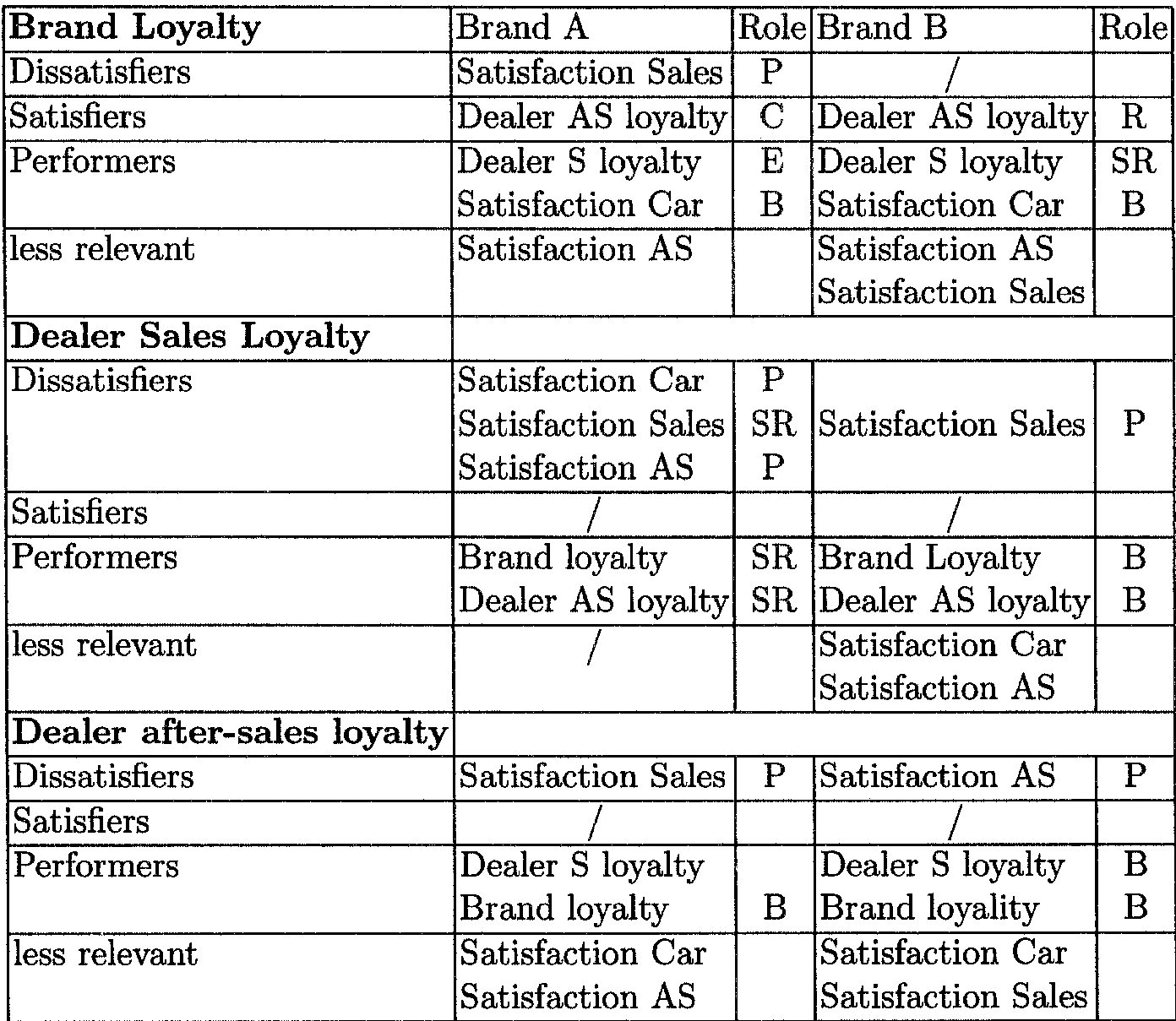
The study focused on two German car brands in the Netherlands. While a standard 2SLS model found that "Car Satisfaction" was significant for both, the ML model revealed a much deeper truth:
| Attribute | Brand A (Exclusive) | Brand B (Mass Market) |
|---|---|---|
| Car Satisfaction | Dissatisfier (Penalty) | Performer (Basic) |
| Dealer Loyalty | Performer (Excitement) | Performer (Basic) |
| Sales Service | Penalty Factor | Penalty Factor |
For the exclusive Brand A, high car satisfaction is a "given." If it's low, you lose the customer (penalty), but raising it doesn't build extra loyalty. Instead, Dealer Sales Loyalty was found to be twice as important. For the mass-market Brand B, loyalty was more transactional and directly tied to the quality of the car itself.
Critical Insight: The "Penalty" vs. "Reward" Logic
The most profound takeaway is the classification of attributes into "Penalty" and "Reward" patterns. Through the analysis of classification rules (e.g., IF satisfaction = high THEN loyalty = high), the authors proved that some service aspects only matter when they go wrong.
For example, meeting a customer's basic technical needs in after-sales service is a "Basic" requirement for Brand B. Failing here guarantees defection, but excelling here is just "doing your job"—it doesn't necessarily create an emotional bond to the brand.
Conclusion & Future Outlook
While the ML method lacks the formal "significance tests" of traditional econometrics, its interpretability for domain experts is vastly superior. It moves beyond "What correlates?" to "How does this specific factor function in the consumer's mind?"
As we move toward more AI-driven marketing, this research highlights that the value of ML isn't just in raw prediction power, but in its ability to uncover the asymmetric and non-linear rules that govern human loyalty.