
Cash Flows: Mapping the Financial Nervous System of the U.S. Congress (1992–2008)
Cash Flows: Leadership PACs in the U. S. Congress from 1992 - 2008
This paper utilizes Social Network Analysis (SNA) to investigate the evolving structure of campaign donations within "Leadership PACs" in the U.S. Congress from 1992 to 2008. It reveals how Republican leadership adopted a centralized core-periphery model to enforce party discipline, while Democrats utilized a more balanced network integrated with broader party structures.
TL;DR
By applying Social Network Analysis (SNA) to nearly two decades of campaign finance data, Suzanne M. Robbins unearths the hidden architecture of power in Washington. The study shows that while Republicans mastered a "top-down" core-periphery money network to enforce loyalty, Democrats eventually built a more "lateral" and resilient network that leveraged presidential ambitions to strengthen the party's overall reach.
Background: Beyond the Candidate-Centered Campaign
In American politics, the primary directive for any legislator is simple: survive. This "personal vote" often leads to candidate-centered campaigns that are independent of party platforms. However, to pass laws and gain committee chairs, members must solve a collective action problem. Enter the Leadership PAC—a legal mechanism allowing powerful incumbents to raise money and redistribute it to colleagues, effectively "buying" influence and building party discipline.
Methodology: The Social Network of Money
The author treats every dollar contribution from one PAC to another as a "directed tie." Using SNA metrics like Betweenness Centrality, the research identifies "brokers" who control the flow of resources.
- Nodes: Representatives (Circles) and Senators (Squares).
- Edges: Financial contributions (Weighted by total dollar amount).
- Metric: Betweenness Centrality (Node size), indicating who acts as a bridge between disconnected parts of the network.
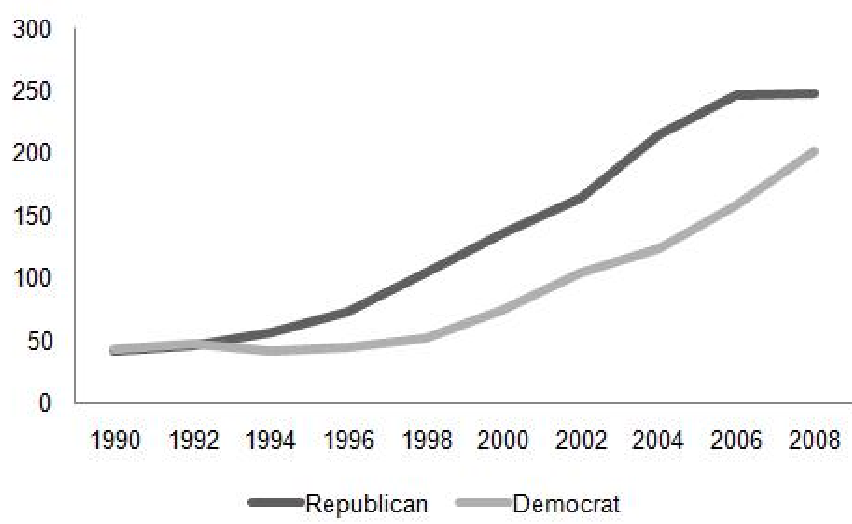 Figure 1: The explosion of member PACs since the 1990s reflects the professionalization of internal party fundraising.
Two Parties, Two Networks
The research highlights a fundamental divergence in how the two major parties organize their financial influence.
1. The Republican "Core-Periphery" Strategy
Under leaders like Tom DeLay, the GOP built an aggressive, centralized network. In the early 2000s, Republican networks were much larger and more cohesive than Democratic ones. However, this structure proved brittle; by 2008, following the loss of their majority, the network fragmented significantly.
2. The Democratic "Distributed" Strategy
Initially slower to organize, the Democrats eventually developed a network that integrated more closely with state and national party organizations. By 2008, Democratic leaders like Steny Hoyer and Charles Rangel demonstrated a much higher "Two-Step Reach" than their Republican counterparts, meaning their funds touched more of the overall network through intermediaries.
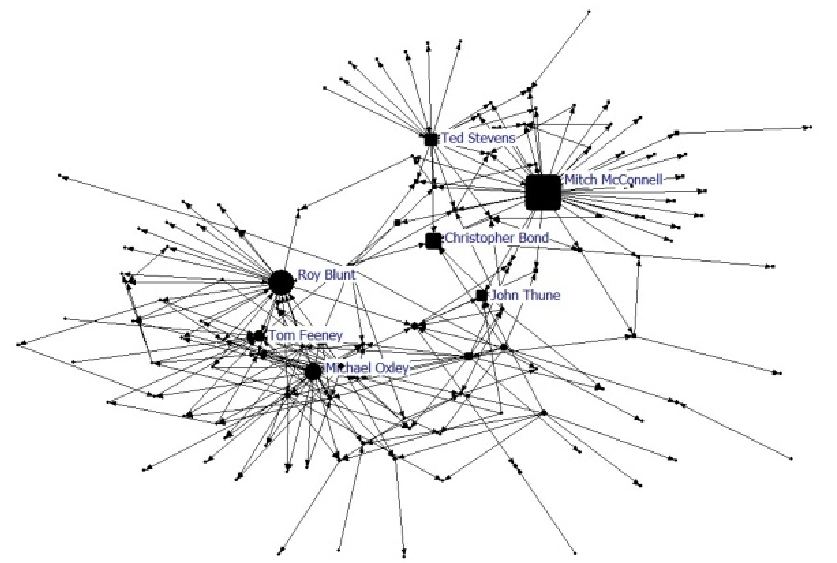 Figure 2: The 2006 Republican network shows a distinct "rear-guard" strategy, with separate House and Senate clusters attempting to protect vulnerable incumbents.
The "Hillary Clinton" Effect: Ambition as a Network Anchor
A fascinating insight from the 2008 data is the role of presidential ambition. While most senior members give money to "safe" colleagues to build a legacy, Senator Hillary Clinton’s PAC (HILLPAC) focused on becoming a primary donor to rank-and-file members and state parties. This transformed her PAC into a high-betweenness hub, effectively securing "buy-in" from the party's grassroots and legislative branches simultaneously.
Key Results & Quantitative Findings
The paper provides a breakdown of network centralization, showing how the "command and control" style of the 1990s gave way to more autonomous, yet interconnected, systems in the 2000s.
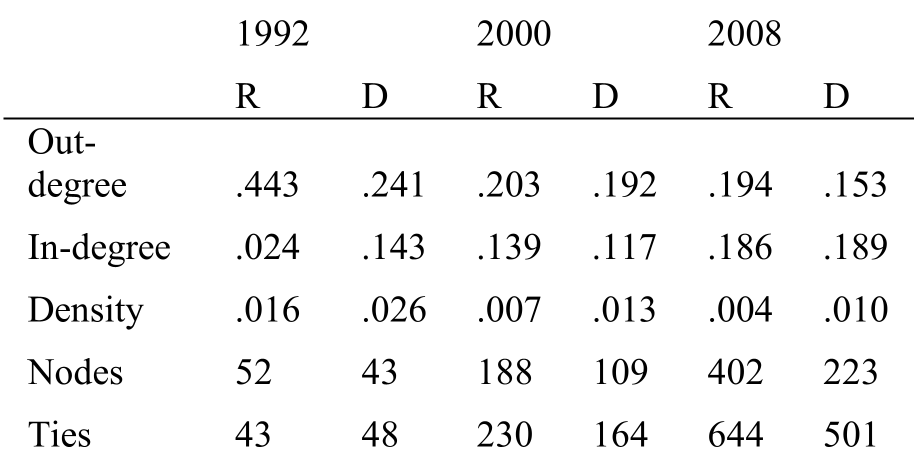 Table 1: Note the sharp drop in Republican Out-degree centralization from .443 (1992) to .194 (2008), indicating a shift from a few dominant donors to a broader base of contributors.
Critical Analysis & Conclusion
Takeaway
Financial networks are not just about "buying votes." They are the structural scaffolding of political parties. A centralized network (like the GOP's early 2000s model) is great for discipline but vulnerable to "shocks" (like losing a majority). A distributed network (like the Democrats' 2008 model) is more resilient and better suited for multi-institutional goals like winning the Presidency.
Limitations
The study focuses on PAC-to-PAC flows. It does not account for direct candidate contributions from individuals, which could provide a different layer of network connectivity. Furthermore, as the author notes, this is an exploratory study that tracks structure rather than proving causality between a donation and a specific floor vote.
Future Outlook
As we move into the era of Super PACs and "dark money," the methods established in this paper will be essential for tracking how power bypasses traditional party headers and moves into the hands of outside ideological brokers.