
CASIMIRO: Avoiding Overfitting in Social Robot Design through Complexity Penalization
CASIMIRO, The Sociable Robot
This paper introduces CASIMIRO, a sociable robotic head designed using a novel development framework inspired by Machine Learning "overfitting" avoidance. The core method emphasizes incremental design and complexity penalization to ensure robust Human-Robot Interaction (HRI) within specific environmental niches.
TL;DR
CASIMIRO is a sociable robot that challenges the trend of increasing algorithmic complexity in robotics. By framing social robot development as an inductive machine learning problem, the researchers argue that "fragile" robot behavior is actually a form of overfitting. They propose a minimalist, incremental design philosophy that prioritizes the robot's specific "niche" over generalized, brittle human-like algorithms.
The Blind Spot of Conscious Intuition
Why is building a social robot so much harder than building a robotic arm? The authors argue the problem lies in the nature of Unconscious Processes.
While tasks like solving differential equations require conscious effort and clear logic (which are easy to algorithmize), social tasks—like recognizing a friendly face or sensing an interaction—are largely unconscious in humans. When engineers try to build social robots, they rely on their conscious interpretations of these tasks. This mismatch leads to "fragile performance": the robot works in the lab (the test set) but fails in the real world (the unseen data). In Machine Learning terms, this is overfitting to a biased human model of social intelligence.
Method: The Niche and Complexity Penalization
The paper introduces two critical concepts to bridge this gap:
- The Realized Niche: Instead of trying to make a robot work everywhere (the fundamental niche), designers should optimize for the specific environment where the robot actually lives (the realized niche).
- Complexity Penalization: Borrowing from Structural Risk Minimization (SRM), the authors suggest that the best implementation is the simplest one that achieves acceptable performance. Use basic skin-color tracking before jumping to deep neural networks for face recognition.
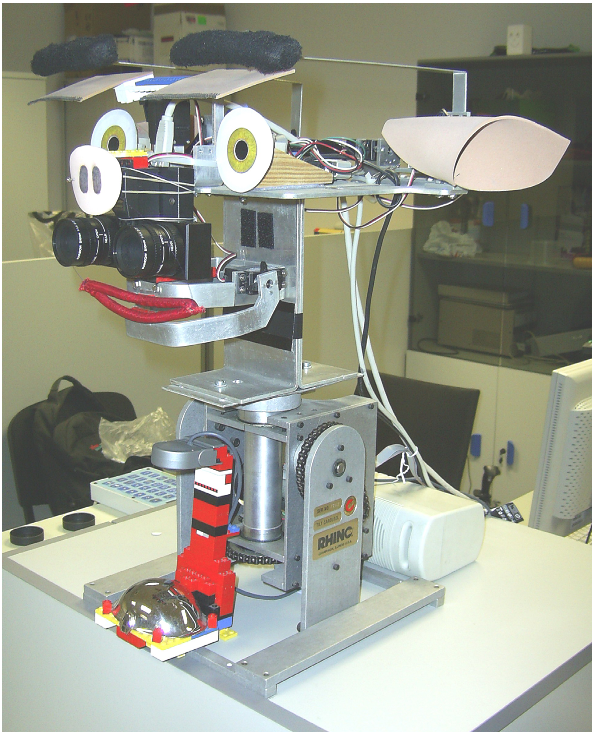 Figure 1: CASIMIRO, a prototype head designed for sociable interaction, emphasizing auditory and visual tracking.
The Recipes for Sociable Robots
The authors provide a set of "recipes" for social robot development:
- Discover Niche Opportunities: Look for environmental shortcuts (e.g., the owner always sits at a specific desk).
- Simple to Complex: Start with the most basic possible representation and only add complexity if testing proves it necessary.
- Caution with "Human Knowledge": Don't assume that because humans think they use a certain social cue, a robot must implement it that way.
Case Study: "Invisible" Owner Recognition
The highlight of the paper is CASIMIRO’s owner recognition system. Instead of implementing a high-complexity face recognition algorithm—which at the time yielded 5-10% error rates—the team looked at their robot's niche.
The robot's "owner" was consistently the person who turned it on from a specific computer monitor behind the robot. By placing a low-resolution camera on that monitor and tracking a simple skin-color blob entering the interaction space from a specific side, they achieved zero error owner recognition.
Experimental Results
Despite the technical simplicity, the "illusion" of social intelligence was highly effective:
- Human Perception: In 19 interviews, users gave the robot a mean score of 3.58/5 for its ability to "recognize people."
- Professional Feedback: Even though 37.5% of the subjects were PhDs in Computer Science or Engineering, they were "amazed" by the robot's social responses.
Deep Insight & Conclusion
The value of CASIMIRO lies in its Inductive Bias. By intentionally limiting the scope of the robot's "intelligence" to its specific niche, the authors created a robust user experience that felt more natural than many complex, failure-prone systems.
Limitations & Future Work
While effective, this "niche-centric" approach risks creating robots that cannot generalize. If the owner moves their computer, CASIMIRO's "recognition" fails. The challenge for future research is finding the balance between this minimalist niche-fitting and the generalized adaptability required for robots that move between different environments.
In an era where "bigger is better" (more parameters, more data), CASIMIRO reminds us that algorithmic stability and environmental awareness are often the true secrets to social intelligence.