
CASINO: Why Your Influence Depends on Who Decides to Follow You
12257_CASINO towards conformity-aware social influence analysis in online social networks.
This paper introduces CASINO (Conformity-Aware Social INfluence cOmputation), a novel framework for social influence analysis that incorporates person-specific conformity and negative relationships (distrust/disagreement). It utilizes a recursive algorithm to compute topic-based influence and conformity indices across signed networks like Twitter, Epinions, and Slashdot.
TL;DR
Social influence isn't just about how loud you speak; it's about how likely your audience is to listen. The CASINO algorithm (Conformity-Aware Social INfluence cOmputation) redefines influence by integrating conformity—a person's inclination to be influenced—and signed relationships (trust vs. distrust). By analyzing topic-specific subgraphs, it achieves SOTA accuracy in predicting social interactions on platforms like Twitter and Slashdot.
The Missing Links: Conformity and Negativity
Most social influence models operate on a "positive-only" assumption: if you follow someone, you are influenced by them. However, academic research has identified two glaring flaws in this logic:
- Conformity Variation: Some users are "easy sells" (high conformity), while others are "skeptics" (low conformity). Influencing a skeptic carries more weight than influencing a serial conformer.
- The Power of 'No': Negative interactions (disagreement/distrust) act as a "penalty." If many people distrust you, your effective influence across the network should decrease.
CASINO addresses these by treating influence and conformity as two sides of the same coin, calculated recursively.
Methodology: The Interplay of Influence and Conformity
The core innovation of CASINO lies in its recursive definition of two indices:
- Influence Index (): Increases when trusted by high-conformity individuals; decreases when distrusted by high-conformity individuals.
- Conformity Index (): Increases when following high-influence individuals; decreases when distrusting high-influence individuals.
The CASINO Workflow
- Topic Extraction: Since you might be an influencer in "AI" but a conformer in "Salsa Dancing," CASINO builds subgraphs for specific topics.
- Sentiment Labeling: It uses sentiment analysis (LingPipe) to turn unlabeled links into "Signed Edges" (Positive/Negative).
- Recursive Indices Computation: An iterative approach (similar to PageRank but with penalties) that converges to stable scores for every user.
Experimental Battleground: Twitter, Epinions, and Slashdot
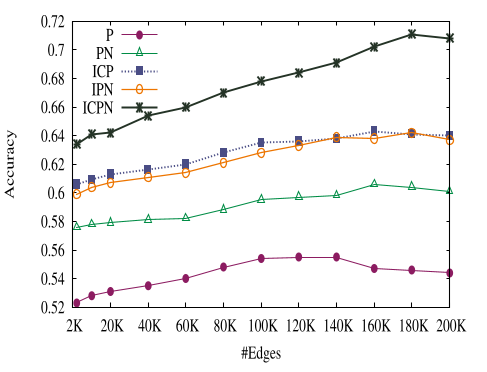
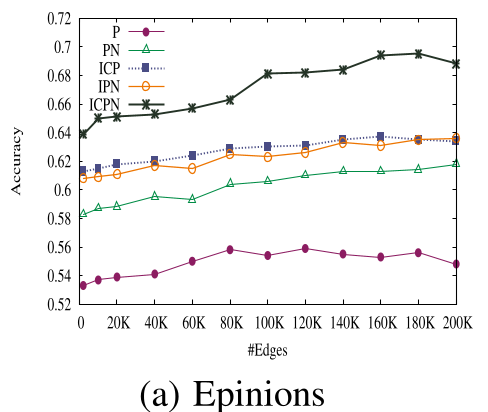
The authors tested CASINO against standard structural baselines across multiple datasets. The results were clear: Context and Conformity matter.
- Edge Sign Prediction: Predicting whether a link is positive or negative becomes significantly more accurate when you know the influence/conformity (ICPN) of the source and target nodes.
- Context Sensitivity: The "Influentials" on Twitter changed completely depending on the topic (e.g., "Mumford & Sons" vs. general trends), justifying the topic-aware approach (ICAPN).
Deep Insight: Influentials vs. Conformers
The paper provides a fascinating visualization of the "social landscape" through heatmap distributions.
- In Epinions: Most users are "conformity-biased," meaning the platform is driven by a small group of experts being followed by a massive, receptive audience.
- In Slashdot/Twitter: There is a distinct group of "Hard-to-influence Influencers"—highly influential people who almost never conform to others.
Critical Analysis & Takeaways
Why this works: CASINO captures the quality of an interaction. By penalizing influence through negative edges, it effectively filters out controversial figures who might have high "engagement" but low actual "persuasion" or "trust."
Limitations: The edge labeling relies heavily on sentiment analysis, which can struggle with sarcasm or platform-specific slang (e.g., a "retweet" isn't always an endorsement).
Future Outlook: As social networks become more polarized, CASINO’s framework for handling negative edges is more relevant than ever. Future iterations could integrate this into GNN-based recommendation systems to prevent the spread of toxic content by weighing "distrust" signals more heavily.