
Shared Leadership: The Engine of Creativity in E-Learning Environments
Categories and Subject Descriptors
This paper investigates the drivers of team creativity within an e-learning environment, proposing an integrative model that links shared leadership, interpersonal trust, and knowledge-sharing. Utilizing a social network perspective and structural equation modeling (SEM) on data from 40 student teams, it identifies shared leadership and cognition-based trust as critical antecedents to creative performance.
TL;DR
In a world moving toward decentralized work, this study reveals that Shared Leadership—where leadership is a distributed property of the group rather than a solo act—is a primary catalyst for team creativity. By fostering Cognition-based Trust and Knowledge-sharing, teams can significantly boost their creative output, even in impersonal e-learning environments.
Background: Beyond the "Heroic" Leader
Historically, we have viewed leadership through a "vertical" lens: the lone hero at the top directing the masses. However, in complex, knowledge-intensive environments like e-learning, this model fails. The complexity of modern tasks exceeds the capacity of any single individual. The authors argue that leadership should be viewed as a relational phenomenon, an emergent property that flows through a team's social network.
The Core Insight: Head vs. Heart
A unique contribution of this research is the granular look at Interpersonal Trust. The authors divide trust into two distinct categories:
- Cognition-based Trust (The Head): Based on the perceived competence, professionalism, and reliability of teammates.
- Affect-based Trust (The Heart): Based on emotional bonds, mutual care, and personal concern.
Interestingly, in the e-learning context (often non-face-to-face), the "Head" wins. While shared leadership builds both types of trust, only the cognitive "Head" trust actually drives knowledge-sharing and creative results.
Methodology and Architecture
The researchers utilized a social network approach to measure shared leadership. Rather than self-reported ego scales, they used Density, calculating the total amount of leadership displayed by all members as perceived by the entire team.
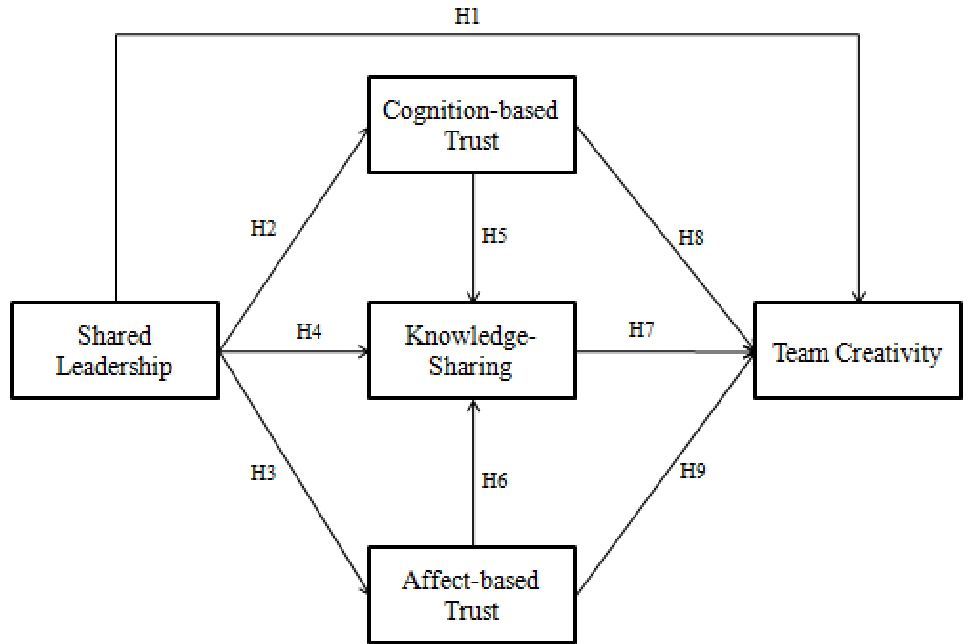 The model hypothesizes that Shared Leadership serves as the catalyst for Trust and Knowledge-sharing, which then culminate in Team Creativity.
The Formula for Leadership Density
To quantify the "sharedness" of leadership, the authors used: Where is the sum of leadership ratings within the team, and is the number of members. This provides a rigorous mathematical basis for what is often a "fuzzy" social concept.
Experimental Results: What Drives the Creative Spark?
The study analyzed 249 valid cases from 40 teams. Using Structural Equation Modeling (SEM), they mapped the pathways to success.
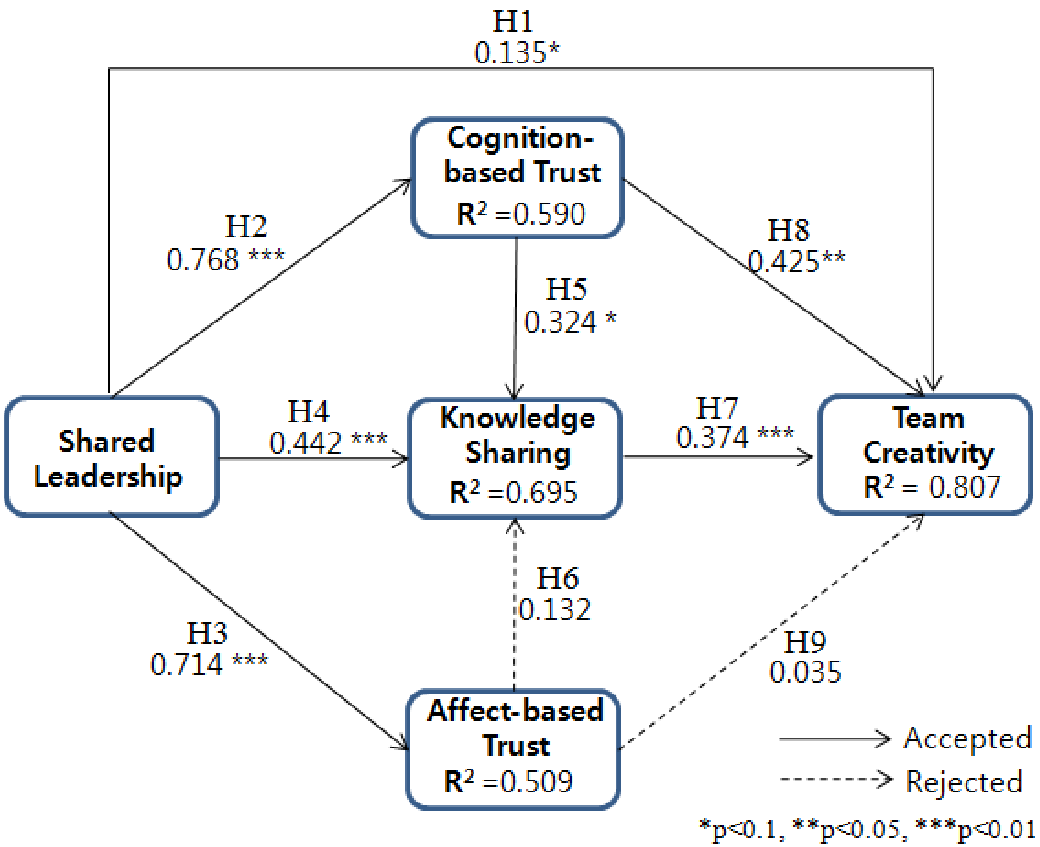 Key results show strong path coefficients from Shared Leadership to Trust (0.768) and Knowledge-sharing (0.442).
Key Findings:
- The Power of Sharing: Knowledge-sharing (β = 0.374) is a massive predictor of creativity. If a team doesn't exchange ideas, its "cognitive resources" remain locked and wasted.
- The Efficiency of Professionalism: Cognition-based trust had a significant impact (β = 0.425), whereas Affect-based trust was rejected as a significant path for creativity.
- Shared Leadership as an Intrinsic Motivator: It directly influences the team's willingness to collaborate, explaining over 80% of the variance in creative performance.
Critical Analysis & Takeaways
The rejection of Affect-based Trust (H9) is a critical point for practitioners. In virtual or asynchronous e-learning environments, waiting for "emotional bonds" to form is a mistake. Teams are more creative when they respect each other's competence and reliability first.
Practical Implications for Managers:
- Foster Autonomy: Don't just appoint a leader; design environments where leadership "emerges" through peer influence.
- Transparency over Teambuilding: In virtual settings, prioritize tools that demonstrate member competence and progress (building cognitive trust) over purely social "ice-breakers" (affective trust).
Limitations
The study focused on students in an e-learning course. In a high-stakes corporate environment, the emotional "heart" might play a larger role in long-term retention and psychological safety, which were not the focus here.
Conclusion
This paper serves as a roadmap for the future of collaborative learning. By shifting the focus from individual "superstars" to the density of leadership across a network, organizations can unlock a higher tier of team creativity.