
Cavity-Induced Pairing: Using Vacuum Fluctuations to Forge New Quantum States
Cavity-driven attractive interactions in quantum materials
The paper presents a novel experiment demonstrating that terahertz (THz) vacuum fluctuations in an optical cavity can mediate attractive interactions in Bernal-stacked bilayer graphene (BLG). By integrating a dual-gated van der Waals heterostructure into a sub-wavelength bow-tie resonator, the authors achieved ultrastrong light-matter coupling (normalized Rabi frequency ~43%) and observed the formation of exciton-like bound states from a continuum of transitions.
Executive Summary
TL;DR: Researchers at ETH Zürich have demonstrated that the "empty" space inside a tiny terahertz cavity can act as a glue, binding electrons and holes together in bilayer graphene to create new, exciton-like states. By achieving ultrastrong coupling (where light and matter mix at nearly 50% of the photon's energy), they have turned a continuous sea of electronic transitions into discrete, manageable quantum states.
Background Table: This work marks a transition from "Cavity QED" as a tool for observation to "Cavity Materials Engineering" as a tool for creation. It bridges the gap between theoretical predictions of cavity-mediated superconductivity and the practical challenges of 2D material fabrication.
The Challenge: Engineering the Vacuum
In the quest to control quantum materials, we usually reach for intense lasers. However, lasers bring heat and decoherence. A more elegant—and difficult—route is to use Vacuum Fluctuations. According to Quantum Electrodynamics (QED), "empty" space is actually filled with transient electromagnetic fields. If you confine these fields in a small enough volume (a cavity), they become strong enough to change how electrons in a material behave.
The problem? Most interesting quantum effects happen at Terahertz (THz) frequencies. But THz waves have long wavelengths (hundreds of microns), while high-quality quantum materials (like exfoliated graphene) are tiny (microns). Matching the two has been an engineering nightmare—until now.
The Solution: A Microscope Inside a Cavity
The team solved this by building a hybrid setup that combines a sub-wavelength bow-tie resonator with a silicon lens system. This allowed them to:
- Concentrate THz energy into a spot 100x smaller than the wavelength.
- Maintain "dual-gating," allowing them to change the material's properties (like the bandgap) while it sits inside the cavity.
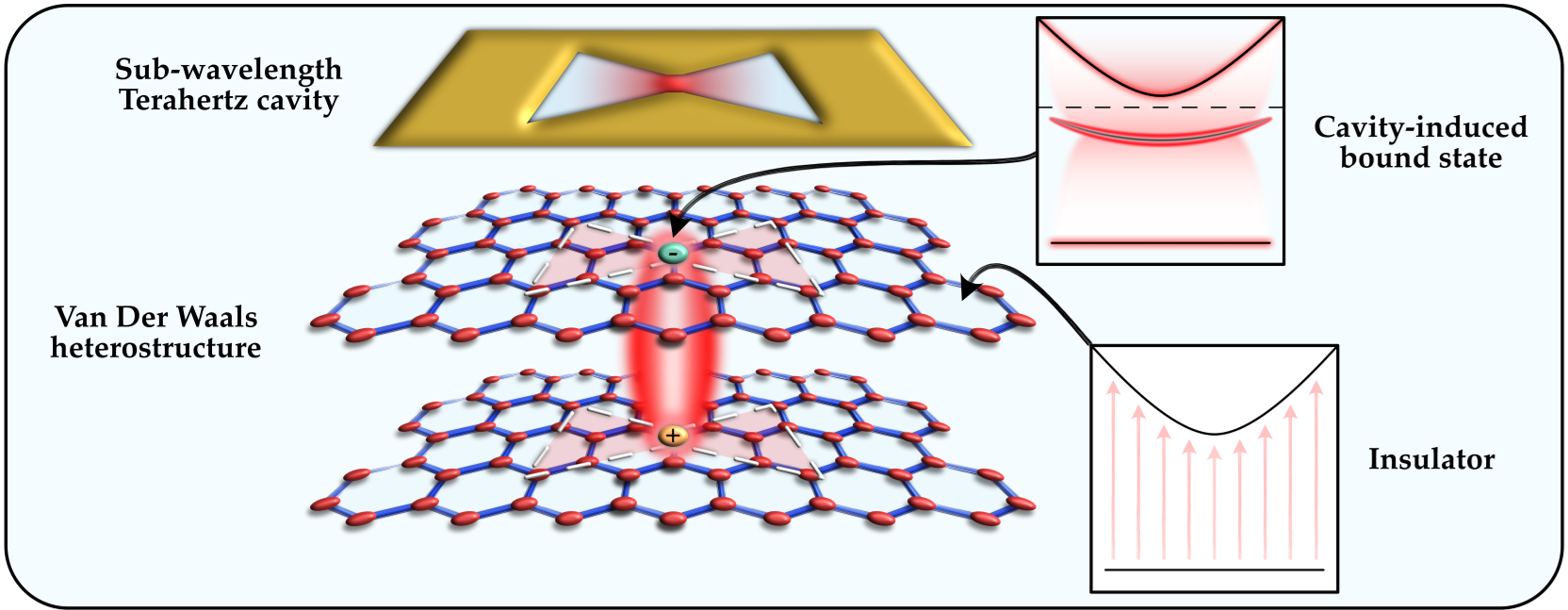 Figure 1: The architecture of the THz cavity-integrated VdW device.
Methodology: From Continuum to Discrete
In a normal semiconductor, you might have a single "exciton" (a bound electron-hole pair) that interacts with light. In bilayer graphene, you don't have that; you have a continuum of many different possible electron-hole transitions across a range of momenta.
Usually, a continuum is "messy" and doesn't couple well to light. However, the ETH team showed that when the cavity is in the Ultrastrong Coupling (USC) regime, the vacuum field provides an attractive interaction that "pulls" a discrete state out of that messy continuum. This state is a Lower Polariton (LP), and it behaves effectively like a bound exciton.
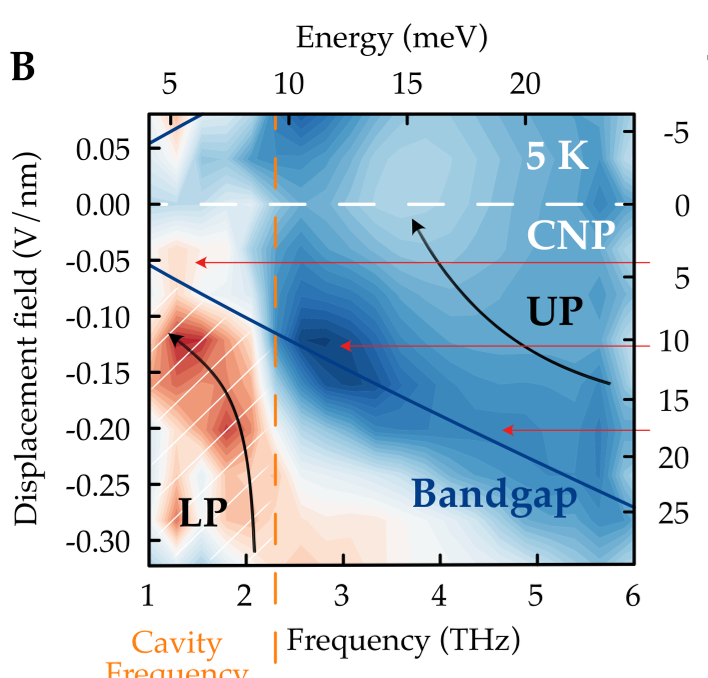 Figure 2: Spectroscopic evidence of the bandgap approaching the cavity resonance, leading to the formation of Upper and Lower Polaritons.
Key Breakthroughs
- The Bandgap Measurement: They achieved the first-ever spectroscopic measurement of the field-tunable THz bandgap in bilayer graphene using a cavity.
- Ultrastrong Coupling Efficiency: . This is far higher than most standard optical systems and enters the regime where the "virtual photons" of the vacuum start to dictate the material’s ground state.
- Thermal Robustness: Unlike natural excitons which are easily destroyed by heat, these cavity-mediated states remained stable up to 50K. The strength of the "vacuum glue" is dictated by the cavity geometry, not just the material's internal temperature.
Deep Insight: Why This Matters
This isn't just about making better sensors. It’s about "Synthetic Interactions." In condensed matter physics, we are usually stuck with the interactions nature gives us (like the Coulomb force). This experiment proves we can use a cavity to add a new interaction—a photon-mediated attraction—to the Hamiltonian of the system.
If the vacuum can bind an electron and a hole into an exciton, it can theoretically bind two electrons into a Cooper pair, potentially leading to cavity-enhanced superconductivity.
Limitations & Future Work
While a milestone, the study acknowledges that we are still in the "spectroscopy" phase. The next step is to cool these devices to Millikelvin temperatures and look for changes in DC transport. Can the cavity vacuum field actually cause the material to conduct electricity without resistance? By moving to a dilution refrigerator, the team aims to answer if "light from nothing" can truly drive a phase transition.
Summary: By shrinking the cavity and perfecting the material interface, Helmrich et al. have turned a theoretical dream into a laboratory reality: manipulating the fundamental vacuum to rewrite the rules of quantum materials.