
EDIT: Bridging Social Networks and Clinical Rehabilitation through CBR
A CBR-Based Game Recommender for Rehabilitation Videogames in Social Networks
The paper introduces EDIT (Elderly & Disabled Impairment Training), a Case-Based Reasoning (CBR) recommender system integrated with social networks. It aims to provide personalized rehabilitation via videogames by matching specific user disabilities (WHO-coded) and personality traits to free internet games.
TL;DR
The EDIT (Elderly & Disabled Impairment Training) system transforms social networks into clinical tools. By leveraging Case-Based Reasoning (CBR) and WHO disability standards, it recommends personalized rehabilitation games to elderly and disabled users. The system doesn't just look at what's "fun"—it calculates "suitability" based on a user's specific impairment and personality, achieving high precision by automating user feedback.
Background: The Gap in Digital Supervision
Medical services often fall short for patients requiring continuous therapy for conditions like hemiplegia or aphasia. While social networks are ubiquitous, most game recommenders are built for entertainment, not therapy. They face three major hurdles in a clinical context:
- Trustworthiness: Open networks are prone to tampered reviews.
- Accessibility: Elderly users may struggle with complex interfaces or manual ratings.
- Clinical Relevance: Traditional collaborative filtering doesn't understand the physical or cognitive "training value" of a game.
Methodology: The EDIT Framework
The core of EDIT is a structured Case-Based Reasoning (CBR) cycle. Unlike standard recommenders that rely on "what others liked," EDIT treats every recommendation as a problem-solving exercise.
1. The Anatomy of a Case
Each "Case" in the EDIT database consists of a game description and a solution. The innovation lies in the Query Procedure, which maps user metadata (from Facebook and short questionnaires) to clinical requirements.
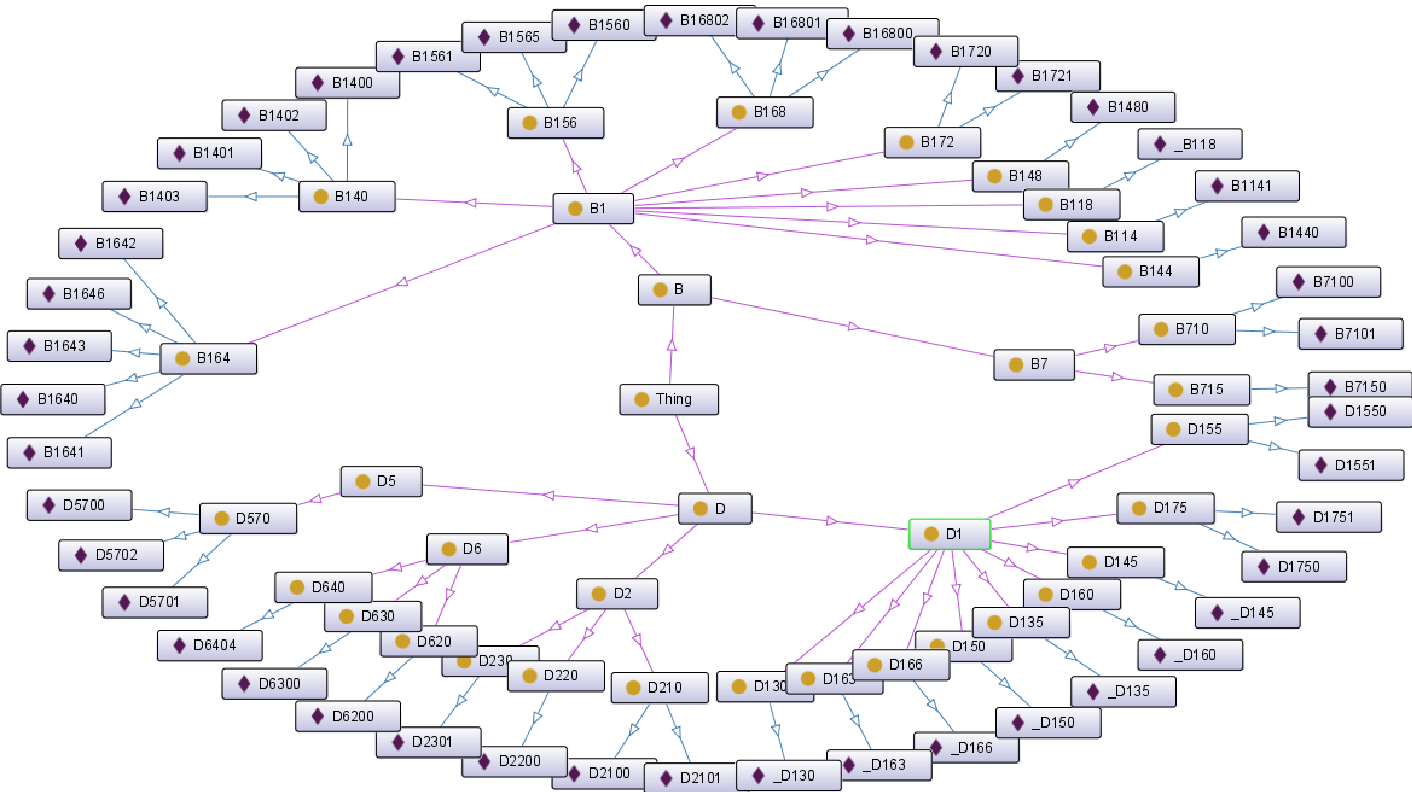
Figure 1: The ontology mapping WHO disability codes to specific game types.
2. The Recommendation Formula
The system avoids the "rating fatigue" by calculating a weighted score () for potential games:
The Similarity () variable is the secret sauce: it assigns a value of 1.0 if the game directly targets the user’s specific disability leaf in the ontology, and 0.5 if it only shares a parent branch.
Experimental Results & Validation
Using the jColibry implementation, the researchers tested how different weighting schemes affected precision.
The Power of Clinical Similarity
The study found that focusing on Similarity ()—the clinical alignment between the game and the disability—led to the most accurate recommendations. As the case base grew, the precision improved significantly, particularly after the first 10 iterations of the learning cycle.
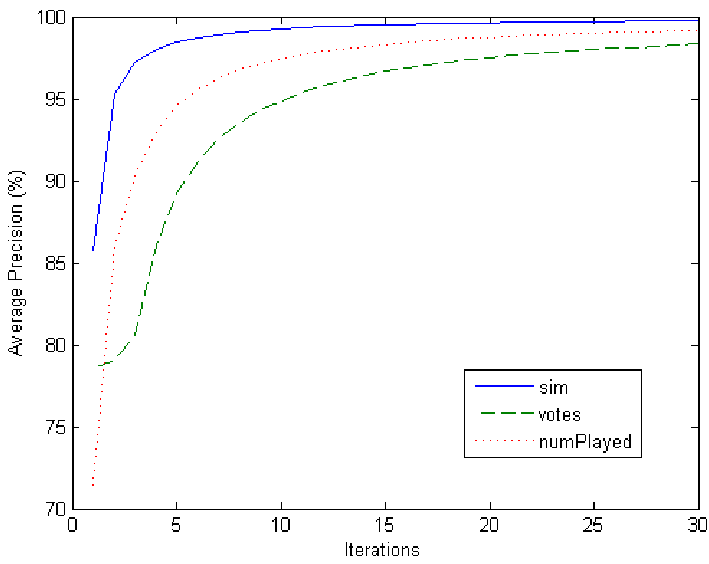
Figure 2: Performance comparison showing that "Similarity" (sim) weighting outperforms popularity or basic voting metrics.
Critical Analysis: Beyond the Prototype
Strengths
- Implicit Feedback: By tracking "time played" and "levels reached" automatically, the system removes the cognitive load of manual reviews from the user.
- Personality Integration: Recognizing that rehabilitation only works if the patient stays engaged, EDIT matches game genres to personality traits, increasing adherence.
Limitations & Future Work
The current prototype was validated on a relatively small database (124 cases). While it shows promise, scale-up tests on larger platforms (beyond Facebook) are necessary. Additionally, the researchers noted that while Lenskit (for collaborative filtering) was tested, it requires a much larger user base to be effective compared to the CBR approach.
Conclusion
EDIT proves that digital rehabilitation doesn't have to be a lonely, clinical experience. By embedding a specialized CBR layer into social media, we can create an intelligent, self-learning environment that makes therapy as accessible as scrolling through a newsfeed.