
CC-GA: Boosting Community Detection through Informed Evolution
CC-GA: A clustering coefficient based genetic algorithm for detecting communities in social networks
The paper introduces CC-GA (Clustering Coefficient-based Genetic Algorithm), a novel evolutionary approach for community detection in complex social networks. By leveraging the Clustering Coefficient for population initialization and an extended mutation operator, the method achieves SOTA modularity scores across 11 diverse real-world datasets.
TL;DR
Community detection in social networks is an NP-hard challenge where the goal is to find dense clusters within sparse graphs. While Genetic Algorithms (GAs) are robust solvers, they are often hindered by random starts. CC-GA changes the game by using the Clustering Coefficient to prime the initial population. The result? Faster convergence and higher modularity across both small-scale and massive social networks.
Background: Scaling the NP-Hard Wall
From co-authorship networks to biological regulatory systems, identifying communities reveals the hidden functional units of a system. However, optimizing Modularity (Q)—the gold standard for measuring community strength—is computationally expensive.
Prior GAs typically start with a "blank slate" of random connections. This is akin to trying to solve a puzzle by throwing pieces randomly on the floor. The authors of CC-GA argue that we should look at the local "interconnectedness" of nodes before we even start the evolutionary engine.
The Core Innovation: Why the Clustering Coefficient?
The Clustering Coefficient (CC) measures the probability that two neighbors of a node are also connected to each other.
1. Informed Initialization
Instead of connecting a node to a random neighbor, CC-GA connects it to the neighbor with the highest CC. This has a profound physical intuition:
- Local Cohesion: It forces the algorithm to focus on dense triangles first.
- Bridge Identification: Nodes on "bridges" between communities have naturally lower CC values. By avoiding connections through these low-CC nodes initially, the algorithm effectively "pre-cuts" the network at its natural weak points.
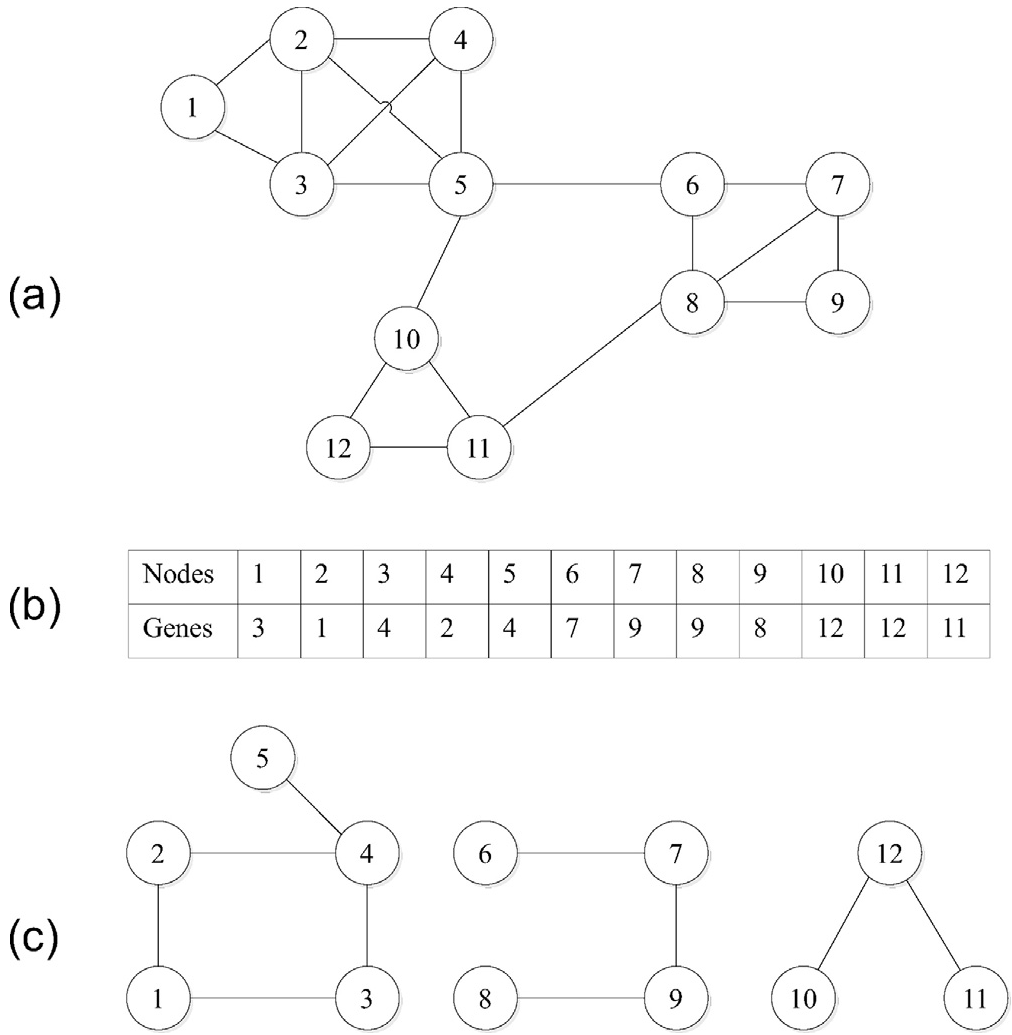
2. The Extended Mutation Operator
Standard mutation randomly swaps a node's community. CC-GA introduces an Extension Rate (). It specifically looks for external neighbors (nodes in different communities) and attempts to merge them. This prevents the GA from getting stuck with a "fragmentation" problem—where a large community is incorrectly split into many tiny ones.
Performance and SOTA Comparison
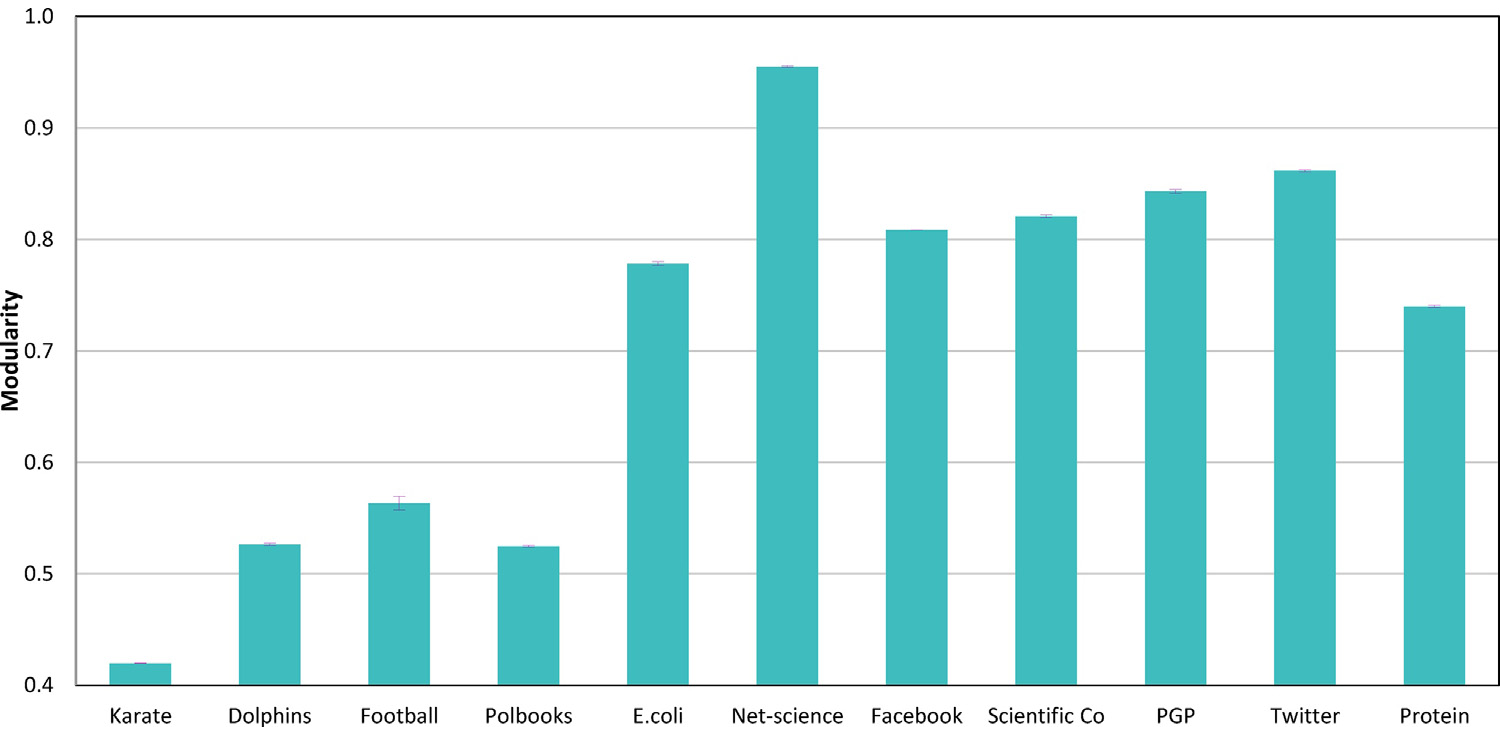
The authors tested CC-GA against a formidable lineup, including InfoMap, LPA (Label Propagation), and other GA variants.
| Network | Type | Best Q (CC-GA) | Improvement Context |
|---|---|---|---|
| Online Social | 0.809 | Significant jump over NeTa/COPRA | |
| NetScience | Collaboration | 0.958 | Near-perfect partitioning |
| PGP | Web of Trust | 0.852 | Outperforms all 9 baselines |
Convergence Speed
One of the most striking results is how quickly CC-GA "finds the path." In the Facebook network, the modularity score plateaus to a near-optimum in just 20 iterations. This is a direct consequence of the "informed" start provided by the Clustering Coefficient.
Critical Insight: The Modularity Trap
While CC-GA excels at maximizing Modularity, the authors honestly note a limitation: The Resolution Limit. Because Modularity favors larger communities, CC-GA sometimes merges small, legitimate communities into bigger ones. This is reflected in their NMI (Normalized Mutual Information) scores on synthetic benchmarks, which are competitive but not always the absolute highest.
Summary and Future Outlook
CC-GA proves that "blind" evolution is no longer sufficient for complex network analysis. By baking social network logic (Clustering Coefficients) into the genetic operators:
- Search efficiency is tripled for large-scale graphs.
- Accuracy increases by avoiding weak random initializations.
The next frontier for this research is adapting CC-GA for overlapping communities, where a single node (like a person) belongs to multiple circles simultaneously.
Methodology Recap
- Fitness Function: Modularity Optimization.
- Representation: Locus-based adjacency (Linear time decoding).
- Selection: Elite reproduction ().
- Key Formula: