
CDPM: Mastering the Overlap with Directed Percolation and Galois Lattices
CDPM: Finding and Evaluating Community Structure in Social Networks
This paper introduces CDPM (Clique Directed Percolation Method), a novel overlapping community detection algorithm that utilizes maximal cliques as fundamental building blocks. It leverages a new objective function, Structure Silhouette Coefficient (SSC), and a directed percolation strategy to merge cluster atoms into high-quality, overlapping communities.
TL;DR
CDPM (Clique Directed Percolation Method) is a sophisticated framework for finding overlapping communities in social networks. By treating maximal cliques as "atoms" and using a novel Structure Silhouette Coefficient (SSC), it manages to find more accurate and cohesive community structures than classic methods like GN or CPM. It essentially brings formal order to the chaotic overlap of real-world social groups.
Background & Motivation: The Overlap Problem
In social network analysis, we often assume a person belongs to just one group. However, reality is messy: you are simultaneously part of your family, your company, and your hobby groups.
Previous SOTA (State-of-the-Art) methods had two major flaws:
- Lack of Metrics: CPM is effective at finding overlaps but doesn't have a reliable way to "score" how good a division is.
- Rigidity: Many algorithms ignore vertices that don't fit perfectly into a fixed -clique template, leading to low "recall" (missing members).
The authors' insight was to use Maximal Cliques (the largest possible complete subgraphs) as the base units and develop a way to "flow" these units into communities based on their size and connectivity.
Methodology: The Core Architecture
The CDPM workflow consists of three distinct phases:
1. Clique Generation and Directed Percolation
Instead of just linking cliques that share nodes, CDPM introduces Directed Percolation.
- Logic: Connectivity flows from larger, more stable cliques to smaller ones.
- Mechanic: If two cliques are -adjacent (sharing a specific proportion of nodes), the direction is constrained from the larger clique to the smaller one. This prevents random "drifting" of community boundaries.
2. The Galois Lattice & Community Centers
To measure community quality, one needs a "center." But what is the center of a graph-based cluster? The authors use a Galois Lattice to organize maximal cliques.
- Physical Intuition: Vertices appearing in multiple overlapping cliques sit at deeper levels of the lattice. These "high-overlap" vertices are identified as the intuitive centers of cluster atoms.
3. Structure Silhouette Coefficient (SSC)
This is the "brain" of the algorithm. Adapted from traditional data clustering, the SSC calculates: Where is the distance to its own community center and is the distance to the neighboring community. CDPM merges cluster atoms specifically to maximize this value.
(Note: Refer to Section 4.2 of the paper for the specific algorithmic steps of the Three-Phase process)
Experimental Validation
The researchers tested CDPM against the Girvan-Newman (GN) algorithm and CPM (CFinder) using classic datasets like the Zachary's Karate Club and large-scale Telecom Call-graphs.
Key Findings:
- Accuracy (F-measure): CDPM consistently beats both GN and CPM. In the "Dolphin" dataset, CDPM achieved an F-measure of 0.68, significantly higher than CPM's 0.52.
- Recall Efficiency: CPM often misses nodes (low recall) because it only looks for fixed -cliques. CDPM's directed percolation allows it to capture more relevant members without losing precision.
- Scalability: On telecom datasets with >500k vertices, CDPM maintained a high Vertex Average Degree (VAD), proving it doesn't just find large clusters, but dense and meaningful ones.
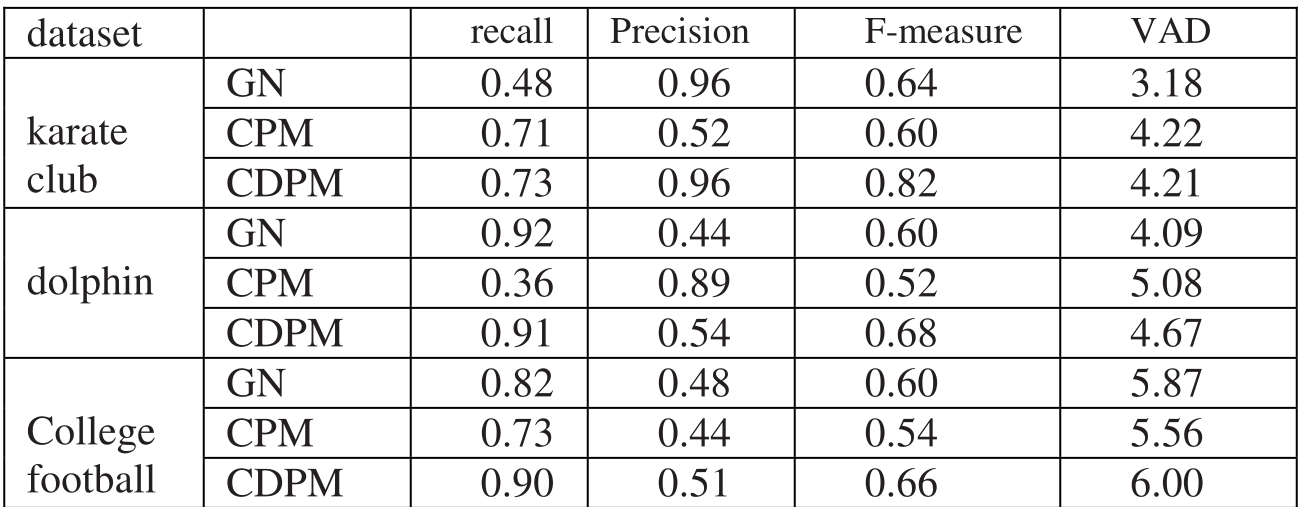 Table 1: Comparison of F-measure and VAD across three popular datasets.
Critical Insight & Conclusion
The true value of CDPM lies in its objective function. By introducing the Structure Silhouette Coefficient, the authors move community detection from "heuristic searching" toward "mathematical optimization."
Limitations:
- Clique Complexity: Finding all maximal cliques is computationally expensive (-hard), though the authors use efficient enumeration techniques to mitigate this.
- Static Nature: The current model doesn't account for how these overlapping communities evolve over time.
Takeaway: CDPM is a powerful tool for any researcher dealing with complex networks where the boundaries between groups are blurred. It offers a mathematically rigorous way to define "who belongs where" in a world of overlapping identities.