
Beyond the Like Button: Why "Fit" Trumps Fame in the Age of Social Media Endorsements
Celebrity Endorsement on Social Networks Sites: Impact of His/Her Credibility and Congruence with the Endorsed Product, on the Consumer’s Information Adoption and Dissemination
This study investigates how celebrity credibility and product-celebrity congruence influence information adoption and dissemination on Social Network Sites (SNS). By analyzing two distinct Tunisian celebrity endorsements—one for a national tourism cause and one for a commercial chocolate brand—the research establishes that congruence is a more consistent driver of consumer engagement than multidimensional credibility.
TL;DR
In a world saturated with digital ads, a celebrity's general fame is no longer enough to guarantee message success. This study reveals that for social media users, the congruence (or "fit") between a celebrity and the product is the most powerful predictor of whether information is adopted and shared. Interestingly, while expertise drives support for social causes, simple trustworthiness is the engine for commercial products—and being "too attractive" might actually hurt a commercial message's credibility.
The Digital Shift: From Billboards to Newsfeeds
Marketing has long relied on the "Source Credibility Model," assuming that if we like a celebrity, we will buy what they sell. However, Social Network Sites (SNS) like Facebook and Instagram have changed the rules. Users aren't just passive viewers; they are gatekeepers who decide whether to adopt information (believe it) and disseminate it (share/comment). The researchers recognized that existing models often fail to explain why some celebrity posts go viral for the right reasons, while others are ignored or mocked.
Methodology: A Tale of Two Actresses
The study looked at two spontaneous, real-world scenarios:
- The Cause-Related Endorsement: Hend Sabry's Facebook post supporting the "Visit Tunisia" campaign after a national crisis.
- The Product-Related Endorsement: Dorra Zarrouk's Instagram post about a chocolate brand.
Through these cases, the authors tested how three dimensions of credibility—Expertise, Trustworthiness, and Attractiveness—interact with "Match-up" (congruence).
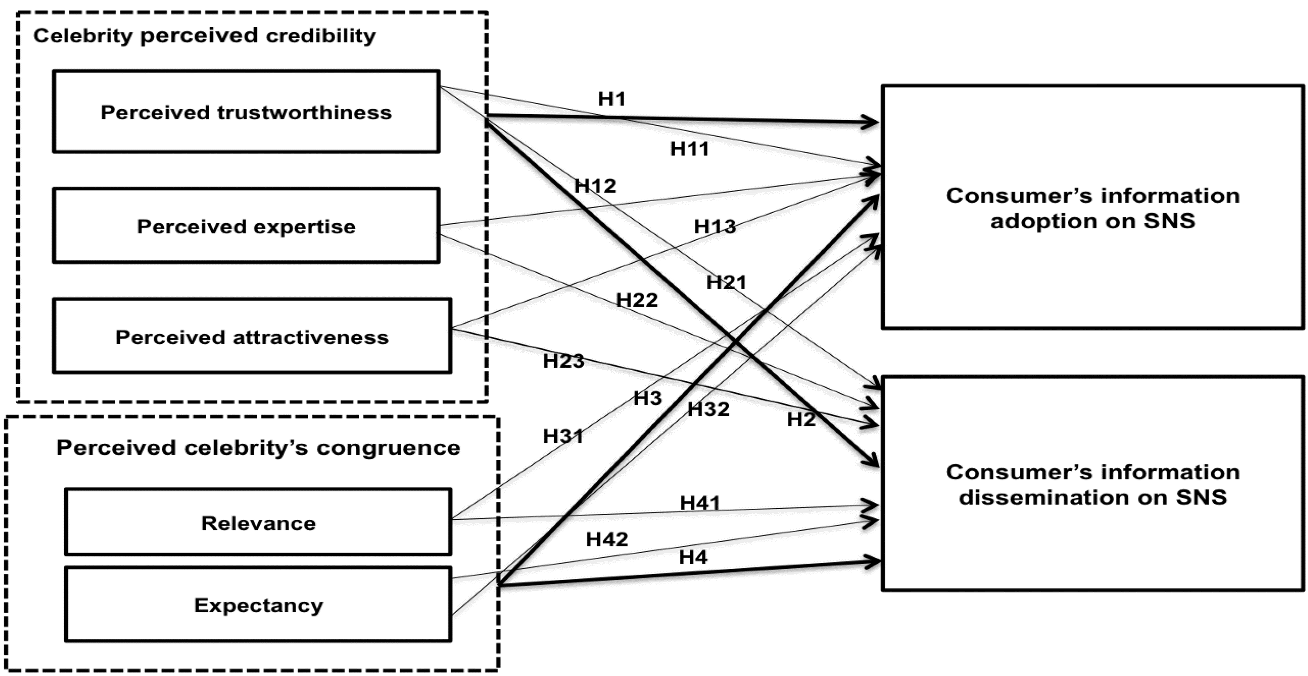 Figure 1: The proposed model linking Credibility and Congruence to Information Adoption and Dissemination.
Key Insights: Why "How" Matters More Than "Who"
1. The Congruence Kingpin
In both studies, congruence was the only consistent winner. If the audience felt the celebrity belonged in that specific context (e.g., a Tunisian actress promoting Tunisian tourism), they were significantly more likely to share the post. This confirms the "Match-up Hypothesis": the brand's image and the celebrity's image must tell a coherent story.
2. Expertise vs. Trust
The requirements for credibility change based on what is being endorsed:
- For Social Causes: Expertise is vital. Followers needed to feel Hend Sabry was knowledgeable about the cause to adopt her message.
- For Products: Trustworthiness (perceived honesty) is the primary driver. For Dorra Zarrouk's chocolate post, her perceived reliability was the only credibility factor that prompted people to share the information.
3. The "Attractiveness" Backfire
In a surprising twist, the study found that Dorra Zarrouk’s attractiveness had a negative impact on information adoption for the chocolate product. The authors suggest this might be due to a lack of fit: the actress is known for high-fashion (Elie Saab), and a "down-to-earth" product like chocolate may have created a cognitive dissonance for followers.
Critical Analysis & Managerial Implication
This research highlights a growing skepticism among SNS users. Simply hiring a famous face is a high-risk strategy if the "fit" isn't perfect.
Takeaways for Brands:
- Prioritize Fit over Fame: A "smaller" celebrity with high relevance to your product category will outperform a global superstar with zero connection to it.
- Context is Key: What works on Facebook for a national cause won't necessarily work on Instagram for a luxury brand.
- Community Management: Firms must monitor the spontaneous endorsements of celebrities. A celebrity endorsing too many products can dilute their credibility, making their advocacy feel like a "media stunt."
Conclusion
The study proves that in the interactive landscape of SNS, the "halo effect" of celebrity is fragile. While congruence remains the gold standard for marketing success, the nuances of credibility—specifically why attractiveness can sometimes correlate with lower adoption—warrant further exploration as social media platforms continue to evolve.
Source: Nadia Ben Halima, Hamida Skandrani, and Nawel Ayadi (2016).