
Beyond Popularity: How Surprise and Structural Bridges Drive Content Selection
Central nodes and surprise in content selection in social networks
This study investigates content selection in social networks, proposing that structural bridges and the emotion of surprise are superior predictors of user behavior compared to traditional centrality measures. By analyzing real-world interactions and survey data, the authors demonstrate that while degree centrality indicates popularity, it does not drive content selection.
TL;DR
Why do we click on some posts while ignoring others from our closest friends? This study reveals that social relevance (how popular a user is) and tie strength (how well you know them) are surprisingly poor predictors of what you’ll actually read. Instead, the "Information Flow" is driven by structural holes and the emotion of surprise. If content provides a sense of novelty—acting as a bridge between disconnected social circles—it is significantly more likely to be selected.
Problem & Motivation: The "Sender" Bias in Social Networks
Most research on social influence has historically focused on the sender. We assume that "influencers" (those with high Degree Centrality) are the primary drivers of information flow. However, this neglects the receiver's psychology.
The authors argue that existing recommendation systems often fail because they emphasize a structural view of the network (who is central?) while ignoring the intrinsic reward of novelty. This paper asks a fundamental question: Does being "popular" actually make your content more likely to be chosen, or is there a deeper emotional mechanism at play?
Methodology: Mapping Information Flow vs. Social Ties
The researchers designed a two-phase study involving Facebook interactions and surveys to distinguish between a person's social position and their informational value.
1. The Dual Network Architecture
The study constructed two distinct networks:
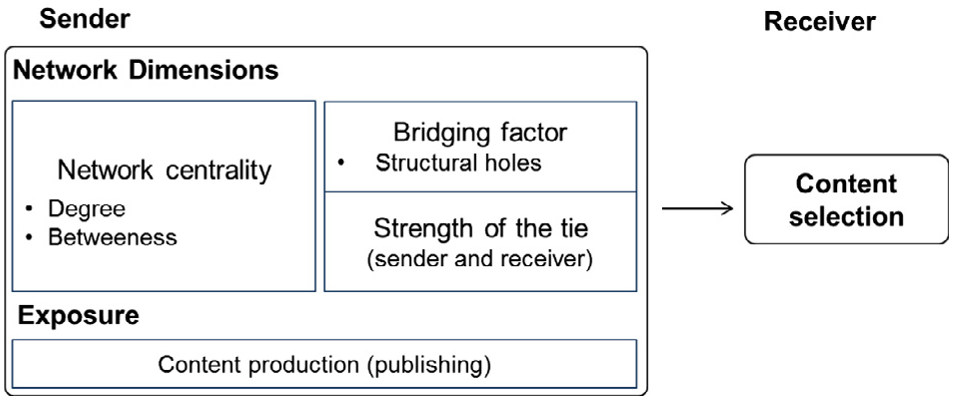
- The Participant Network: Mapping traditional friendship ties and calculating metrics like Betweenness and Degree Centrality.
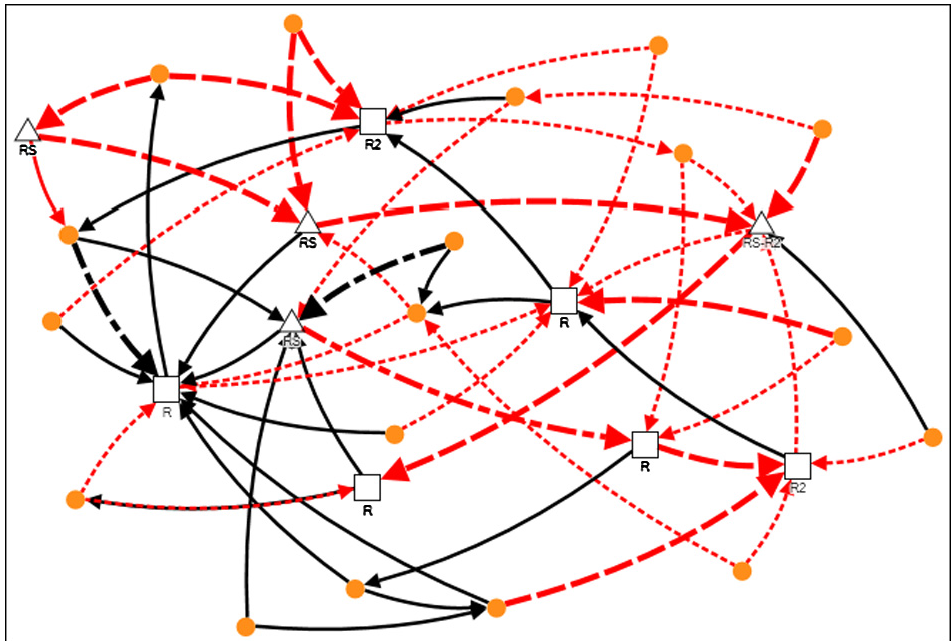
- The Information Flow Network: Mapping actual "content selection" events and the emotional responses (Surprise vs. No Surprise) associated with them.
2. Surprise as a Proxy for Novelty
The researchers used Surprise as a psychological identifier for the perception of novelty. They hypothesized that "bridging nodes"—those that span structural holes—are the sources of this surprise because they bring in information from outside the receiver's redundant social circle.
Core Insights: The Failure of Centrality
The results were striking:
- Popularity is irrelevant: There was no significant association between a sender’s popularity (degree) and the number of times their content was selected.
- Friendship doesn't drive clicks: Tie strength (strong vs. weak) did not predict content selection. Being a "close friend" doesn't guarantee your content provides value in terms of novelty.
- The "Surprise" Factor: Content selection was overwhelmingly linked to surprise. When a user felt surprised, the probability of them selecting the content skyrocketed (R² = 57.4%).
The Reality of Weak Ties
The study confirmed that weak ties—connections to people outside your immediate "clique"—are the essential "bridges" that trigger surprise. Strong ties often share redundant information, leading to low surprise and, consequently, lower selection interest.
Critical Analysis: Why This Matters for AI and UX
The most profound takeaway is the decoupling of Social Relevance and Informational Value.
1. The Limitation of Betweenness Centrality
Interestingly, the study found that high Betweenness Centrality (a mathematical measure of being a "broker") did not always coincide with the nodes that elicited surprise. This suggests that mathematical brokerage in a static social graph is not enough; the content must also bridge a cognitive distance for the receiver.
2. Personalization with "New Perspectives"
For developers of search engines and recommendation systems, the implications are clear: current algorithms that prioritize "the most liked" or "your friends' likes" are creating filter bubbles that reduce novelty. To increase engagement, systems should identify nodes that occupy structural holes relative to the user—the "kindness of strangers" that brings unexpected, non-redundant insights.
Conclusion: Toward Emotional SNA
This work pushes Social Network Analysis into the realm of affective computing. It tells us that our digital behavior is less about "following the leader" and more about "seeking the unexpected." While popularity might give a node power, it is the bridge that grants a node attention.
Future Outlook: The next generation of social algorithms should likely optimize for "Maximum Surprise" rather than "Maximum Agreement" to satisfy the human hunter-gatherer instinct for new information.