
Beyond the Index: Rethinking Centrality via Positional Dominance
Central Positions in Social Networks
The paper presents a theoretical shift in network analysis from calculating scalar centrality indices to evaluating "Positional Dominance." It introduces a framework that defines a node's position based on its derived relations and establishes a partial ranking system that outperforms traditional indices in interpretability and theoretical grounding.
TL;DR
In network science, we are obsessed with identifying the "most important" nodes. Usually, we do this by reaching for a standard index—Closeness, Betweenness, or PageRank. This paper by Ulrik Brandes argues that this "one-shot" index approach is theoretically fragile. Instead, it proposes Positional Dominance: a systematic framework that moves from "what is the score?" to "is node A structurally superior to node B?" by decomposing centrality into derived relations and neighborhood inclusion.
The Blind Spot of Modern Network Science
We often treat centrality indices as black boxes. When you calculate Closeness Centrality, you are implicitly assuming that:
- Indirect relations are best captured by shortest paths.
- Homogeneity exists—all target nodes are equally important.
- Additivity is valid—distances can be summed linearly.
But what if these assumptions don't hold for your specific data (e.g., a disease spreading vs. a rumor)? The author points out that computer science has focused heavily on making these indices faster to compute, without questioning if the indices themselves make sense for the domain at hand.
Methodology: Deconstructing the "Position"
The core innovation is defining a node's Position independently from its Centrality Index.
1. Derived Relations
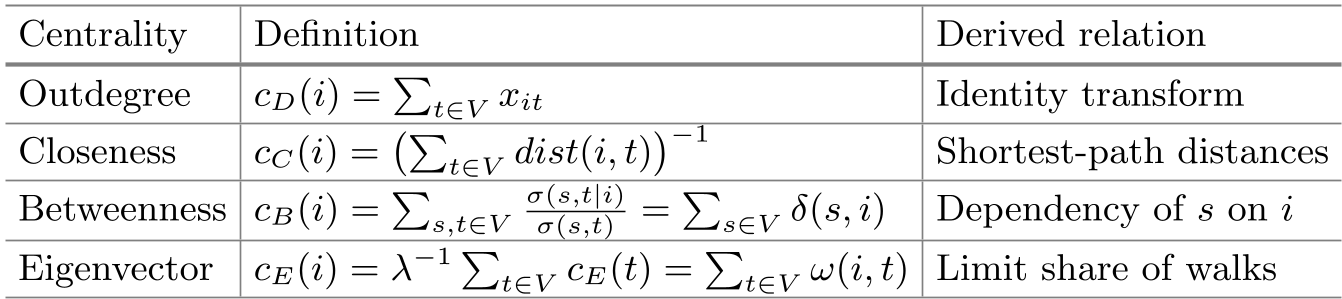
Most indices can be rewritten as a simple sum of a "derived relation."
- Closeness = Sum of shortest-path distances.
- Betweenness = Sum of node dependencies.
- Eigenvector = Limit share of walks.
2. Neighborhood Inclusion & Dominance
The paper argues that the "ideal" central structure is the Threshold Graph, where all nodes can be perfectly ranked. In these graphs, if node is more central than node , then the neighbors of are a subset of the neighbors of ().
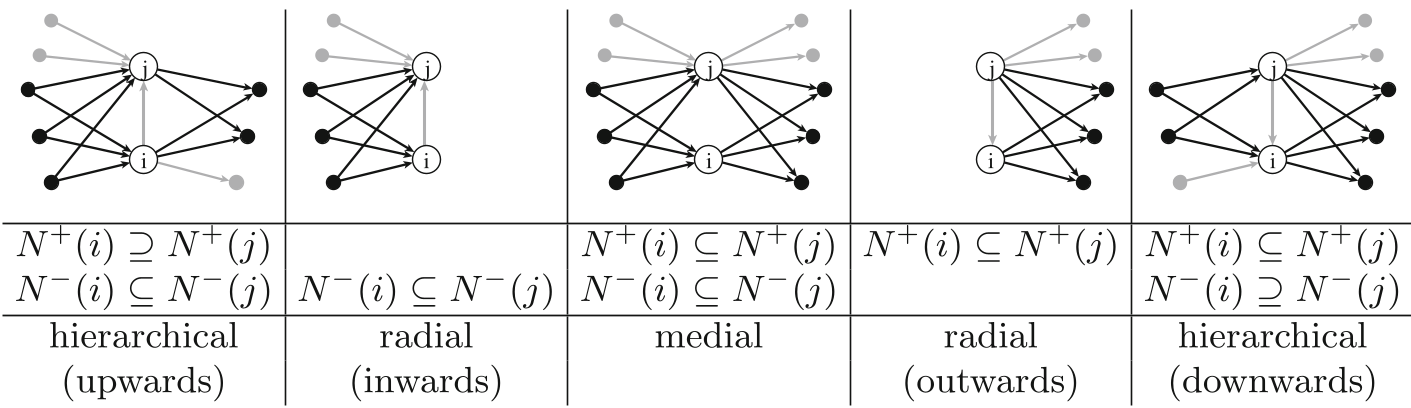
This is the "Vicinal Preorder." The paper extends this logic to directed graphs, creating three categories based on how in- and out-neighborhoods interact:
- Radial: Focus on one direction (e.g., Out-degree).
- Medial: Focus on being "between" incoming and outgoing ties.
- Hierarchical: Stronger in one direction, less constrained in the other.
Applying Homogeneity and Substitutability
Pure neighborhood inclusion is rare in real-world data. To make the framework practical, Brandes introduces Homogeneity.
Instead of requiring node to connect to the exact same nodes as , we allow Substitutability. If node connects to "someone just as wealthy/important" as the person node connects to, still dominates . This turns centrality into a multi-step process:
- Transform the network (e.g., calculate distances).
- Compare positions using dominance.
- Relax constraints (allow substitution) until a clear ranking emerges.
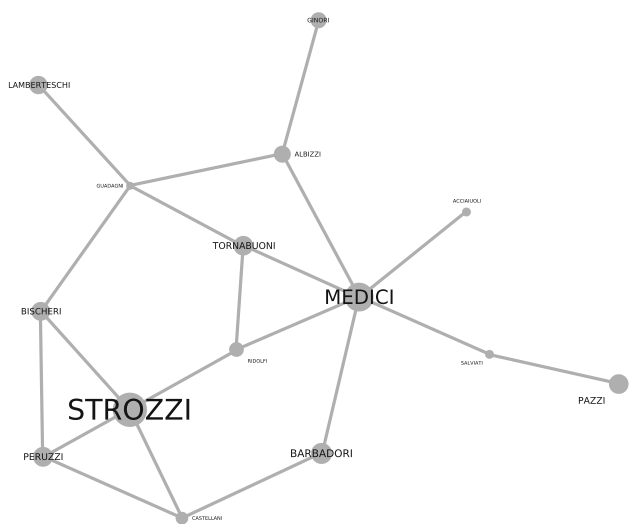 Above: In the Medici/Strozzi marriage network, moving from raw adjacency to substitutable neighbors creates a clearer hierarchical dominance structure (Hasse Diagram).
Computational Challenges: The Road Ahead
This framework isn't just theoretical; it opens new doors for algorithm design:
- Transformation Density: Calculating derived relations (like all-pairs shortest paths) makes graphs dense, requiring new "sketching" and "lazy evaluation" techniques.
- Dominance Algorithms: How do we efficiently compute the transitive skeleton of a positional dominance relation?
- Rank Completion: Since dominance usually gives a partial ranking (sparse), what are the most mathematically sound ways to complete it into a total order?
Conclusion
Ulrik Brandes has provided a much-needed "reset" for centrality research. By moving away from scalar indices and toward a logic of Positional Dominance, we gain the ability to tailor our network analysis to the actual physics of the system being studied. For researchers in Data Science and Algorithmics, the message is clear: stop optimizing the calculation of 1970s indices and start building tools that can handle the nuanced layers of positional data.