
Detecting Influence Volatility: Efficient Centrality-Burst Detection in Data Streams
Centrality-Burst Detection in Social Networks: An Efficient Approach for Data Stream
The paper introduces "Centrality-Burst Detection," a novel task for identifying social network members whose betweenness centrality increases significantly over time. It leverages the QUBE algorithm within a sliding window framework to detect these influential "bursts" in high-velocity data streams.
TL;DR
In the fast-paced world of social media, "influence" isn't a static trait—it's a dynamic event. This paper proposes a method to detect Centrality-Bursts, identifying users who suddenly become critical nodes in a network. By integrating the QUBE algorithm with a sliding window approach, the authors achieve near real-time detection on streaming graphs, bypassing the heavy complexity of traditional centrality calculations.
Background: The Price of Being Central
Betweenness Centrality (BC) is the gold standard for finding "bridge" nodes that control information flow. However, calculating BC requires finding all-pairs shortest paths—a nightmare for big data. In a streaming environment where edges (follows, likes, friendships) are added every millisecond, re-calculating the entire graph's centrality is computationally prohibitive.
Furthermore, static snapshots are deceptive. A user might have high centrality today but be irrelevant tomorrow. The real value for marketers and analysts lies in bursts: who is becoming influential right now?
Methodology: QUBE Meets Sliding Windows
The authors define a Centrality-Burst as a significant jump in a vertex's BC value within a specific time window.
1. The Burst Definition
The system maintains a sliding window . A vertex is flagged if: Where is a user-defined threshold.
2. Efficiency via QUBE
Instead of recomputing the entire graph when a new edge arrives, the algorithm uses the QUBE technique. QUBE identifies the Minimum Union Cycle (MUC) affected by a change. It limits updates only to the subgraph segments where shortest paths might have actually changed.
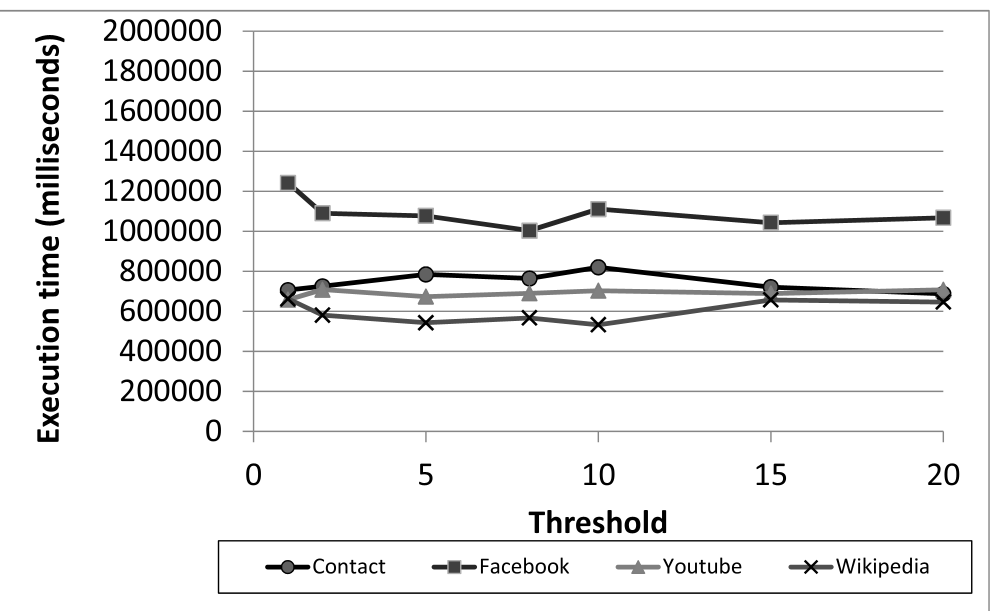 Fig: The QUBE-based update logic used to minimize redundant calculations.
Experimental Validation
The authors tested their approach on diverse datasets (Facebook, Youtube, Wikipedia).
- Scalability: As shown in the logarithmic scale results, the proposed method maintains a massive performance lead over the naive approach (recomputing from scratch). Even at 10,000 vertices, the execution remains within an "acceptable level" for production environments.
- Parameter Sensitivity: Interestingly, the execution time is largely independent of the Threshold (T) and Window Size (W). This is because the bottleneck is the graph update logic itself, not the filtering of results.
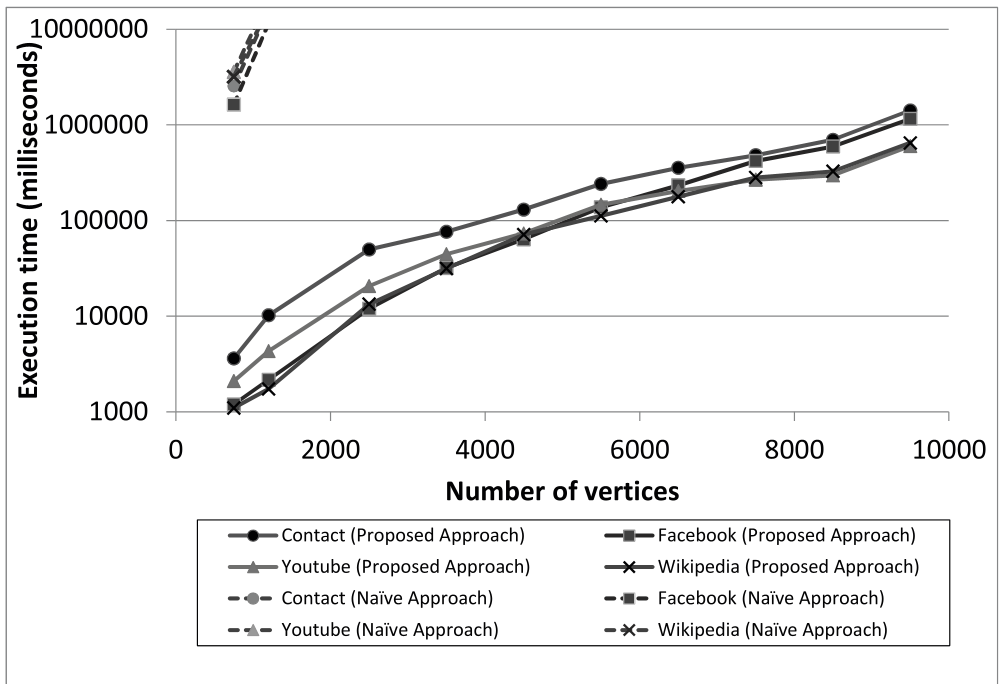 Fig: Execution time comparison between the proposed method and the naive baseline.
Depth Insight: Why This Matters
Most graph algorithms treat the network as a static entity. This paper shifts the focus to graph kinematics. By detecting the acceleration of influence, platforms can:
- Optimize Marketing: Target "rising stars" before they become expensive "top-tier influencers."
- Early Intervention: Identify the rapid rise of misinformation bridges before they saturate the network.
- Resource Allocation: Prioritize cloud computing resources on the most volatile parts of the graph.
Conclusion & Future Work
The "Centrality-Burst" framework provides a robust solution for tracking the pulse of social networks. While effective, the authors acknowledge that as graphs grow into the millions of nodes, even QUBE may need further optimization—potentially through parallel processing on cloud platforms. The logic of "calculating only what changed" remains the most promising path forward for real-time graph analytics.