
Centrality as a Friendship Selection Heuristic: Optimizing the Social Internet of Things (SIoT)
Centrality as a Friendship Selection Heuristic in Social Internet of Things
This paper proposes a novel friendship selection heuristic for the Social Internet of Things (SIoT) based on network centrality measures. By evaluating Betweenness, Harmonic Closeness, and Eigenvector centralities, the authors demonstrate a localized mechanism for nodes to select "friends" that optimize network navigability and efficiency.
TL;DR
In the rapidly expanding world of IoT, managing billions of connections requires more than just raw bandwidth—it requires "social" intelligence. This paper explores the transition from Smart Objects to Social Objects, proposing that nodes should choose their "friends" based on Centrality Measures. By prioritizing connections with influential or strategically placed nodes, SIoT networks can achieve significantly higher navigability and lower latency.
The Motivation: Why IoT Needs a Social Life
Traditional IoT architectures struggle with the "Scalability Wall." As more devices join, the overhead of finding services and routing data becomes prohibitively expensive. SIoT solves this by mimicking human social structures, where nodes form relationships (Parental, Co-work, Co-location) to navigate the network efficiently.
However, the question remains: How should a node decide which request to accept? Previous works focused on "degree" (number of connections), but having many friends doesn't necessarily mean you are a good bridge for information. The authors argue that Centrality—a measure of a node's structural importance—is the secret sauce for a truly navigable network.
Methodology: The Centrality Heuristics
The researchers tested three core types of centrality across six strategies (ranking by either highest or lowest values):
- Betweenness Centrality (): Measures how often a node acts as a bridge along the shortest path between others.
- Harmonic Closeness Centrality (): Measures how "close" a node is to all other nodes, modified for potentially unconnected graphs.
- Eigenvector Centrality: A measure of influence—your importance increases if you are connected to other important nodes.
The selection process is straightforward: When a "Guest" node requests friendship, the "Host" evaluates the guest's centrality against its current friends. If the guest is more "central" (in decreasing strategies), the link is established.
Experimental Setup & Results
The authors utilized the Barabási-Albert (BA) Model to generate scale-free networks, which closely resemble real-world social topographies.
Key Findings:
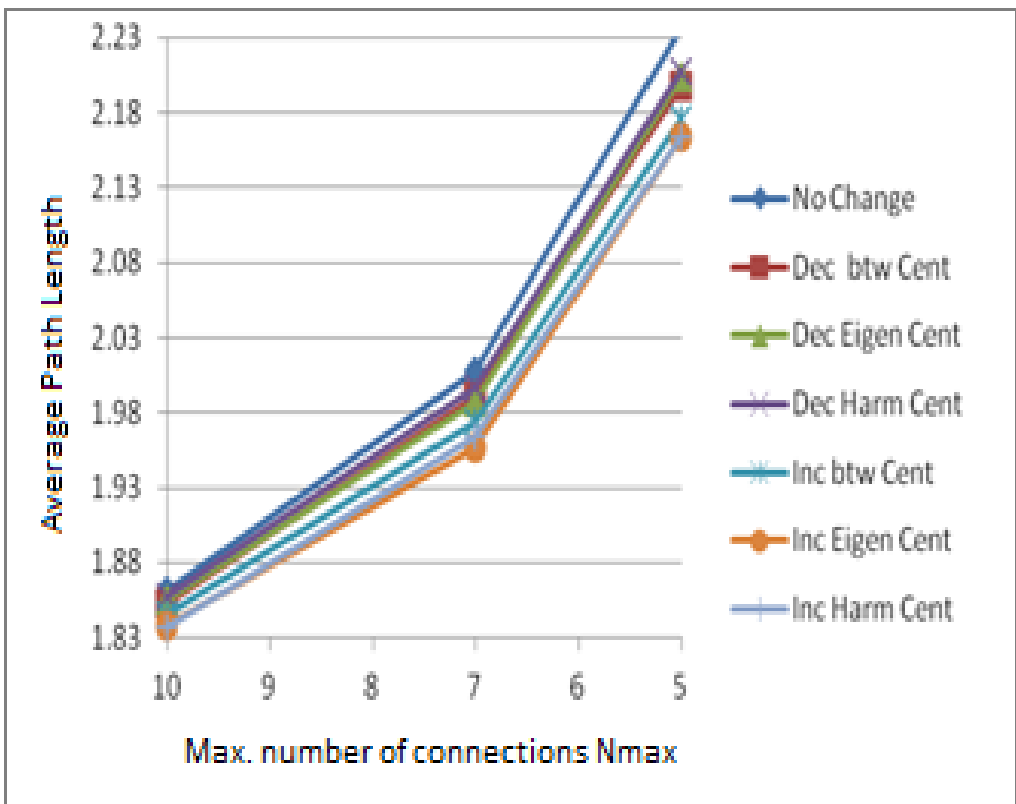
- Reduced Path Length: All centrality-based strategies decreased the Average Path Length compared to the original network structure. This translates directly to faster service discovery.
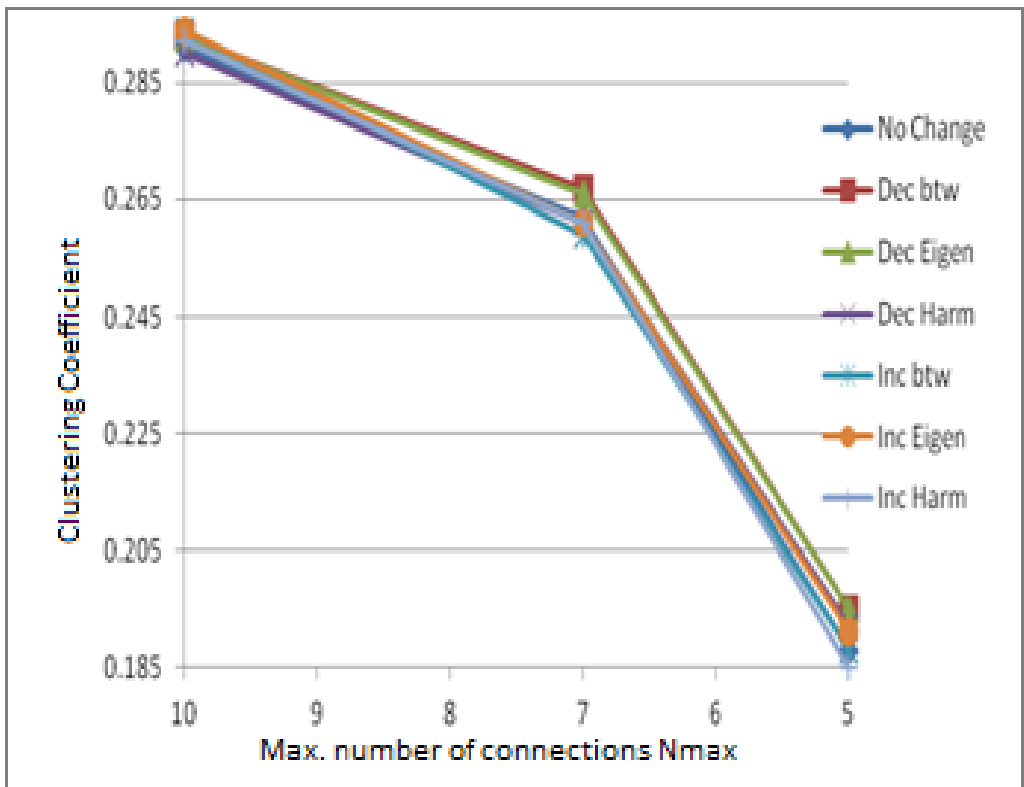
- Enhanced Local Clustering: The Clustering Coefficient (CC) saw a marked improvement. High CC indicates a cohesive network where "friends of friends" are likely to be connected, improving local search efficiency.
- The Winner: Strategy 6 (Increasing Eigenvector Centrality) emerged as the most effective for smaller values, providing the best balance between local density and global connectivity.
Critical Insight: Why Does It Work?
The physical intuition here is rooted in the Small-World Property. Conventional IoT discovery is often a "blind search." By using Eigenvector centrality, a node aligns its connectivity with the "hubs" of the network. This creates a "highway" system—most nodes are only a few hops away from a high-influence hub that can route their request to the correct destination.
Conclusion & Future Outlook
This paper successfully bridges graph theory and IoT resource management. By treating a network connection not just as a link, but as a strategic choice, SIoT can become self-optimizing.
Limitations: The current study assumes a static environment. In reality, IoT devices move, fail, and switch off. Future research must address dynamic centrality, where importance is recalculated as the topology shifts. Furthermore, integrating Trustworthiness alongside centrality will be crucial to prevent "central" but malicious nodes from hijacking the network traffic.
Final Takeaway: In the future of SIoT, it's not about how many connections you have, but how strategically those connections are placed. Centrality is the compass for that strategy.