
Beyond the Hub: Why Community Structure Redefines Social Influence
Investigating Centrality Measures in Social Networks with Community Structure
This paper investigates the relationship between 5 classical centrality measures and 5 community-aware centrality measures across 8 real-world online social networks (OSNs). Using Kendall’s Tau and Rank-Biased Overlap (RBO), the authors identify that community-aware measures provide distinct node influence information that traditional metrics overlook.
TL;DR
Is a user with thousands of followers always more influential than one who connects two separate social circles? This paper argues "No." By comparing classical centrality (like Degree and PageRank) with community-aware measures across 8 real-world datasets, the researchers demonstrate that traditional metrics are blind to the "bridging" roles that define social dynamics. They find that metrics like Bridging Centrality and Participation Coefficient provide entirely unique information about node influence that classical algorithms miss.
The Blind Spot of Classical Centrality
In the study of Online Social Networks (OSNs), we often rely on "Classical Centrality" to find influencers. Degree centrality looks at local popularity; Betweenness looks at information bottlenecks; Closeness looks at global accessibility.
However, real networks aren't uniform; they have Community Structure—clusters of nodes with dense internal links and sparse external ones. Classical measures are "agnostic" to these clusters. A node might have a high degree just by being in the middle of a massive, isolated cluster, while a "bridge" node with a lower degree might actually control the flow of information between two different worlds (e.g., connecting a group of scientists to a group of policymakers).
Methodology: Bridging the Gap
The authors selected 5 classical and 5 community-aware measures, testing them on 8 datasets including Facebook Ego networks, Twitter retweets, and Deezer friendship graphs.
The Community-Aware Contenders:
- Bridging Centrality (BC): Specifically targets nodes that connect dense components.
- Community Hub-Bridge (CHB): Weights intra-community links by community size and inter-community links by the number of reached communities.
- Participation Coefficient (PC): Measures how evenly a node’s links are distributed across various communities.
- Community-based Mediator (CBM): Uses entropy to evaluate the density of communities a node links to.
- Number of Neighboring Communities (NNC): A simple count of how many communities a node can reach in one hop.
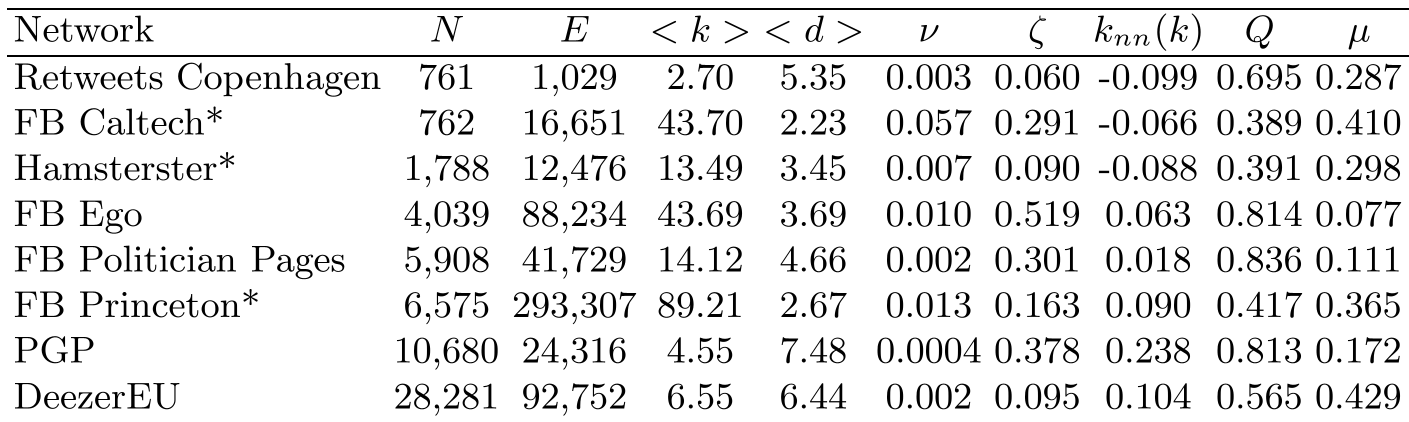 Table 1: Topological characteristics of the 8 OSNs studied, showing varying sizes and mixing parameters (μ).
Key Insights from Experimental Results
The authors used Kendall’s Tau (for rank correlation) and Rank-Biased Overlap (RBO) (which focuses on whether the top-tier influencers are the same).
1. The "Unique Information" Group
Bridging Centrality, Community Hub-Bridge, and Participation Coefficient showed consistent low correlation with classical measures across almost all networks.
- The Insight: These metrics are capturing a "structural niche" that Degree or PageRank cannot see. If you are looking for nodes that facilitate viral marketing or control "fake news" spread across communities, these are your go-to metrics.
2. The "Context-Dependent" Group
Community-based Mediator and Number of Neighboring Communities were less consistent. In some networks (like FB Ego), they behaved uniquely; in others (like DeezerEU), they correlated highly with classical Degree centrality.
- The Interpretation: The effectiveness of these measures depends heavily on the Mixing Parameter (μ)—how "blurry" the boundaries between communities are.
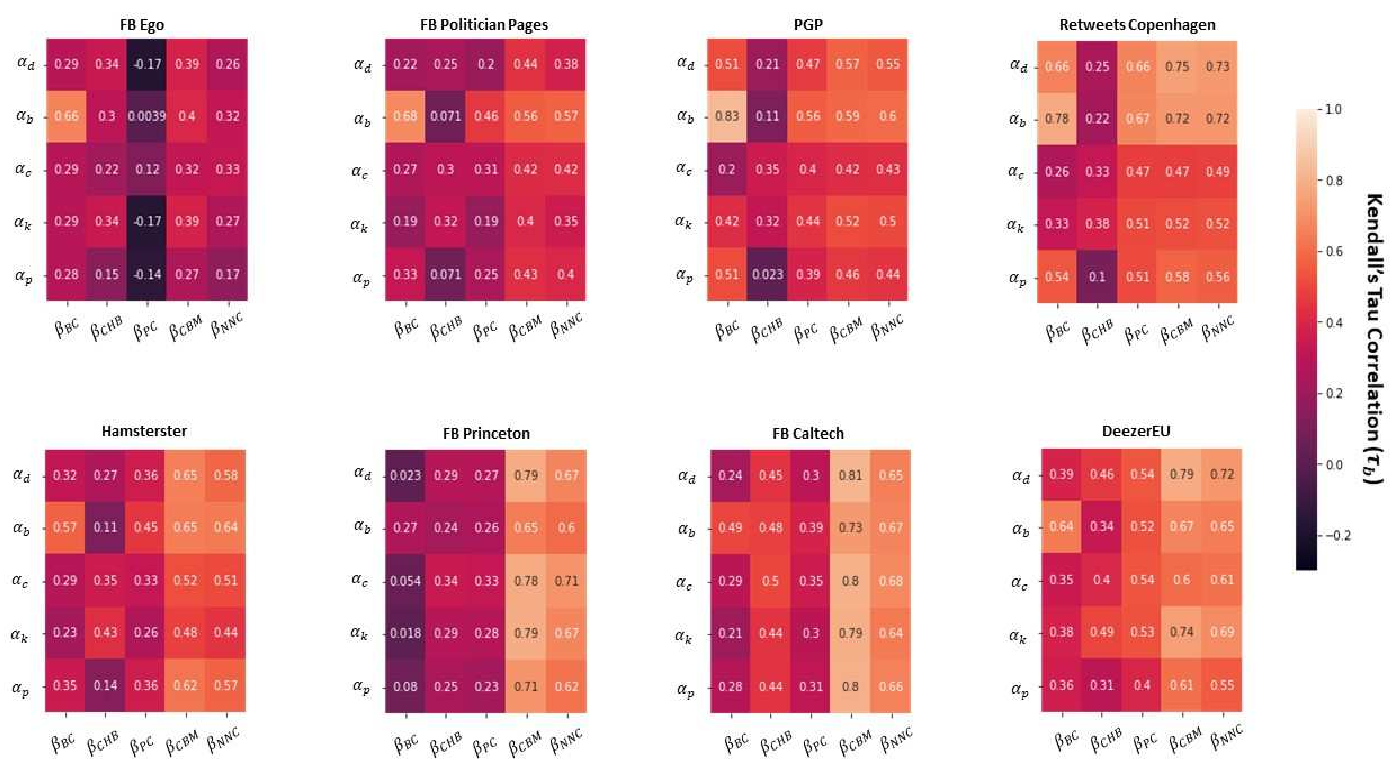 Figure 1: Kendall’s Tau heatmaps. Notice the dark purple regions for BC and PC, indicating they provide information very different from classical Alpha-measures.
Critical Analysis: Why This Matters
The most striking finding is in the RBO Similarity Analysis. Even when two measures have a medium correlation, their "Top-10" lists are often completely different. In social network applications—like identifying who to vaccinate to stop a pandemic or which influencer to seed for a product launch—the "Top-10" list is all that matters.
Limitations: The study relies on the Infomap algorithm for community detection. Since community-aware metrics are sensitive to how boundaries are drawn, using different detection algorithms (like Louvain or Leiden) might shift the results.
Conclusion
This research proves that "influence" is not a monolithic trait. A node's value is defined not just by how many people it knows, but by where those people live in the social architecture. For researchers and data scientists, the takeaway is clear: if your network has clusters (and it almost certainly does), using classical centrality alone is like looking at a 3D object through a 2D lens.