
Crowdtasking: Bridging Formal Response and Spontaneous Voluntarism in Disasters
Centralized Crowdsourcing in Disaster Management: Findings and Implications * Full paper
This paper introduces "Crowdtasking," a centralized crowdsourcing workflow for Disaster Management (CDM). It presents the "CrowdTasker" prototype, a system designed to coordinate unaffiliated volunteers through micro-tasks via a smartphone application, achieving more structured and relevant data collection than traditional social media-based methods.
TL;DR
In the chaos of disaster response, spontaneous volunteers are a double-edged sword: they offer massive capacity but can overwhelm formal responders. This paper introduces Crowdtasking, a centralized crowdsourcing approach that transforms chaotic volunteer energy into structured "micro-tasks." Developed by the Austrian Red Cross and academic partners, the system uses a controlled workflow to verify, activate, and task volunteers, though it faces challenges in maintaining the "social fabric" of community volunteering.
Background: The Problem of Convergence
When disaster strikes, "Convergence" happens—an influx of people, information, and supplies at the disaster site. While well-intentioned, this "mass assault" often hinders professional relief efforts. Prior work has focused on monitoring social media (Twitter, Facebook), but this data is frequently "noisy" and lacks tactical utility for commanders.
The authors identify a shift from traditional, long-term volunteering to "project-oriented volunteering"—short-term, situational engagement enabled by ICT. The goal of Crowdtasking is to harness this situational energy without the overhead of traditional hierarchical management.
Methodology: The Crowdtasking Workflow
The core of the paper is a shift from open crowdsourcing to Centralized Crowdtasking. The workflow is structured to prioritize data relevance and manageable coordination.
1. The Two-Stage Filter: Activation and Tasking
Unlike typical apps where you just "do a task," Crowdtasking requires an Activation phase.
- Activation: Potential volunteers are queried based on location or skills. Only those who "Accept" enter the active pool.
- Tasking: Only activated volunteers receive specific micro-tasks (e.g., "Check the water pump at address X").
2. The Prototype Architecture
The system, CrowdTasker, consists of three distinct components:
- CTA (Coordinators' Web Interface): Where crisis managers define events and spatial boundaries.
- APP (Volunteer Smartphone App): A streamlined interface for executing step-by-step tasks.
- EVA (Visualization Tool): A common operational picture system that aggregates and maps volunteer feedback.
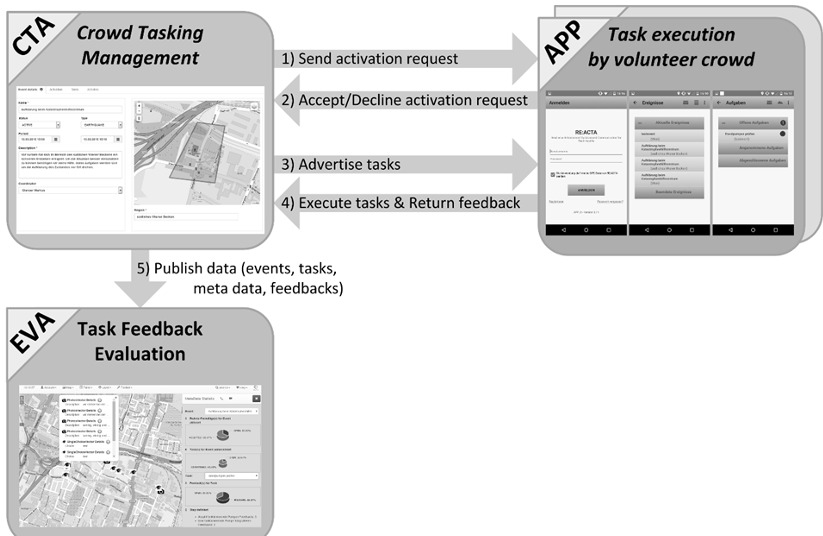 Figure: The three-component architecture of the CrowdTasker system.
Experiments & Field Trial Results
The researchers conducted a field trial at the Austrian Red Cross center with three coordinators and nine volunteers.
The "Activation" Insight
The primary finding was that despite an initial learning curve, the Activation phase is vital. It allows coordinators to "right-size" their requests. For instance, you wouldn't send 500 people to find one blanket. Knowing the "A-priori" crowd size enables tactical precision.
Usability Friction
- Maps over Lists: Volunteers struggled with list-based task views. The paper argues that for spatial tasks, a map-centric UI is non-negotiable.
- Status Anxiety: When the system was idle (coordinators taking time to type), volunteers became "restless," wandering around and checking their GPS. Visual "heartbeat" indicators are required to maintain user trust in high-stress environments.
 Figure: Differentiating volunteer types by their level of integration into formal structures.
Critical Analysis: The Missing Social Link
The most profound finding is the Social Gap. By stripping volunteering down to "micro-tasks" via a centralized command-and-control app, the system inadvertently destroyed the lateral communication that makes volunteering rewarding.
- Lack of Peer Interaction: Younger volunteers wanted to see where their friends were and coordinate "car-sharing" to the site—features the central app lacked.
- Suppression of Initiative: Volunteers felt restricted. They wanted to report a "collapsed house" they saw, but the app only allowed them to answer pre-defined questions about "fuel prices."
Conclusion & Future Outlook
The paper concludes that while "Crowdtasking" is a powerful tool for relief organizations to get specific data, it risks alienating the very crowd it seeks to manage if it ignores Social Capital.
The authors propose a future "Hybrid Model" where centralized tasking co-exists with a Common Space for community building. This would allow emergent, self-organized groups (like those seen in the European migration crisis) to preserve their egalitarian structures while still providing valuable data to formal authorities.
Takeaway for Tech Leaders
When designing CSCW systems for high-stakes environments, efficiency cannot come at the cost of human agency. A successful platform must balance Top-Down Coordination with Bottom-Up Initiative.