
Personalized Pixels: Enhancing Social Photos with User-Preferred cGANs
CGANs Based User Preferred Photorealistic Re-stylization of Social Image
The paper introduces a customized photorealistic re-stylization method using Conditional Generative Adversarial Networks (cGANs). It leverages a user's collection of favorite images to transfer personal aesthetic styles to new photos, achieving State-of-the-Art performance in user-preferred color and light distribution.
TL;DR
In the era of social media, everyone wants their photos to reflect their unique "vibe." This paper presents a framework that automatically re-stylizes photos to match a user's personal taste. By analyzing a user's favorite images for content and composition, the system selects the best reference "anchors" and uses a Conditional GAN (cGAN) to transform a random snapshot into a photorealistic masterpiece tailored to that specific user.
Background & Motivation: The Gap in Generic Filters
Existing photo editing tools fall into two camps: generic filters (which often look artificial) and complex editors like Photoshop (which require professional skill). From a research perspective, "Style Transfer" has historically struggled with a trade-off:
- Artistic methods (like Gatys et al.) create beautiful textures but lose photorealism.
- Global color transfer methods require the input and reference scenes to be nearly identical, which is rarely possible for casual users.
The authors identify a crucial insight: A user's style isn't just about color; it's about the interplay between content (what is in the photo) and composition (how it is framed).
Methodology: The Photographer's Perspective
The core of the paper is a three-stage pipeline designed to mimic the intuition of a professional photographer.
1. Dual-Factor Image Selection
Instead of using a random reference image, the system calculates a similarity score based on:
- Image Content: Using the Bag-of-Words (BoW) model to ensure the objects in the images are semantically related.
- Image Composition: This includes Salience Arrangement (where the main object is located), Line Directions (the "flow" of the image), and Visual Complexity.
2. The User Preference Indicator
Are you a "Light" person or a "Color" person? The researchers observed that users gravitate toward one of these two poles. They calculate an indicator to weight the importance of composition versus content:
- Light-preferred users: Composition is weighted higher.
- Color-preferred users: Content takes priority.
3. cGAN-Based Mapping
Once the top reference images are selected, they are used to train a Conditional Generative Adversarial Network (cGAN). The input is a grayscale version of the original photo, and the goal is to generate a colorized, stylized version that mimics the statistical distribution of the selected references.
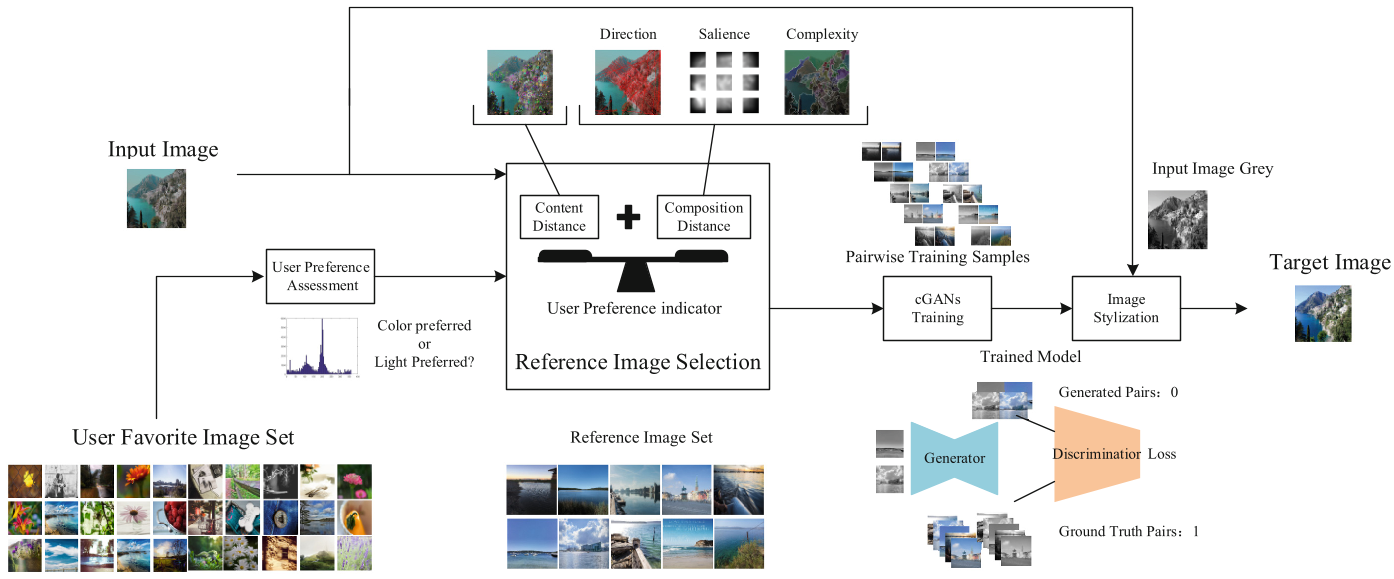 Figure 1: The framework pipeline, from preference assessment to cGAN stylization.
Experiments and Results
The authors tested their method against heavyweights like Pix2pix and the Zhang et al. colorization model.
- Personalization: Using the Bhattacharya Coefficient (BC) to measure Hue and Saturation similarity, the proposed method significantly outperformed others, proving it truly captured the "user's voice."
- Efficiency: Remarkably, the model achieved these results using only 5 reference images per test, whereas standard Pix2pix models were trained on 2,000 images. This highlights the power of intelligent data selection over brute-force training.
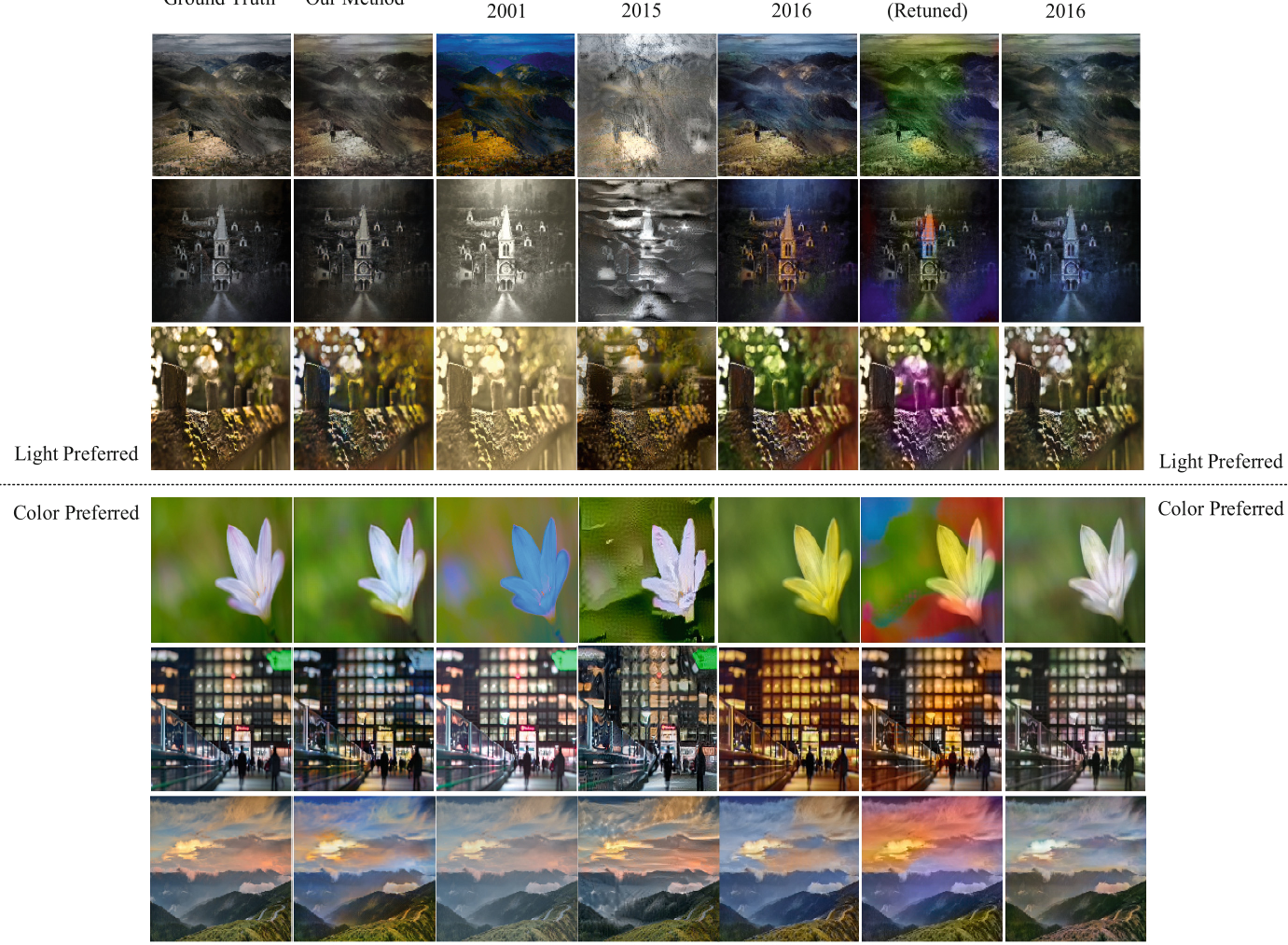 Figure 2: Qualitative comparison showing how the proposed method (last column) better matches the Ground Truth's "mood" compared to baseline filters.
Critical Insight: Why Does It Work?
The breakthrough here isn't just the use of GANs—it's the pre-filtering of the latent space. By using photography theory (compositional features) to select the training set, the authors provide the GAN with a much clearer "prior." When the training data is highly relevant to the specific input, the generator achieves a Nash equilibrium much faster and with higher fidelity.
Conclusion & Future Work
This work demonstrates that photorealism and personalization are not mutually exclusive. By quantifying "taste" through content and composition, social networks could eventually provide every user with a "personal AI photographer."
Limitations: The current model requires a grayscale conversion as an intermediate step, which might lose some original luminance information. Future research could explore direct style-to-style mapping without the desaturation bottleneck.