
Personalized Photorealism: Mastering Social Image Re-stylization with cGANs
CGANs Based User Preferred Photorealistic Re-stylization of Social Image
The paper introduces a customized photorealistic re-stylization method for social images using Conditional Generative Adversarial Networks (cGANs). By combining image content and composition analysis with a "User Preference Indicator," it selects the most relevant reference images from a user’s favorites to guide the style transfer.
TL;DR
This research presents a novel framework for photorealistic re-stylization of social media photos. By analyzing a user's favorite images through the lenses of content and composition, and weighting them according to a User Preference Indicator, the system retrieves the best reference styles. These styles are then applied using a Conditional GAN (cGAN), resulting in personalized photos that look like they were taken by the user's favorite photographer, rather than being processed by a generic filter.
Background & Motivation: The "Artificiality" Trap
In the era of social sharing, everyone wants their photos to reflect their personal "vibe" or aesthetic. However, users face a trilemma:
- Generic Filters: Often look "fake" or "over-processed" (artificiality).
- Artistic Style Transfer: (e.g., Gatys et al.) Excellent for turning a photo into a Van Gogh, but terrible for maintaining photorealistic integrity.
- Expert Tools: Photoshop requires professional skills that most casual users lack.
The core technical challenge is Scene Consistency. Most photorealistic color transfer methods only work if the reference image and the target image are nearly identical in content. The authors of this paper ask: How can we achieve personalized, realistic style transfer using a user's favorite images, even if those images depict completely different scenes?
Methodology: The Photographer’s Perspective
The authors argue that a "style" isn't just a color palette; it's a combination of how a photographer chooses Content and Composition.
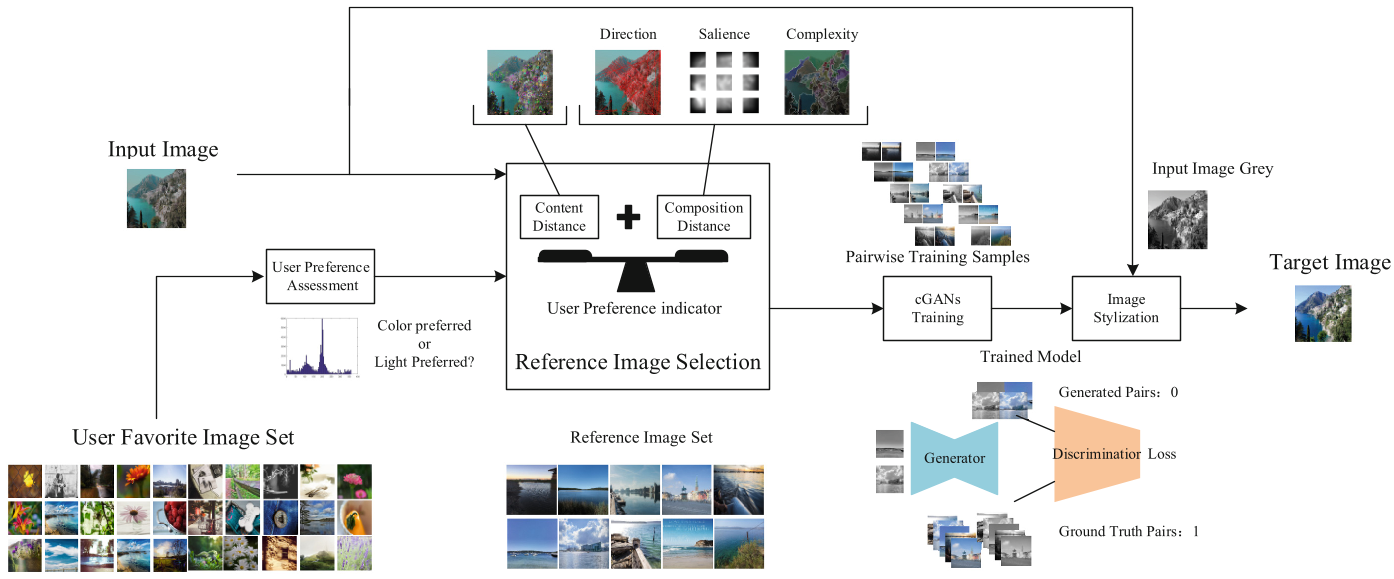
1. Dual-Factor Retrieval
To select the best reference images () for an input image, the system calculates two distances:
- Content Distance (): Uses Bag-of-Words (BoW) to ensure the semantic theme matches.
- Composition Distance (): A weighted sum of Salience Arrangement (Rule of Thirds), Line Directions (Hough Transform), and Visual Complexity.
2. The User Preference Indicator ()
This is the "secret sauce." Users are categorized as:
- Light-preferred: Heavily influenced by monochromatic tones and lighting. Here, Composition is weighted more heavily.
- Color-preferred: Content is more important for these users. The indicator dynamically balances the retrieval objective:
3. cGAN Training
Instead of using a static formula to transfer colors, the authors use a Conditional GAN (pix2pix). They create synthetic training pairs by converting the selected reference images to grayscale (input) and using the original colored versions as the ground truth. This teaches the network the specific "mapping" of how this user would colorize a scene.
Experiments & SOTA Comparison
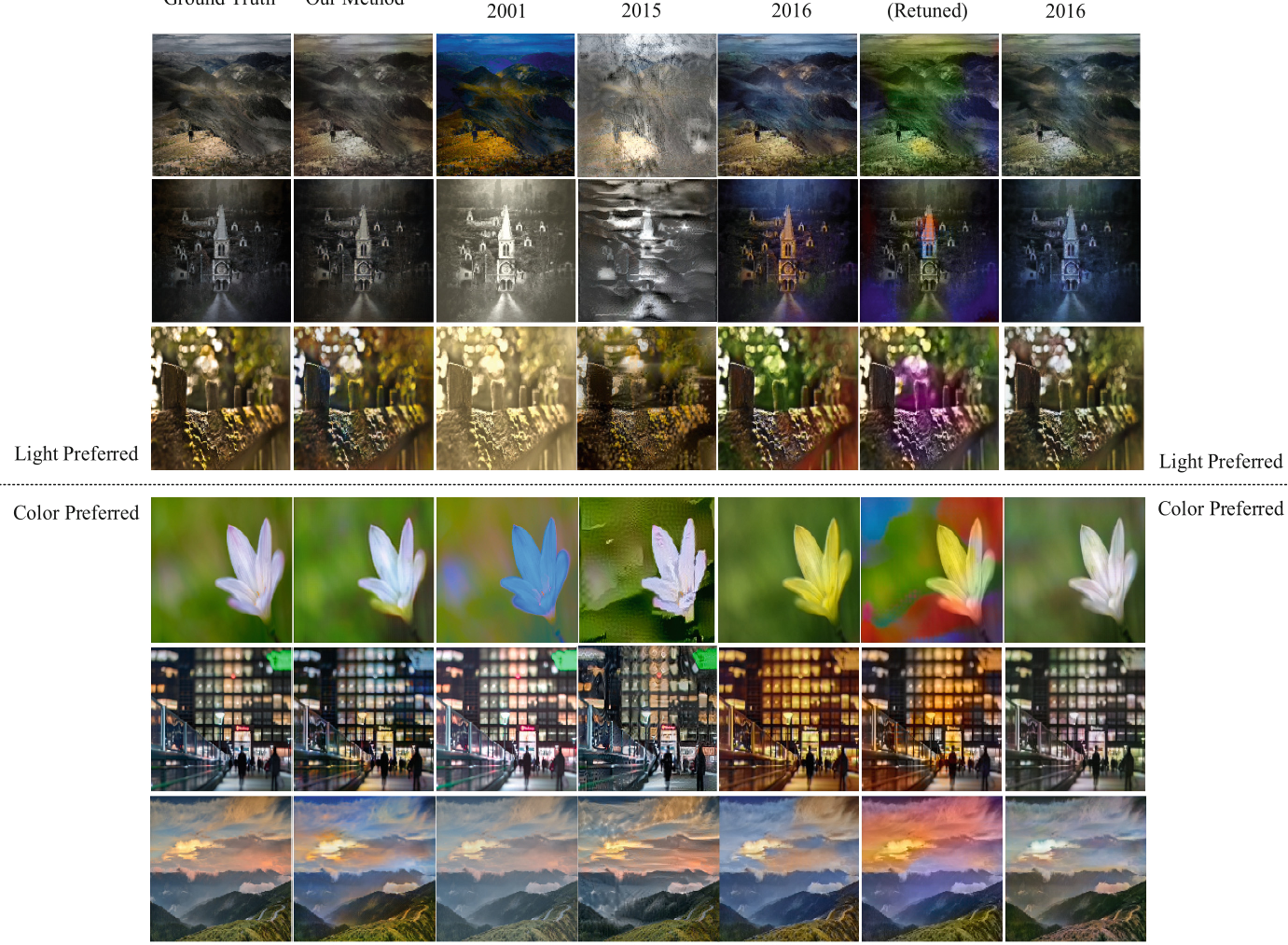
The method was tested against classic color transfer (Reinhard), Neural Style Transfer (Gatys), and deep colorization (Zhang et al.).
Key Findings:
- Efficiency: The model achieves superior results with only 5 reference images, whereas other deep learning models require thousands or millions.
- Preference Alignment: The Bhattacharya Coefficient for Hue (measuring color distribution similarity) showed a 44.23% improvement over baseline methods.
- Visual Quality: Unlike the "grayish" or "blurry" results often produced by Likelihood-maximization models, the cGAN approach maintained structural integrity (high SSIM) and vibrant, realistic colors.
Critical Insight: Why it Works
The brilliance of this work lies in its Inductive Bias. By forcing the retrieval mechanism to look at composition (the skeleton of the photo) rather than just color, the GAN learns a more robust mapping. For a "light-preferred" user, the model learns that specific shadows and highlights matter more than the specific hue of an object, preventing the "color bleeding" artifacts common in earlier style transfer works.
Conclusion & Future Work
The paper successfully demonstrates that Personalization > Scale. By understanding the "photographer's intent" through composition, we can perform complex style transfers with minimal data.
Limitations: The current method relies on a grayscale-to-color training pretext, which might lose some original color information from the input image. Future iterations could explore using Latent Diffusion Models to better preserve fine textures while applying these personalized "compositional styles."