
Bridging the Gap: Why API Governance is the Secret Ingredient for Reliable AI Services
Challenges and Governance Solutions for Data Science Services based on Open Data and APIs
This experience report explores the intersection of Open Data/APIs and Data Science services within the maritime sector. It identifies five critical software engineering challenges and proposes a comprehensive API Governance framework to ensure dependable AI/ML integration in transport ecosystems.
Executive Summary
TL;DR: While Open Data is becoming a legal mandate, it remains a "wild west" for developers. This paper identifies the structural failures of current APIs—such as lack of historical data and unpredictable evolution—and argues that for AI services (like maritime ice-breaking predictions) to be viable, we must implement a rigorous API Governance model.
Contextual Positioning: This is an industry experience report that bridges Software Engineering (SE) and Data Science. Instead of proposing a new algorithm, it addresses the "infrastructure debt" that prevents SOTA ML models from being deployed reliably in real-world critical ecosystems like the Finnish-Swedish Winter Navigation System (FSWNS).
The Motivation: From Raw Data to Intelligence
The premise is simple: In the age of Open Data, the data itself is no longer the product (since it's free). The value lies in the Intelligence built on top.
In the maritime domain, Finnish and Swedish authorities provide massive amounts of real-time traffic data. Imagine an AI agent predicting the perfect route for an icebreaker to assist a convoy, saving thousands of tons of CO2. However, the authors found that current API implementations act as a bottleneck rather than a bridge.
The 5 Pillars of Failure in Current Open Data
The report enumerates five pain points that haunt Data Science services:
- Irrelevant Data (The "Fat" API Problem): REST APIs often return massive JSON blobs when only a single ETA value is needed. This leads to high latency and redundant processing.
- Missing Context (The "Goldfish" Memory): Most APIs show the current state. ML models, however, require years of historical data for training. Storing this yourself is a governance nightmare.
- The Licensing Labyrinth: Unlike Open Source software (MIT, GPL), data licenses are erratic, inconsistent, or non-existent, making commercialization a legal risk.
- No Safety Net (Runtime Quality): Governmental APIs rarely come with Service Level Agreements (SLAs). If the API goes down, the real-time AI service fails.
- API Evolution (Silent Breaking): Small refactors in an API can cause "Model Drift" or silent failures in ML pipelines that aren't built for fault tolerance.
Methodology: The Governance Solution
To solve this, the authors don't suggest better code, but better management. They cross-map API Governance aspects against the identified challenges.
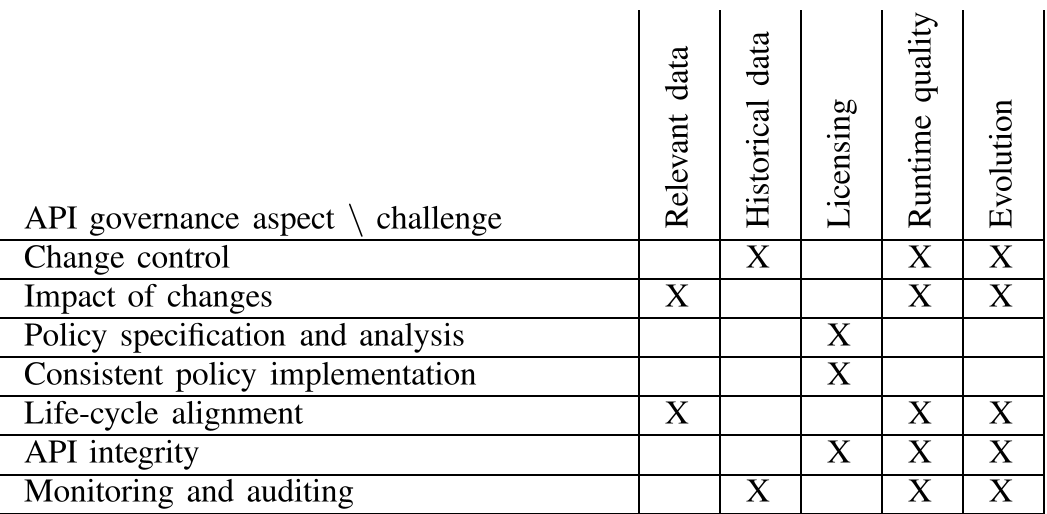
Key Aspects of the Proposed Model:
- Change Control & Impact Analysis: Ensuring that when an API version changes, the downstream AI models are notified or transitioned smoothly.
- API Integrity: Maintaining backward compatibility so that a model trained on version 1.0 doesn't produce "garbage" when 1.1 rolls out.
- Monitoring and Auditing: Crucial for "History." If governmental providers audit their own data, they can offer high-quality historical datasets as a standard feature.
Critical Analysis & Conclusion
Takeaway
The "intelligence" layer of the future depends entirely on the stability of the data layer. Without API Integrity and Life-cycle Alignment, building an AI startup on Open Data is like building a skyscraper on shifting sand.
Limitations
The paper is an experience report based on a specific (maritime) case. While the logic holds for most IoT/Transport domains, it may not perfectly account for the privacy-centric challenges in medical or financial Open Data (where GDPR/HIPAA adds another layer of complexity).
Future Outlook
We are likely to see a move toward GraphQL for data-science-ready APIs to solve the "Relevant Data" problem, and perhaps a standardization of "Open Data Licenses" similar to how the Creative Commons transformed the content industry. For researchers, the next frontier is building "API-Change-Aware" ML models that can automatically detect and adapt to schema updates.
Note: This report is based on the findings of Joutsenlahti et al. regarding the Finnish maritime cluster.