
The Chameleon Attack: How "Safe" Likes Can Be Weaponized Against You
8702_The Chameleon Attack Manipulating Content Display in Online Social Media.
This paper introduces the Chameleon Attack, a novel exploitation technique targeting major Online Social Networks (OSNs) like Facebook, Twitter, and LinkedIn. By leveraging link redirection and cached link previews, attackers can manipulate the displayed content of published posts and profiles without triggering "edited" notifications or losing social capital (likes/shares).
TL;DR
Researchers from Ben-Gurion University have uncovered a design flaw in how Facebook, Twitter, and LinkedIn handle Link Previews. The "Chameleon Attack" allows a post to "change its skin"—transforming from a benign video into extremist propaganda or a phishing link—after you’ve already liked or shared it, without any "Edited" label appearing.
The Illusion of Social Stability
We typically trust posts with thousands of likes or retweets. This "Social Capital" acts as a proxy for safety and quality. However, the Chameleon Attack breaks this trust by exploiting a gap between Content Delivery and Metadata Caching.
In most OSNs, when you post a link, the platform scrapes the website’s metadata (Title, Thumbnail, Description) and caches it. The authors discovered that by using redirection services (like Bitly or custom 301 redirects), an attacker can point a "matured" post to an entirely new destination and then force the OSN to refresh its cache.
Methodology: The Art of the Swap
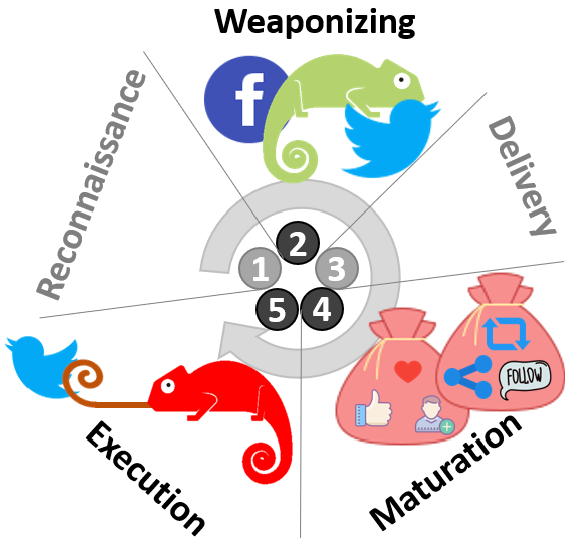
The attack follows a sophisticated 5-stage workflow:
- Weaponizing: Creating a redirection chain.
- Maturation: Posting a link to something universally liked (e.g., a trending sports highlight) to gather "social capital."
- Execution: Once the post has hundreds of likes, the attacker changes the redirect target to the "true" malicious content.
- Cache Refresh: Using tools provided by the platforms themselves (intended for developers) to update the preview image and text.
The result? Your timeline shows you liked a controversial political statement, even though you only ever clicked "Like" on a cute cat video.
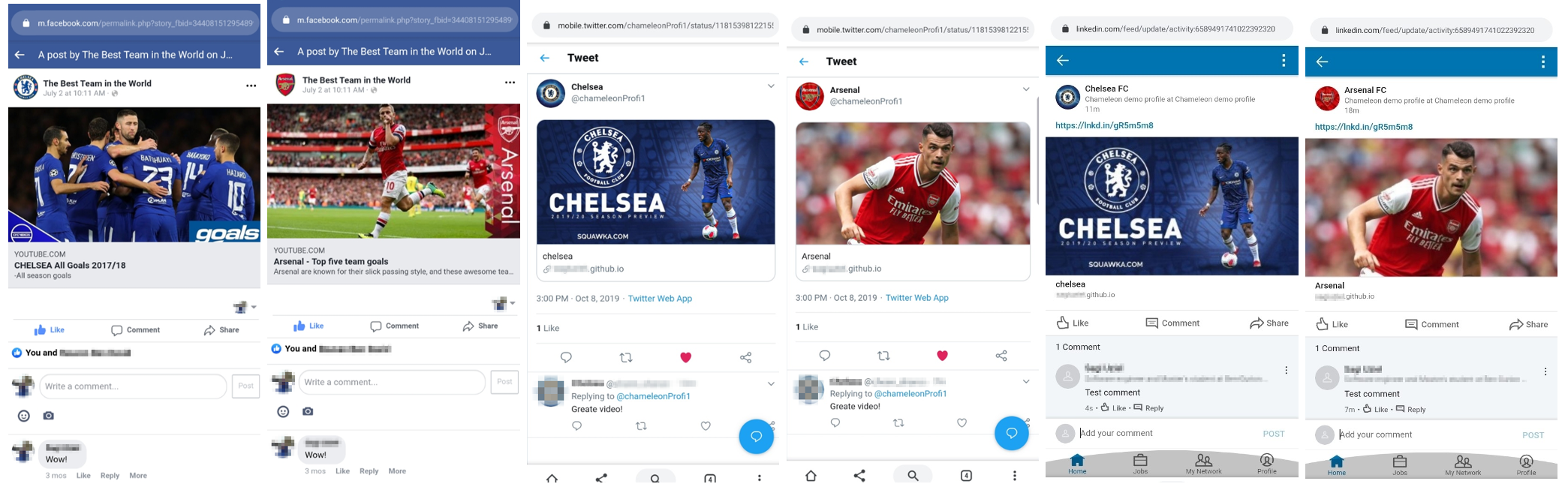 Figure: The same post on Facebook, Twitter, and LinkedIn, transformed while retaining engagement metrics.
Key Finding: Groups Are Defenseless
The researchers conducted a "Group Infiltration" experiment involving 96 Facebook groups. They used "Chameleon Pages" to bypass strict moderation.
- The Result: Moderators approved Chameleon pages at the same rate as genuine fan pages.
- The Danger: Once inside a private group as a "trusted" member, the Chameleon page can swap its entire history to spread misinformation or perform "shaming" attacks on other members.
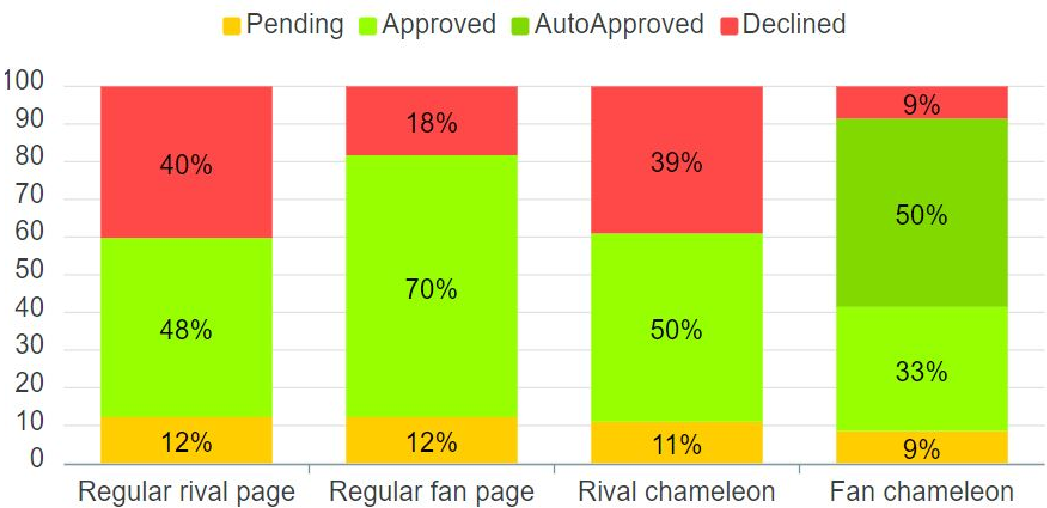 Figure: Smaller groups tend to be more selective, but even they fail to detect Chameleon profiles once the "skin" matches the group's agenda.
Critical Analysis & Future Outlook
The core of the issue is that Social Capital (Likes/Shares) is bound to a URL alias, not the content's hash.
Limitations of Current OSNs:
- Facebook: Shows edit history for text, but not for link preview updates in shared posts.
- Twitter/LinkedIn: Provide "Card Validators" and "Post Inspectors" that allow anyone to refresh a link's preview, potentially weaponizing even other people's posts.
- Resilient Platforms: WhatsApp and Instagram are largely immune because they either don't allow link updates (WhatsApp) or store images locally rather than relying on external link previews (Instagram).
Conclusion & Takeaway
The Chameleon attack represents a shift from "hacking the code" to "hacking the context." To fix this, OSNs must:
- Version Social Capital: A "Like" should be associated with the specific version/timestamp of a link preview.
- Mandatory Notifications: If a link preview changes, the post should be flagged as "Modified."
For users, the takeaway is simple: Be wary of profiles that use generic descriptions and frequent redirects. Your digital endorsement is a precious asset—don't let it be stolen by a chameleon.