
Beyond Smooth Trends: Decoding Spanish Climate Dynamics via Computational Intelligence
Characterization of climatic variations in Spain at the regional scale: A computational intelligence approach
The paper introduces a Computational Intelligence (CI) framework to characterize regional climatic variations in Spain (1901–2005). By employing Genetic Programming (GP), Differential Evolution, and Sammon mapping, the authors derive a scalar regional climatic index that outperforms traditional Principal Component Analysis (PCA) in interpretability and feature efficiency.
TL;DR
Researchers have moved beyond simple linear regressions to analyze a century (1901–2005) of Spanish maximum temperature data. By leveraging Genetic Programming (GP) and Hybrid Evolutionary Optimization, they discovered that the climate doesn't just "warm up" smoothly—it shifts in discrete, rhythmic "landmarks." The study successfully reduced complex 10-station spatial data into a single, highly interpretable scalar index that identifies these transition points with higher efficiency than traditional Principal Component Analysis (PCA).
Problem & Motivation: The Illusion of Linearity
Most climate change discussions focus on "global warming" as a continuous upward slope. However, climate at the regional scale is influenced by complex topographies and varying physical processes.
The authors identified two major roadblocks in existing research:
- Static Boundaries: Defining "homogeneous" regions based on politics or geography ignores the fluid nature of climate over decades.
- Linear Limitations: Methods like PCA assume linear relationships and require all data points, making them brittle when faced with the missing values (approx. 4.8%) common in historical records.
The motivation was to find an intrinsic dimensionality—a single "climate rhythm" for Spain—that could be expressed through a simple mathematical formula.
Methodology: The Hybrid Evolutionary Engine
The core of the methodology lies in Similarity-Preservation. The researchers didn't just want to compress data; they wanted the new "compressed" space to mirror the similarity structure of the original 10-D station data.
1. Hybrid Optimization (DE-FR)
To solve the non-linear Sammon Mapping (an error-minimization problem), the authors combined:
- Differential Evolution (DE): To explore the vast "landscape" of potential solutions and avoid local minima.
- Fletcher-Reeves (FR): A classical gradient-based method to fine-tune the solution once DE converged.
2. Genetic Programming (GP)
Unlike PCA, which produces a linear combination of all inputs, GP evolves "forests" of trees to find the best functional mapping. It searches for the simplest equation that minimizes information loss.
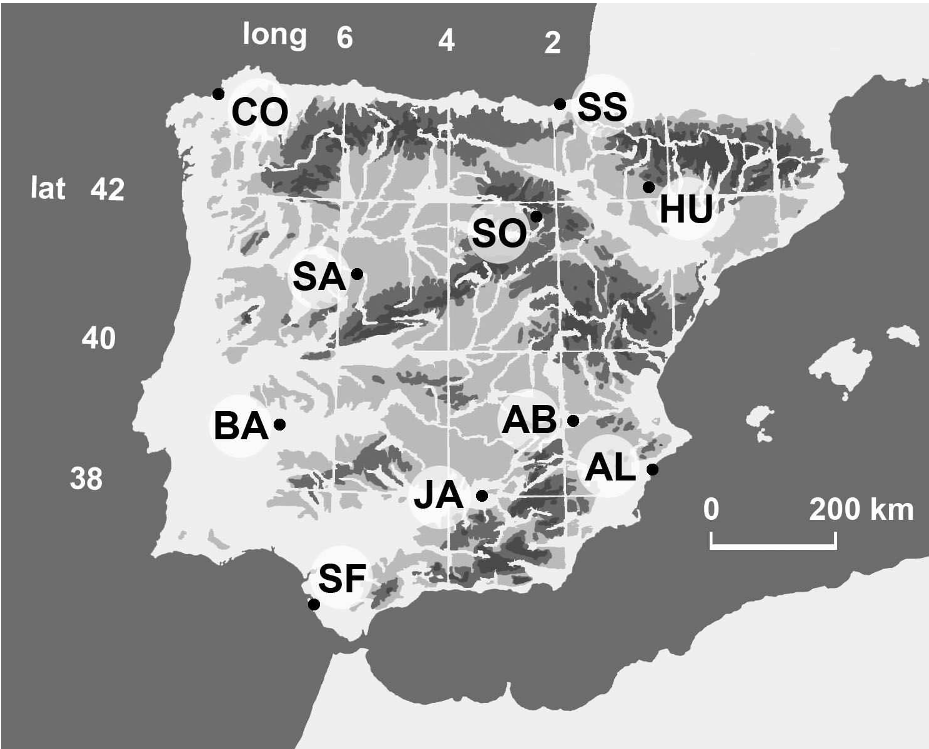 Fig 1: The 10 meteorological stations forming the 10-D input space for the model.
Experiments & Results: Discrete Shifts vs. Smooth Trends
The results challenged the "smooth warming" consensus. By analyzing the Kolmogorov-Smirnov (KS) dissimilarity of their derived index (), the authors identified clear clusters of years.
Key Findings:
- Intrinsic Dimension: Despite Spain’s diverse climates (Atlantic, Continental, Mediterranean), the data suggests the peninsula behaves largely as a single climatic region when viewed through maximum temperatures.
- Efficiency: The GP-derived equations (see below) achieved comparable Sammon errors to PCA but used only 60-70% of the sensors, effectively identifying the most "informative" geographic sites.
- Landmarks: Significant climate shifts were identified in years like 1911, 1920, and 1989. Note that 1936-1940 shifts were correctly identified as artifacts due to the Spanish Civil War, validating the model's sensitivity.
The GP-evolved scalar index: Simpler and more selective than PCA.
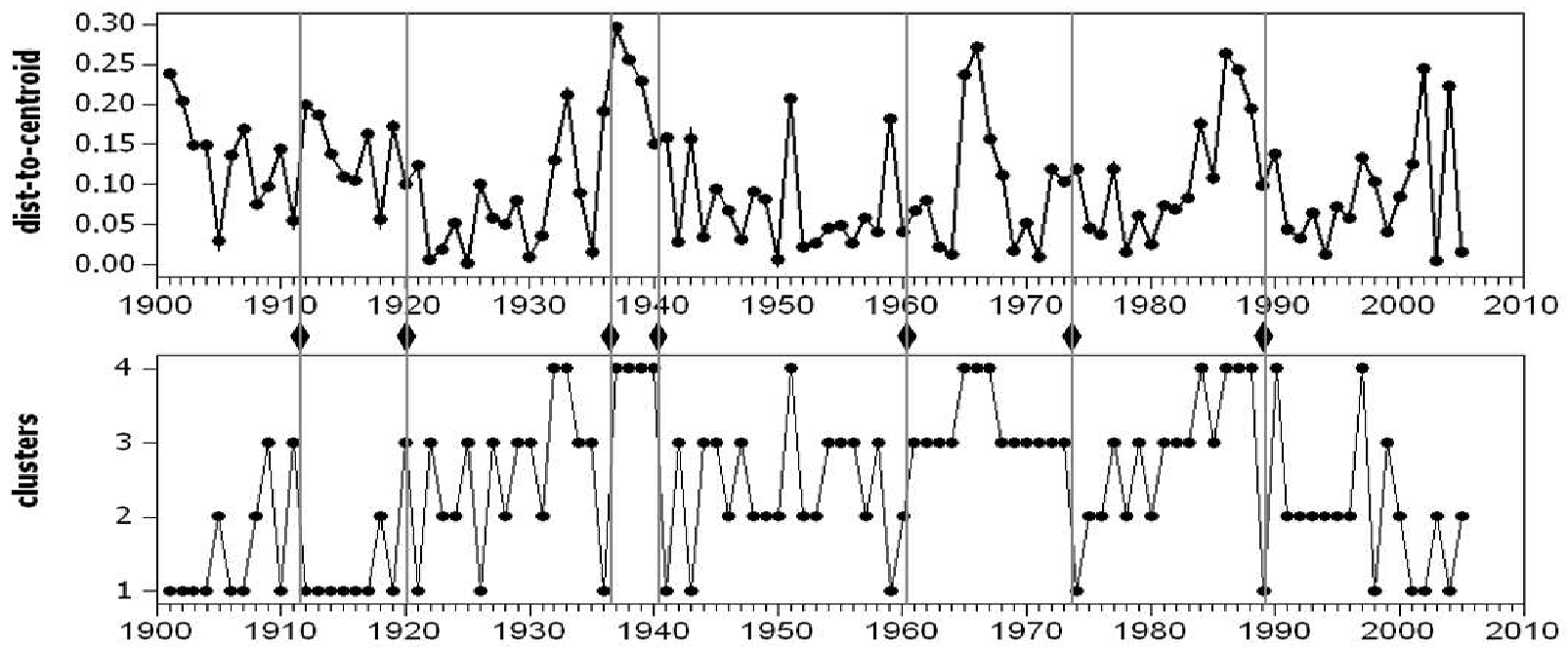 Fig 2: The behavior of the climatic index F over a century, showing discrete state transitions indicated by vertical lines.
Critical Insight & Conclusion
Takeaway
The study proves that Computational Intelligence can "see" through the noise of missing data and the bias of pre-defined regions. The Spanish climate rhythm is not a slide; it's a staircase. The ability of GP to select only the most relevant stations (Feature Selection + Generation) provides a blueprint for more cost-effective meteorological networks.
Limitations & Future Work
While successful, the study focused only on maximum temperatures. The authors acknowledge that a complete picture requires integrating minimum temperatures and precipitation. Future research should apply this "staircase" model to global datasets to see if these discrete rhythm changes are synchronous across the planet or unique to the Iberian Peninsula.