
Trusting the Crowd: Massive Vulnerabilities Discovered in Mobile Crowdsourcing Services
Characterizing Improper Input Validation Vulnerabilities of Mobile Crowdsourcing Services
This paper presents a systematic characterization of Improper Input Validation (IIV) vulnerabilities in 10 high-profile Mobile Crowdsourcing Services (MCS). Using a custom feedback-driven analysis framework, the researchers executed over 7,400 successful spoofing attacks across fitness, pricing, and safety domains, demonstrating that most services fail to validate basic semantic or range constraints of user-submitted data.
TL;DR
Researchers have exposed a fundamental security flaw in the DNA of popular mobile crowdsourcing services (MCS) like Strava, Transit, and Ring. By simply "trusting the client," these services allow attackers to inject supernatural fitness data, fake supersonic buses, and plausible but false crime reports. This systematic study reveals that Improper Input Validation (IIV) is not just a bug, but a widespread architectural epidemic across the MCS landscape.
The "Trusting the Client" Fallacy
Mobile Crowdsourcing Services (MCS) power our world—from Google Maps' traffic predictions to health insurance premiums linked to Fitbit data. However, the industry has long operated on the dangerous assumption that the data coming from a mobile app is genuine.
While legendary hacks (like the artist who dragged 100 phones in a wagon to create a fake traffic jam on Google Maps) showed the possibility of manipulation, this paper proves the scalability of it. The authors argue that the root cause is a lack of Improper Input Validation (IIV). If an app tells a server a human is running at Mach 12, the server should probably ask questions. Currently, it doesn't.
Methodology: The Feedback-Driven Analysis Framework
The authors didn't just manually poke at apps; they built a sophisticated "fuzzing" engine for the physical world. The framework targets three layers of the mobile stack:
- Network APIs: Bypassing SSL pinning via Frida to talk directly to the backend.
- User Interface (UI): Using record-and-replay tools (Appium/UIAutomator) to simulate human input.
- Sensors: Feeding fake GPS coordinates directly into the Android emulator's location provider.
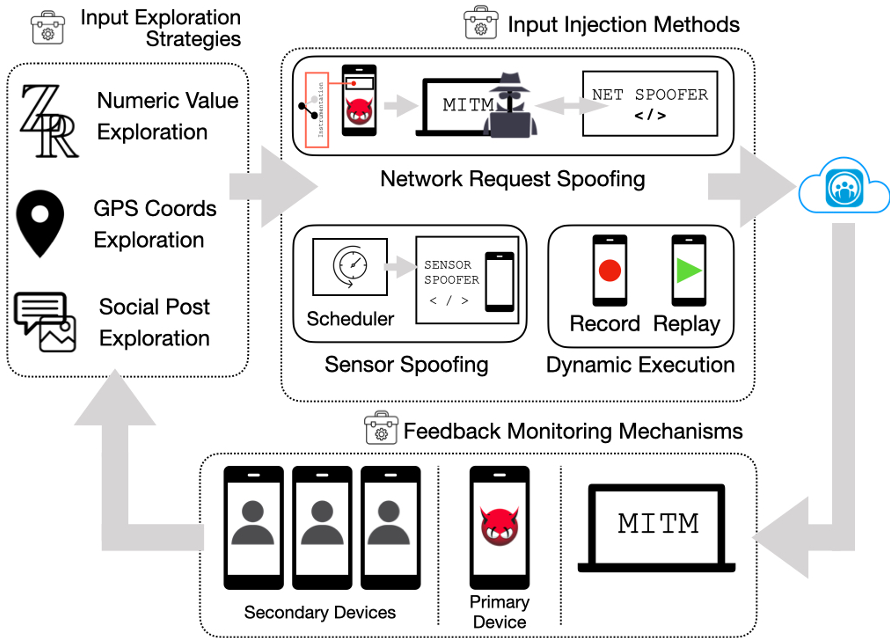
To find the boundaries of what the servers would accept, they used Numeric Value Exploration (NVE)—a hybrid geometric/linear growth strategy that quickly identifies the maximum "distance" or "speed" a service will store before rejecting a request.
Key Findings: Breaking the Laws of Physics
The results are both impressive and alarming. By exploiting IIV, the researchers achieved the following:
1. Fitness Services (Strava, Fitbit, MapMyRun)
- The Flash/Superman Feat: On Strava, the team successfully faked a run covering 50,000 km in 3.5 hours (14,285 km/h).
- Incentive Fraud: Such vulnerabilities allow users to unfairly win challenges and even potentially manipulate health insurance premiums that rely on fitness tracking.
2. Transportation & Safety (Transit, Neighbors by Ring)
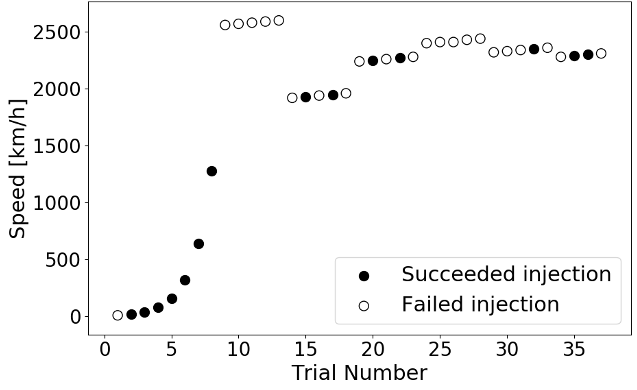
- Supersonic Transit: The app "Transit" was fooled into displaying a bus moving at 2,350 km/h. This wasn't just a local display error; the fake bus appeared on other users' devices, potentially ruining commute planning for thousands.
- AI-Generated Panic: Using GPT-2, the team generated fake reports of gunshots and robberies. When paired with a relevant (but fake) image, these reports had an 80% approval rate by Ring's "Neighbors" service.
Why Does This Work? (The SOTA Comparison)
Most modern MCS rely on Majority Voting or Reputation Systems to weed out bad data. However, as this paper points out:
- Cold Start Problem: Reputation doesn't exist for new accounts, which can still inject high-impact poison data immediately.
- Real-time Constraints: In services like Transit, you can't wait for a "majority" to confirm a bus's location; the data must be live, which creates an opening for attackers.
Critical Insight & Recommendations
The most striking takeaway is how easy the fix is. The authors demonstrated that simple backend constraints (e.g., "No human can run faster than the world record") could reduce the attack surface by over 99%.

The Industry Mandate:
- Geofencing: Location-based reports should be validated against road segments or logical bounds (no restrooms in the middle of the Atlantic).
- Semantic Sanity: Use ML models not just to see if a post looks like English, but if it describes a physical impossibility given the user's sensor context.
- Backend-First Security: Never trust client-side validation. If the validation only happens in the app code, it doesn't exist.
Conclusion
This study serves as a wake-up call for the "Smart City" era. As we move toward autonomous systems that rely on crowdsourced data for navigation and safety, the cost of an Improper Input Validation vulnerability moves from "annoying" to "deadly."