
Characterizing Information Diffusion: A Physics-Inspired Linear PDE Approach
Characterizing Information Diffusion in Online Social Networks with Linear Diffusive Model
The paper proposes the "Linear Diffusive Model" (LDM), a spatio-temporal mathematical framework based on Partial Differential Equations (PDEs) to characterize information spreading in online social networks. Using the Digg dataset, it achieves state-of-the-art accuracy, specifically reaching 97.41% precision for highly popular news stories by modeling user interest decay and spatial population heterogeneity.
TL;DR
Researchers have developed a Linear Diffusive Model (LDM) based on Partial Differential Equations to predict how news travels across both time and social distance. By treating information spread like a biological invasion, the model achieves up to 97.41% accuracy in describing how news stories go viral on platforms like Digg.
Background: Beyond the Time Dimension
Most existing studies ask: "How many votes will a story get in 5 hours?" (Temporal). This paper asks a much harder spatio-temporal question: "At time , what is the density of influenced users at exactly hops away from the source?"
The authors argue that understanding the "spatial" aspect—the social distance—is the key to unlocking the underlying structure of influence in social networks.
The Problem: The Complexity of Social Networks
Human interactions are messy and heterogeneous. Prior attempts, such as the diffusive logistic model, were a step in the right direction but were often too complex or inflexible. The authors identified two critical regularities that these models missed:
- Spatial Heterogeneity: Most of your "neighbors" aren't your direct friends; they are often 3 or 4 hops away.
- Temporal Decay: Interest in news doesn't just stop; it decays exponentially.
Methodology: The Linear Diffusive Model (LDM)
The core of the paper is a Linear PDE that combines a Social Process (how information moves between groups) and a Growth Process (how it spreads within a group).
1. The Mathematical Framework
The model is expressed as:
- (Social Capability): Represents the fluid-like spread across friendship links.
- (News Decay): An exponential function capturing how interest fades.
- (Spatial Power): A quadratic function describing the density of users at distance .
2. Architecture and Data Flow
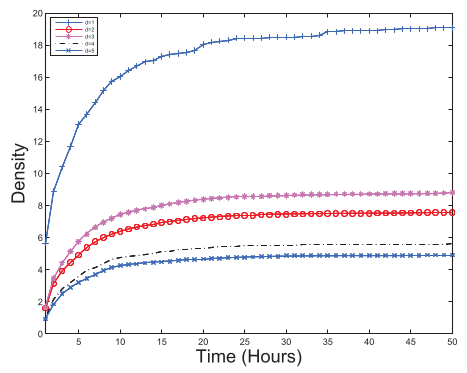 The figure above illustrates consistent density evolution across distances 1 to 5. Notice how the density at Hop 1 (direct friends) is always higher, confirming that friendship is the primary conduit for information.
Experiments and Results
The authors validated the LDM using 3,553 news stories from Digg.
Case Study: The Viral Outbreak
For the most popular news story (24,099 votes), the LDM achieved a staggering 97.41% accuracy.
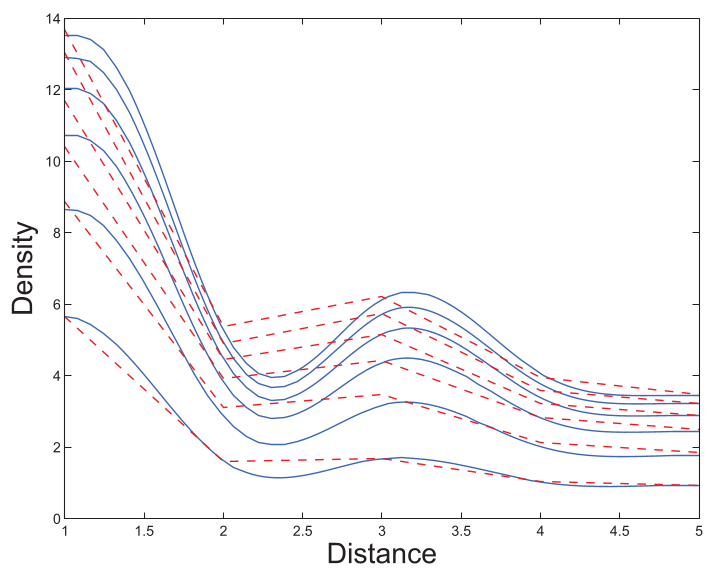 In this comparison, the solid blue lines (Model) almost perfectly overlap with the dotted red lines (Actual Data), demonstrating the model's high fidelity.
The "Influential Submitter" Effect
An interesting discovery was the correlation between the submitter's followers and predictability. News started by users with over 2,000 followers followed consistent patterns and were significantly easier to predict (always >80% accuracy) than those started by "average" users.
Critical Insights: Finding Super Spreaders
Perhaps the most impactful application of this model is its ability to locate Super Spreaders. By analyzing the peak of the spatial function , researchers found that the highest "growth power" for popular stories often occurred at Distance 4, rather than the expected Distance 3 (where population is highest). This suggests that highly influential users often sit at specific "social shells" relative to the source.
Conclusion
The Linear Diffusive Model provides a simpler, more accurate alternative to non-linear models for tracking social media cascades. While it excels at modeling news initiated by influential sources, the next challenge lies in predicting the "black swan" events—the low-follower stories that occasionally explode into the mainstream.
Future Outlook: Scaling this model to real-time platforms like Twitter or TikTok could allow for the early detection of viral trends and more effective identification of misinformation sources.