
The Silent Network: How Deaf Communities Rewrote the Rules of Orkut
Characterizing Interactions among Members of Deaf Communities in Orkut
This paper presents a sociotechnical characterization of deaf communities on Orkut, a once-dominant social network in Brazil. Using a combination of network topology analysis and the Semiotic Inspection Method (SIM), the authors demonstrate that deaf users form significantly tighter, more connected friendship clusters compared to other social groups, despite interface barriers.
TL;DR
While we often assume social media is "accessible" because it lacks audio, this research reveals a deeper linguistic divide. By analyzing the Brazilian social network Orkut, researchers found that deaf users form much tighter social bonds than hearing users (higher connectivity), yet they are forced to "hack" the system—using personal "scraps" and visual media—because official community tools are too text-dependent.
Background Positioning
This work sits at the intersection of Social Network Analysis (SNA) and Human-Computer Interaction (HCI). It moves beyond generic accessibility (can they see the button?) to Cultural-Linguistic Accessibility (does the interface respect their primary language, Sign Language?).
Problem & Motivation: The Textual Barrier
For the deaf community, written Portuguese or English is often a second language; the first is a visual/spatial Sign Language (like LIBRAS in Brazil). Most social networks of the 2010 era (like Orkut) were built on the assumption that text is the universal "default."
The authors hypothesized that:
- Deaf users would seek "homophily by selection"—connecting deeply with those sharing the same "immutable" traits.
- The lack of visual communication tools in forums would stifle formal community interaction.
Methodology: Measuring Silence
The study compared 14 deaf communities against control groups (homosexual, family, and random). They used:
- Friendship Network Analysis: Mapping how many "friends" a user has within a community vs. their total network.
- Semiotic Inspection Method (SIM): A theoretical lens to see if the "message" the designer intended (e.g., "use this forum for discussion") was actually what users received.
Architecture of Connectivity
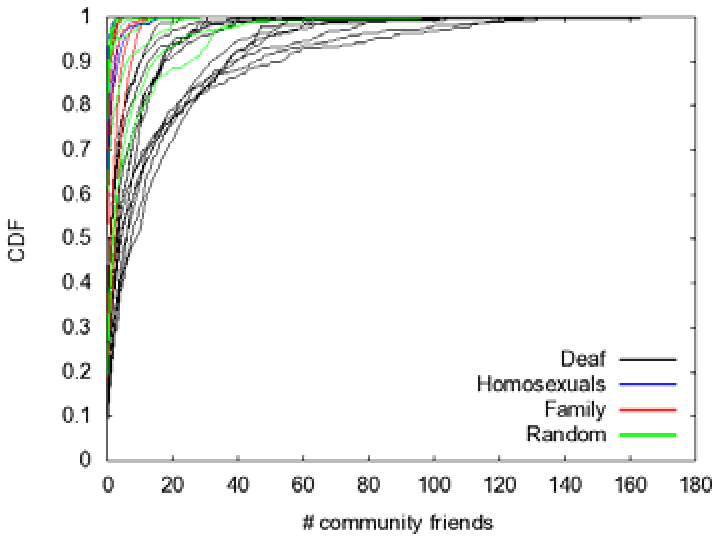 Figure 1: The Curves of Connection. The slower growth of the "Deaf" curves (shown in the paper's CDFs) indicates a higher concentration of friends within the community.
Key Insights from results
The quantitative data was startling. As shown in the graph below, the rate of "internal friends" is significantly higher for deaf users.
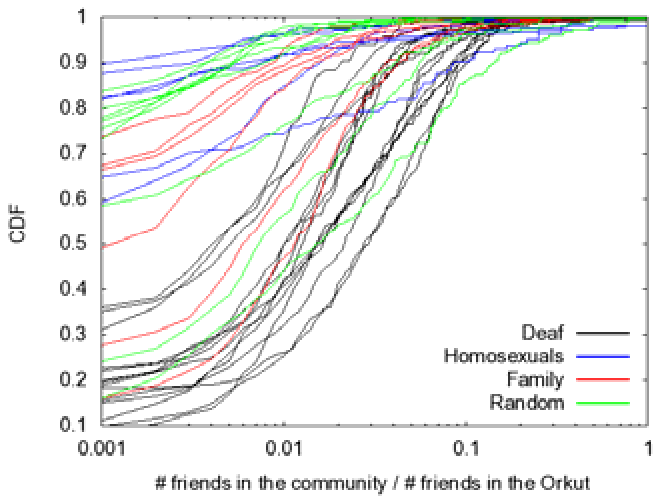 Figure 2: The "Tighter Clusters" phenomenon. Deaf users (the leftmost/slowest rising curves) show a much higher percentage of shared community friendships.
The Paradox of Interaction: Despite these tight bonds, the "Forums" and "Events" sections were ghost towns. Why?
- Text Overhead: Forums were text-only. For a deaf user, writing long paragraphs in an oral language is a high-effort task.
- Visual Bypass: Users migrated to "Scraps" (personal walls) where they could post animations, short sentences, and videos.
- Spam Neglect: Interestingly, deaf users often left long spam messages on their profiles—not because they liked them, but because the "long-form text" was essentially white noise that they didn't bother to parse or delete.
Critical Analysis & Conclusion
This paper proves that social cohesion does not guarantee tool adoption.
Takeaway: Designers cannot assume that a "tight-knit" community will automatically use the tools provided. If the tool (Text Forums) contradicts the community's primary mode of expression (Visual Sign), the community will either bypass the tool or seek new platforms.
Limitations: The study was limited to Orkut (now defunct) and a specific Brazilian context. However, the core insight—that we must design for "Visual First" communication for deaf users—remains a foundational principle for modern accessibility in the age of TikTok and Instagram.
Future Outlook: As we move toward VR and AR (the Metaverse), the opportunity to support native Sign Language through motion capture and video-first interaction offers a chance to finally build the "accessible" spaces Orkut failed to provide.