
Beyond Star Ratings: Decoding the Multifaceted Nature of Educational Web Quality
Characterizing and Predicting the Multifaceted Nature of ality in Educational Web Resources
The paper presents a four-step methodology (meta-analysis, expert study, human annotation, and machine learning) to characterize and predict quality in educational Web resources. Using SVM classifiers with content (N-grams) and link (PageRank) features, the authors developed models that accurately identify multifaceted quality indicators like "source authority" and "pedagogical support" across different digital library contexts.
TL;DR
Assessing the quality of educational content online is notoriously difficult because "quality" means different things to a librarian than it does to a 9th-grade teacher. This research introduces a systematic framework to break down quality into predictable indicators—such as source authority and pedagogical guidance—using Machine Learning. By transitioning from a single "quality score" to a multifaceted prediction model, the authors achieved an error reduction of over 50% compared to traditional baselines.
The "Quality" Dilemma: Why One Size Doesn't Fit All
When searching for a science video, a curator might look for scientific accuracy and reputation of the publisher, whereas a teacher in a time crunch might prioritize clear instructions and alignment with grade-level standards.
Previous attempts to automate this process often fell into two traps:
- The Length Bias: Predicting quality based on word count (commonly seen in early Wikipedia quality studies).
- Low Agreement: Asking humans to rate "overall quality" often results in wild disagreements because their underlying criteria remain implicit.
Methodology: Engineering Subjectivity into Data
The authors propose a "Human-Centered" methodology to transform subjective expert intuition into objective computational features.
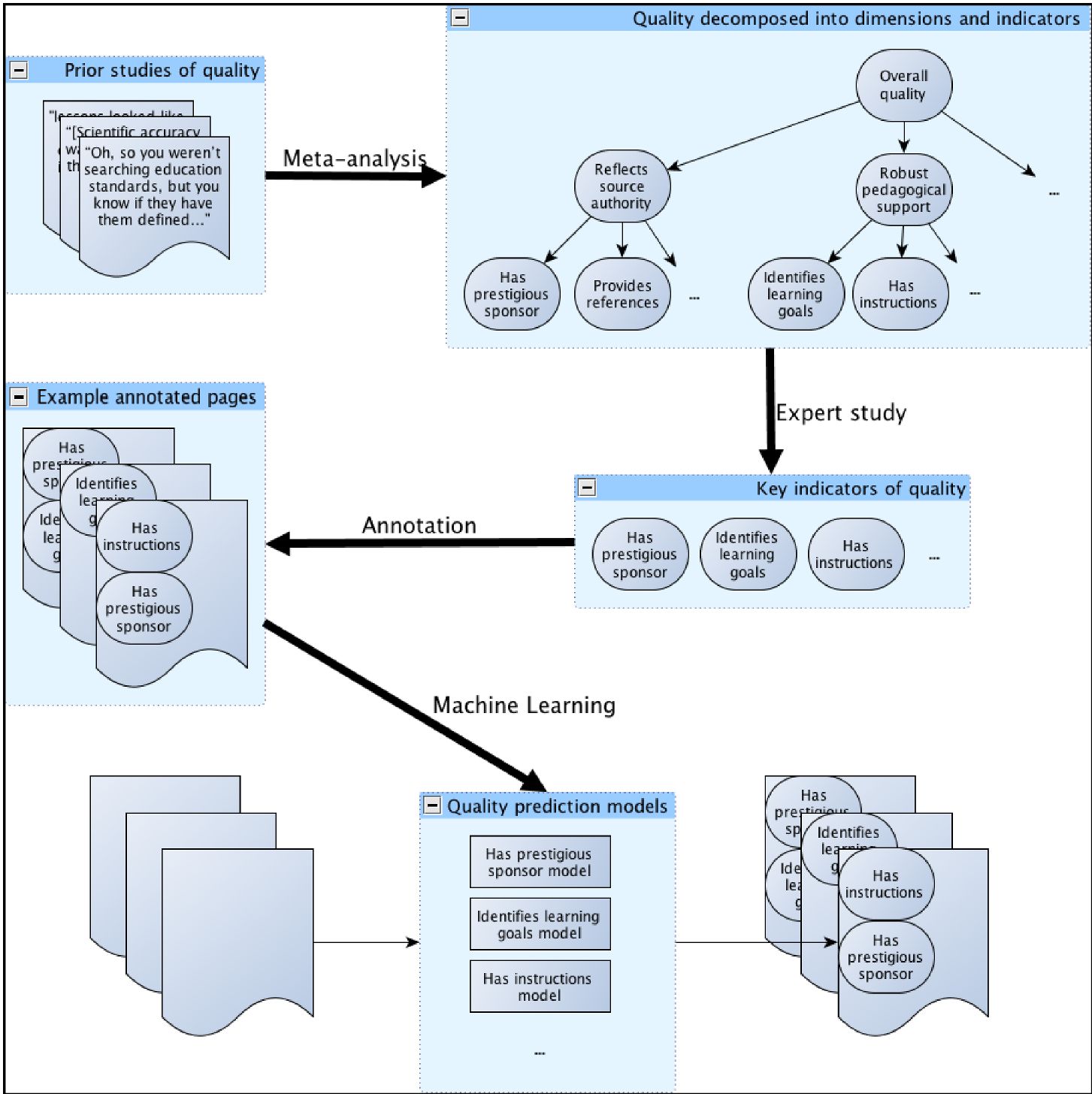
The workflow follows four rigorous steps:
- Meta-Analysis: Analyzing 25 dimensions of quality from prior educational research.
- Expert Study: Identifying the 7 "Golden Indicators" that actually correlate with a resource being accepted into a high-quality library (e.g., "Has Prestigious Sponsor," "Identifies Learning Goals").
- Human Annotation: Building a ground-truth dataset where indicators are labeled as present/absent.
- Machine Learning: Training Support Vector Machines (SVMs) to "see" these indicators.
Technical Deep Dive: What Makes a Model "Smart"?
The researchers didn't just look at words; they looked at the context and connectivity of the resource.
1. The Feature Set
- N-Grams (Bag-of-Bigrams): This was the MVP of the study. While simple words (unigrams) are okay, bigrams (pairs of words) are far better at capturing pedagogical cues like "Students will..." or "After completing..."
- Link Authority: Using Google PageRank and Alexa TrafficRank to identify if a resource is linked to by reputable institutions (e.g., NASA or NOAA).
- URL Structure: Analyzing the domain (.edu vs .com) to infer credibility.
2. Experimental Results
The model's performance on the DLESE (Digital Library for Earth System Education) dataset was impressive. For indicators like "Identifies Learning Goals," the model achieved 90.1% accuracy.
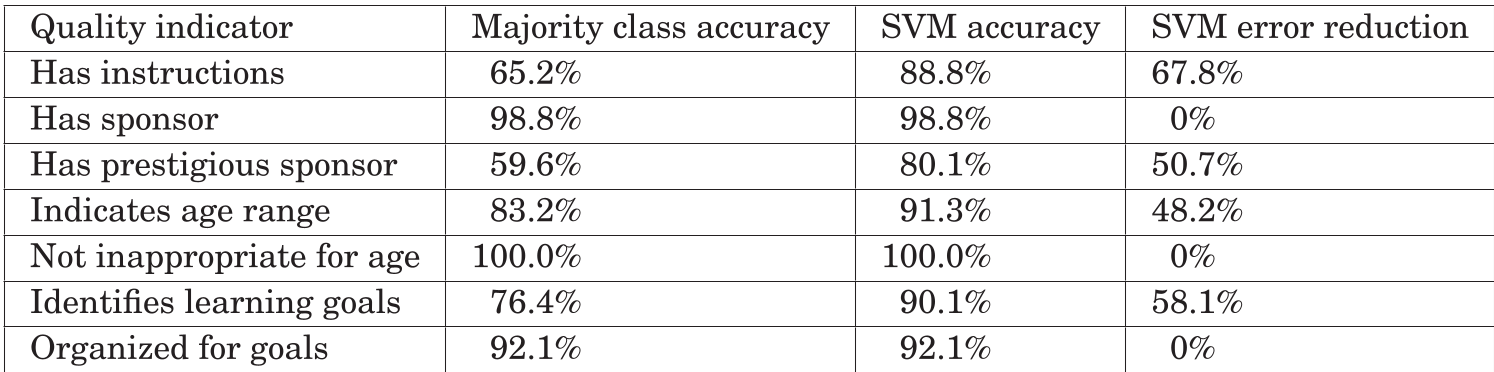
Interestingly, the study found that link features were critical for identifying "Prestigious Sponsors," while textual bigrams were essential for identifying "Instructions" and "Learning Goals."
Domain Generalization: Can we use the same model everywhere?
A key contribution of this work was testing the model's portability. The authors applied the DLESE-trained model to the Instructional Architect (IA)—a platform for teacher-generated content.
- The Good News: The methodology (the way we build the models) is universal.
- The Reality Check: The specific models are not. A model trained on Earth Science doesn't automatically understand "quality" in a different domain because the vocabulary of quality changes. This highlights the need for domain-specific "fine-tuning" (a precursor to modern transfer learning concepts).
Future Outlook: Faceted Search as a Service
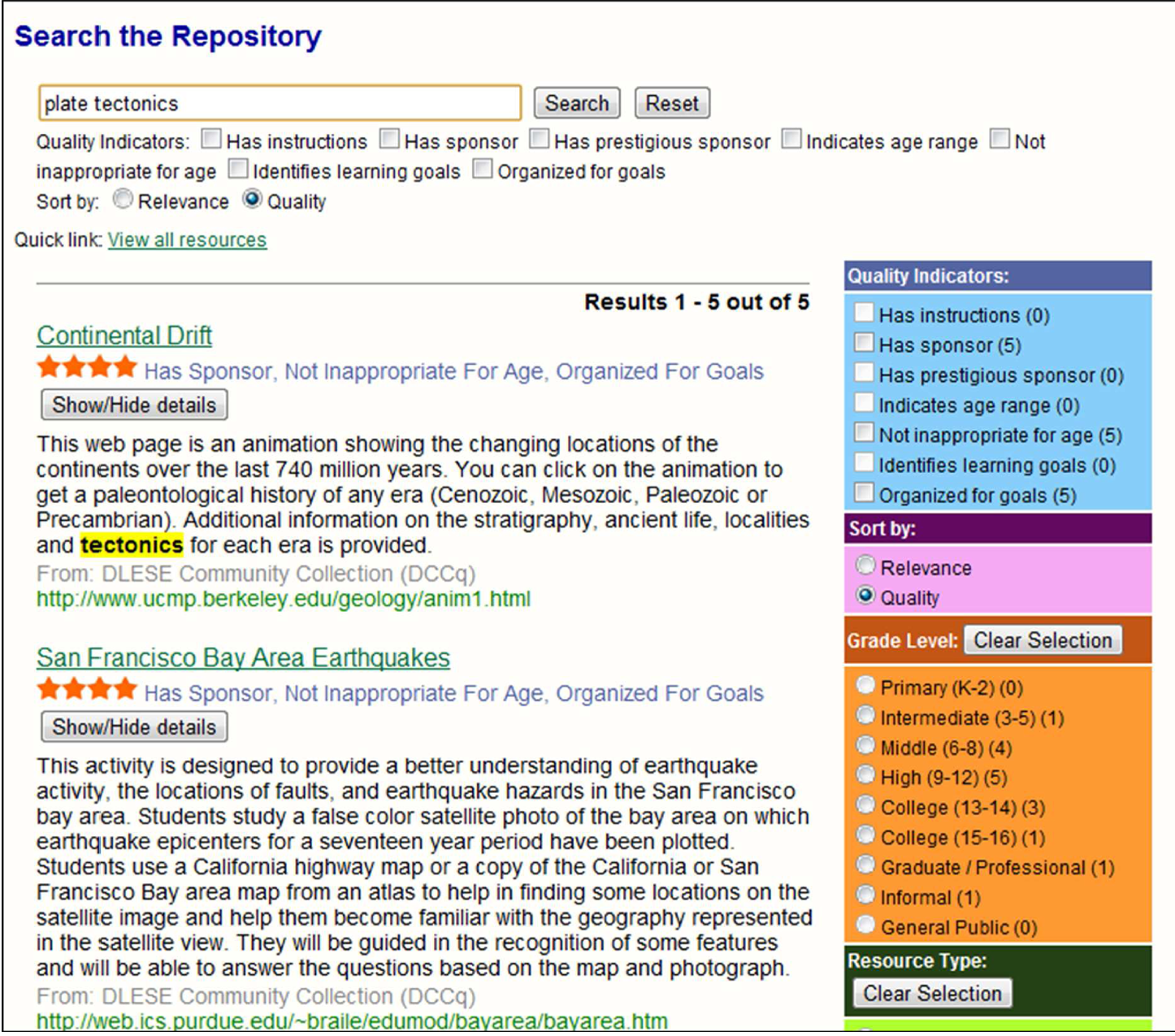
The ultimate vision of this research is a Quality-Aware Search Engine. Instead of a black-box ranking algorithm, the authors designed a UI where educators can toggle filters like "High Pedagogical Support" or "Age Appropriate."
Conclusion & Key Takeaways
- Quality is Multifaceted: Automated systems should provide a suite of indicators rather than a single score.
- Expert Knowledge is Scalable: By decomposing expert judgment into low-level indicators, we can train machines to replicate high-level curation tasks.
- Context Matters: While the features (bigrams, links) are consistent across the Web, the weights we assign them must be tailored to the specific educational community being served.