
Characterizing Social Cascades: Why Content Is More Infectious Than Disease
Characterizing social cascades in flickr
This seminal paper characterizes "social cascades" in Flickr by analyzing how 1,000 popular photos propagate through its social network. Leveraging an epidemiological framework, the authors quantify the infection rates of digital content, demonstrating that social links are a primary driver for content discovery with some photos reaching a reproduction number (R0) as high as 190.
TL;DR
This research provides an empirical deep-dive into how photos go "viral" on Flickr. By viewing content sharing through the lens of epidemiology, the authors prove that social links are the backbone of discovery. They found that popular digital content can be ten times more infectious than the most contagious human diseases, with social links facilitating rapid, multi-step "cascades."
The "Why": Beyond the Popularity Tab
In the mid-2000s, the "magic" of virality was often attributed to luck or mysterious algorithms. Most researchers viewed popularity as a monolithic metric. However, the authors of this paper noticed a discrepancy: some photos showed steady, organic growth, while others had massive, sudden spikes.
They hypothesized that there are two distinct mechanisms at play:
- Exogenous Factors: Being featured on the front page or linked from an external blog.
- Endogenous Cascades: Information flowing through the "friendship" or "contact" links of the social network itself.
The core motivation was to prove—and quantify—that the social graph is a living, breathing transmission medium.
Methodology: Photos as Pathogens
The researchers tracked 1,000 popular photos and over 2.5 million users. They defined a Social Cascade using a strict temporal-logic constraint: User A only "caught" the photo from User B if B was already a fan AND they were contacts before A bookmarked the photo.
The Epidemiological Framework
The study adopts the formula for the Basic Reproduction Number (): Where is the transmission probability and is the node degree.
This formula reveals a critical insight: In networks with high heterogeneity (where a few "super-spreaders" have thousands of contacts), the explodes. Even a mediocre photo can go viral if it hits the right hub.
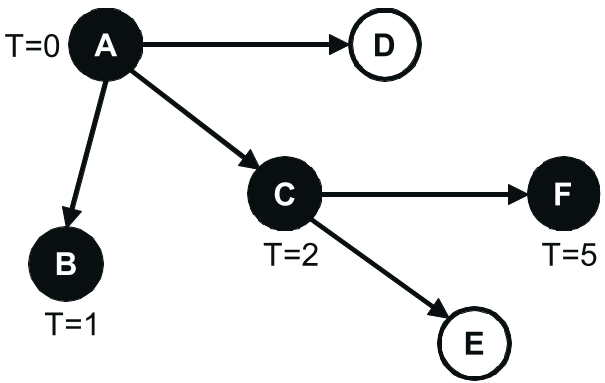 In this model, black nodes represent "infected" users who have bookmarked the photo, passing the "virus" to their susceptible contacts.
Key Insights from the Data
1. Speed of Infection
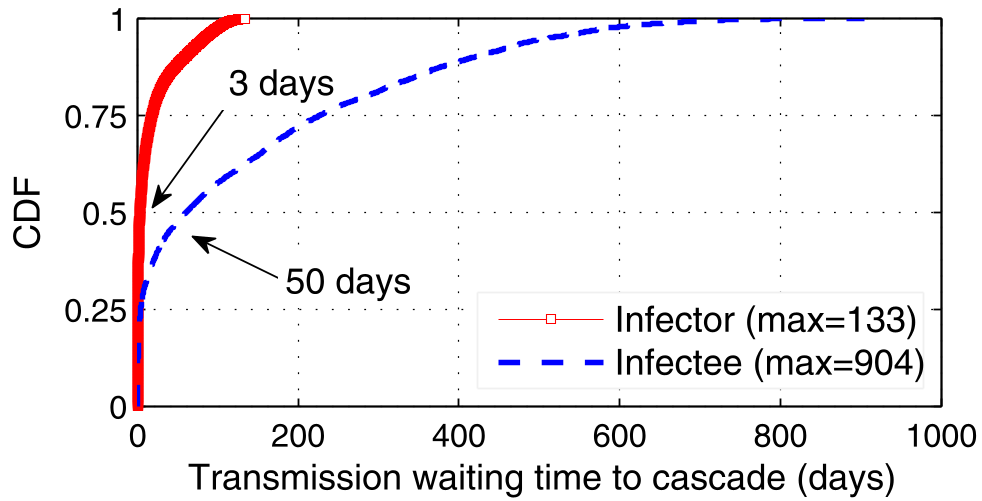
The study found two different "clocks" in a cascade:
- The Initial Spark: The time to the first person catching the virus is fast (50% within 3 days).
- The Long Tail: Subsequent social spreading takes longer, sometimes months, as it moves through the "dormant" parts of the social graph.
2. The Power of Multiple Exposures
Unlike a biological virus where one contact might be enough, social content often requires "reinforcement." The study found that while 35% of people bookmark a photo after one friend shows it, nearly 45% require 3 or more friends to "infect" them before they take action.
3. : More Contagious than Measles
The most striking result is the values. While Measles—one of the most infectious human diseases—has an of 12-18, Flickr photos reached values up to 190. This explains why "going viral" happens at speeds and scales that biological systems rarely achieve.
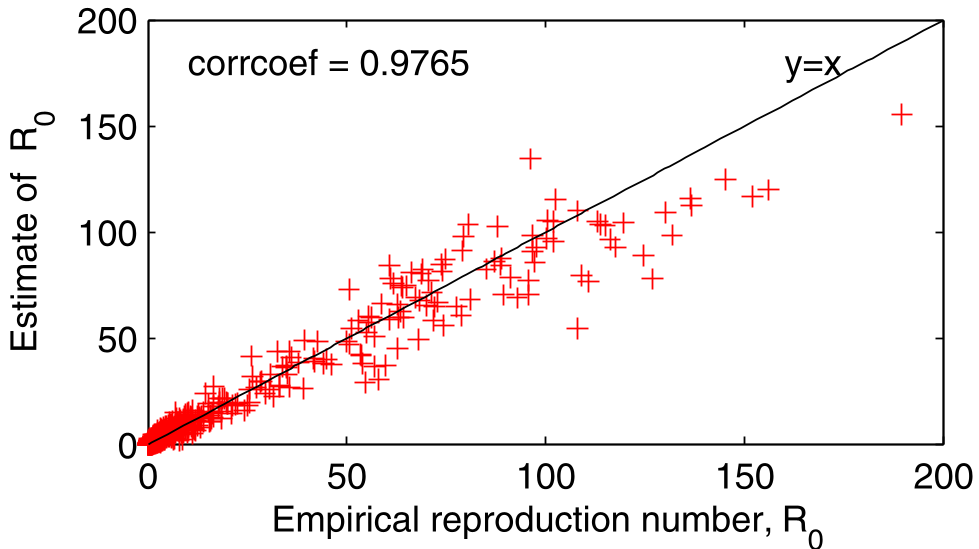 The high correlation (0.97) between the predicted and actual traces proves that the epidemiological model is a valid tool for social media analysis.
Critical Analysis & Takeaways
Impact: This paper moved social media analysis from "counting likes" to "modeling flows." It provided a mathematical basis for viral marketing, showing that the structure of the network (the variance in degree ) is just as important as the quality of the content.
Limitations:
- The study primarily focuses on popular content. Unpopular content likely has an , causing it to die out quickly.
- It assumes users stay "infected" forever, whereas modern "feed" culture means we "recover" (forget) content in minutes.
Future Outlook: In the age of TikTok and AI-driven feeds, the "Social Cascade" is being supplemented by "Algorithmic Cascades." However, the fundamental math of remains the gold standard for understanding how ideas, whether they are photos or political movements, saturate a population.