
Decoding the Social Pulse: A Deep Dive into User Activity Groups in OSNs
Characterizing User Groups in Online Social Networks
This paper performs a large-scale measurement study of user activity across four major Online Social Networks (OSNs): MySpace, Bebo, Skyrock, and Flixster. Using over 200 PlanetLab nodes to monitor 3,000 users over three weeks, the authors classify users into distinct behavioral clusters and achieve SOTA insights into session dynamics and sign-out patterns.
TL;DR
This research provides a rare, empirical look into the "invisible" habits of social media users. By monitoring thousands of profiles across MySpace, Bebo, Flixster, and Skyrock on a minute-by-minute basis, the authors reveal that social networks are composed of highly distinct behavioral clusters. From "Heavy Users" who live on the platform to "Ghost Users" who barely visit, this study quantifies the engagement metrics that define OSN success.
Background: Beyond Graph Theory
For years, academic interest in Online Social Networks (OSNs) focused on topology—how many friends a user has or how many "degrees of separation" exist between strangers. While mathematically elegant, these studies missed the temporal dimension: When are people actually online, and for how long?
Understanding "sojourn time" (uptime) and login frequency is the holy grail for advertisers and developers, yet this data is usually locked in the private databases of tech giants. This paper breaks that seal using a distributed measurement framework.
The PlanetLab Framework
To capture high-resolution data without being blocked, the researchers deployed scripts across 212 PlanetLab nodes globally. By sampling the "online status" of 3,000 users every 60 seconds, they processed over 100 million pages.
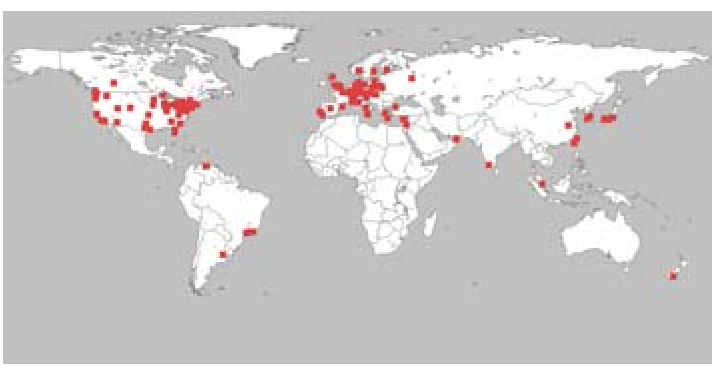 Figure 1: The distributed topology of PlanetLab nodes used to monitor user status across the globe.
Methodology: The Geometry of Engagement
The core of the paper lies in its clustering analysis. Using the TwoStep clustering algorithm, the authors categorized MySpace and Bebo users into eight distinct groups based on:
- Uptime (Mean/Median): How long a single session lasts.
- Downtime: The gap between sessions.
- Login Frequency: How often they return per week.
The "Physical Intuition" here is that user behavior isn't a bell curve; it's a fractured landscape.
Key Cluster Insights:
- Cluster 1 (The Addicts): Extreme login frequency (327+ per period) and very short downtimes.
- Cluster 2 (The Socialites): Highest friend counts (~450) and long uptimes.
- Cluster 5/6 (The Casuals): Check the site roughly once a week, often with high variance in what they do.
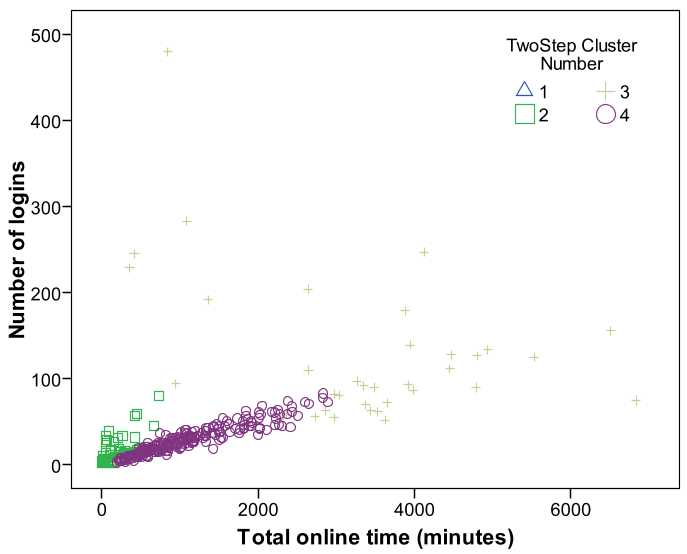 Figure 2: Visualization of user groups based on Uptime and Downtime. Note the separation between high-frequency users and occasional visitors.
The "Dirty" Secret of Sign-Outs
One of the most fascinating technical insights in the paper involves the Sign-Out Prediction. By comparing the median uptime of a user to the known server timeout of the platform (e.g., 20 minutes for MySpace), the authors could identify "lazy" users.
If a user’s session length consistently hits exactly 20 minutes, they aren't using the site for 20 minutes—they likely closed the tab after 30 seconds. The study found that >25% of users never actually click "Sign Out," which poses significant session-hijacking risks and skews engagement data for advertisers.
Comparative Results
| Metric | MySpace | Bebo | Flixster | Skyrock |
|---|---|---|---|---|
| Daily Usage (min) | 33.84 | 27.26 | 17.26 | 2.29 |
| Avg. Uptime (min) | 11.58 | 28.15 | 18.20 | 9.17 |
| Avg. Downtime (days) | 0.33 | 1.01 | 1.04 | 3.98 |
The data suggests MySpace was the "stickiest" platform of its era, characterized by high-frequency, short-burst sessions, whereas Bebo users stayed longer once they actually logged in.
Critical Analysis & Conclusion
Takeaway
The value of an OSN isn't just in its user count, but in the cluster distribution of its population. A platform with 1 million "Cluster 1" users is significantly more valuable (and computationally expensive to maintain) than one with 10 million "Cluster 6" users.
Limitations
The study relies on "Public Profiles." In the modern era of GDPR and strict privacy settings, this methodology would face significant hurdles. Furthermore, the 1-minute sampling interval might miss "micro-sessions" that are increasingly common in the mobile app era.
Future Outlook
As we move toward decentralized social media (Web3) and Fediverse platforms, understanding these behavioral clusters will be vital for managing server load and designing incentive mechanisms that prevent "user churn."