
Debunking the Myths of Pediatric RF Exposure: A Technical Deep Dive into SAR Dosimetry
Response to “Children Absorb Higher Doses of Radio Frequency Electromagnetic Radiation From Mobile Phones Than Adults” and “Yes the Children Are More Exposed to Radiofrequency Energy From Mobile Telephones Than Adults”
This paper serves as a formal rebuttal to critiques regarding the authors' 2014 review on mobile phone radiation. It clarifies that while kids show higher Peak Spatial Average Specific Absorption Rate (psSAR) specifically in the brain due to smaller head size, they do not exhibit significantly higher psSAR for the head as a whole, which is the metric used for regulatory compliance.
TL;DR
In this definitive response, Kenneth Foster and Chung-Kwang Chou address a long-standing academic and public debate: Do children absorb more radiation from mobile phones? The answer is nuanced. While children’s brain tissue absorbs a higher peak dose due to smaller cranial dimensions, their total head exposure (the regulatory standard) is comparable to adults. Crucially, the authors demonstrate that standard safety "phantoms" used for testing are designed to be so conservative that they protect all users, regardless of age.
The Core Conflict: Metric Confusion
The primary tension in this research field stems from a misunderstanding of Specific Absorption Rate (SAR) metrics.
- psSAR (Head): The peak spatial average SAR measured anywhere in the head. This is the value used to determine if a phone can be legally sold.
- psSAR (Brain): The peak SAR specifically within brain tissue.
Critics often claim that children are more "exposed," citing studies where brain absorption is higher. Foster and Chou point out that while this is anatomically true (the brain is closer to the antenna in a smaller head), it does not mean the phone exceeds safety limits or that the child absorbs more total energy across the regulatory 1g/10g tissue mass.
Methodology: Re-evaluating the Data
The authors performed a meta-analysis of existing numerical modeling studies, specifically filtering results by the tissue type (Head vs. Brain). They analyzed image-based models (MRI-derived) rather than simple scaled spheres to ensure anatomical accuracy.
 Figure 1: Ratios of psSAR(head) for child vs. adult models. Most results cluster around 1.0, indicating no systematic increase for children in the compliance metric.
The "Size Effect" Explained
By comparing the head-wide SAR to the brain-specific SAR, the authors identified a clear "Size Effect." In smaller head models, the 1g cube of tissue with the highest SAR is more likely to overlap with brain matter because the skull is thinner.
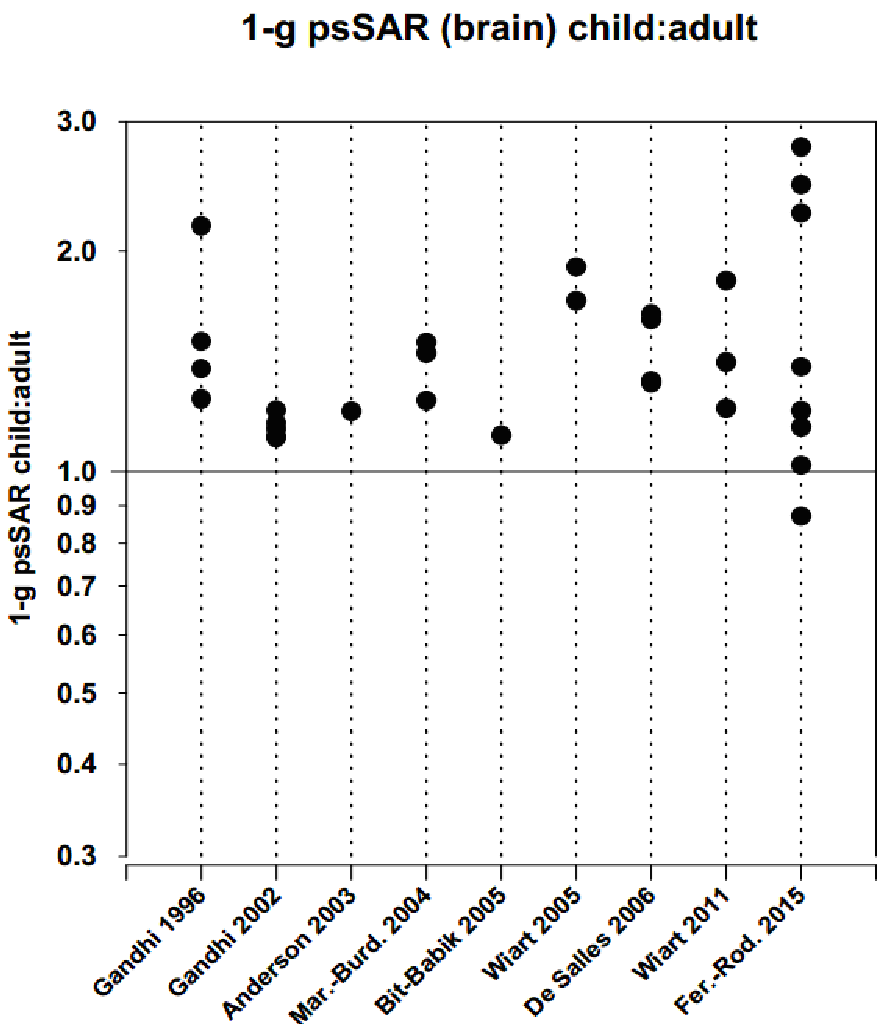 Figure 2: Ratios of psSAR(brain) for child vs. adult models. Here,children clearly show higher absorption ratios, confirming that the "nearer to the antenna" intuition holds for internal organs but not for the regulatory 'surface-dominated' head metric.
Experiments and Results: Is the SAM Phantom Safe?
One of the most critical parts of the study tests the Specific Anthropomorphic Mannequin (SAM). Critics argue that since SAM is based on a large adult male, it cannot protect children. However, the data proves the opposite.
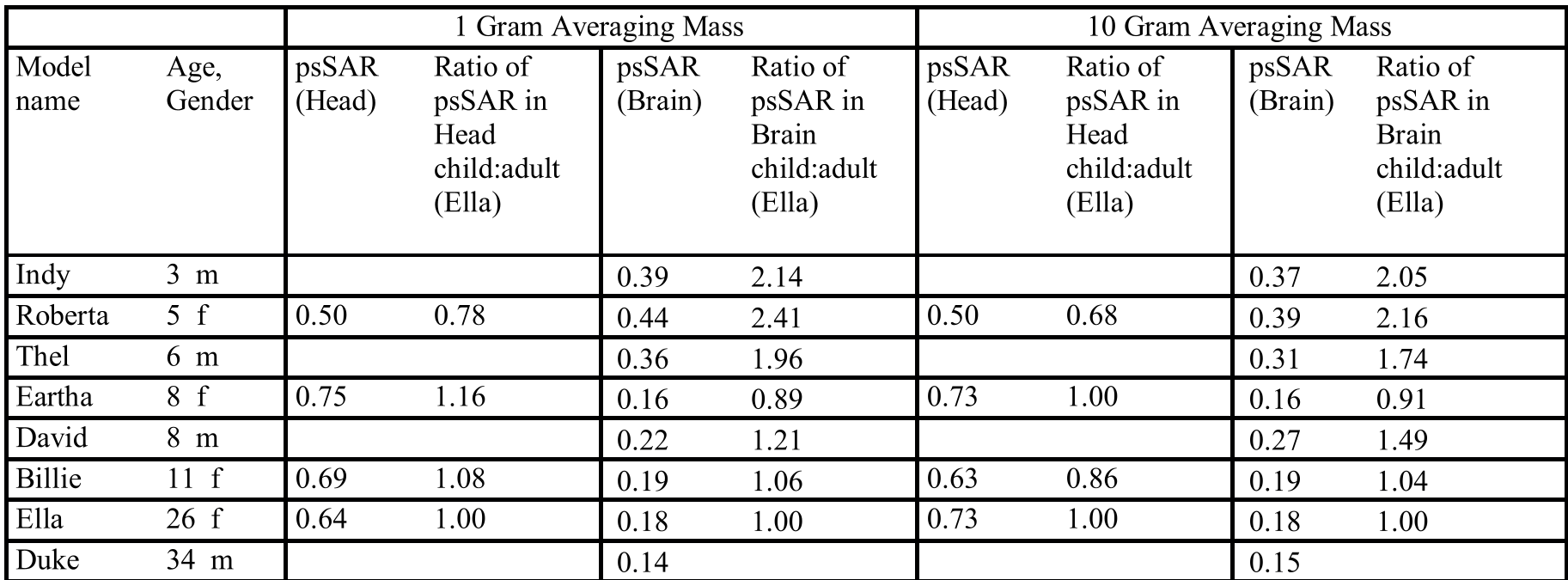 Table 1: All anatomical models (adults and children) show PSAR values well below the SAM baseline (1.0). This demonstrates that SAM is a "conservative" or "worst-case" model that provides a significant safety margin for everyone.
Critical Insight: Real-World vs. Simulation
The authors conclude with a vital reality check for the research community. While lab simulations are precisely controlled:
- Handset Positioning: A 1mm shift in how a child holds a phone can change SAR by over 10%.
- Adaptive Power Control: Real-world phones rarely operate at the maximum power used in these studies. In actual networks, the power is often 100 to 1,000 times lower than the peak levels modeled.
Conclusion
The paper successfully argues that while pediatric anatomy leads to different internal distribution patterns of RF energy, it does not lead to higher compliance levels. The debate is often fueled by misinterpreting "higher brain dose" as "unsafe exposure," ignoring that current regulatory limits and the SAM phantom are specifically engineered to account for these variations.
Takeaway for Future Research: Future studies must stop treating "exposure" as a single variable and distinguish between regulatory compliance and localized anatomical dosimetry to avoid misleading the public.