
PCNN and Attention: Advancing Chinese Agricultural Relation Extraction
Chinese Agricultural Entity Relation Extraction via Deep Learning
2019-01-01
Summary
Problem
Method
Results
Takeaways
Abstract
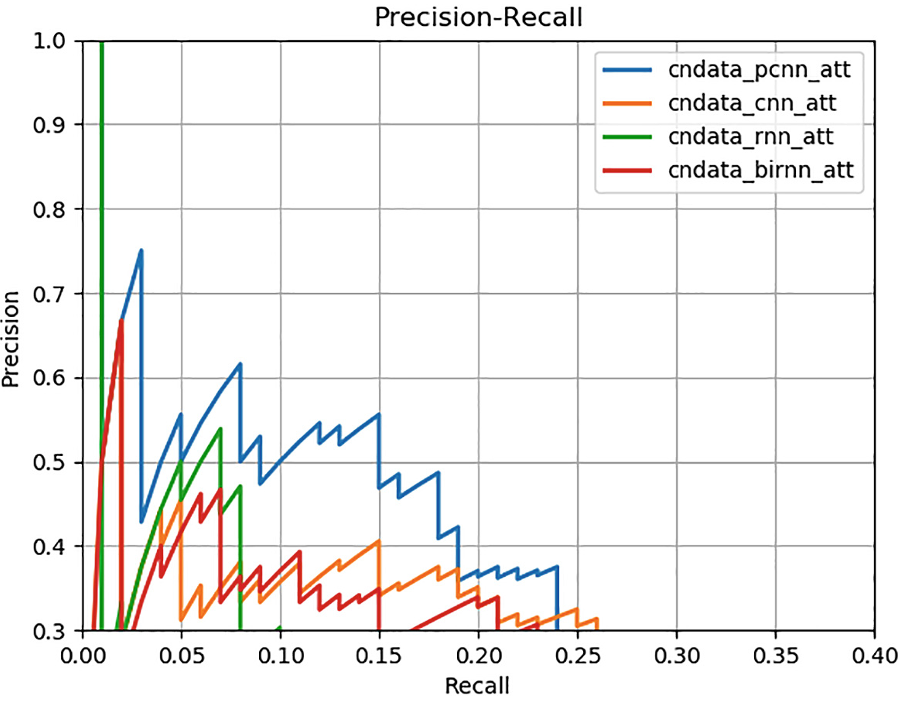
The paper explores Chinese agricultural entity relation extraction using Deep Learning models, specifically comparing PCNN, CNN, RNN, and Bi-RNN architectures. It demonstrates that the Piecewise Convolutional Neural Network (PCNN) combined with an Attention Mechanism achieves superior performance, reaching an AUC of 0.154 and a test accuracy of approximately 69.7%.
## Executive Summary
In the rapidly evolving landscape of Natural Language Processing (NLP), extracting meaningful relationships between entities in specialized domains remains a significant challenge. This paper presents a specialized deep learning approach to **Chinese Agricultural Entity Relation Extraction**. By evaluating four distinct architectures—PCNN, CNN, RNN, and Bi-RNN—integrated with an Attention Mechanism, the researchers identified that the **Piecewise Convolutional Neural Network (PCNN)** serves as a robust backbone for this task, achieving superior performance on a dataset curated from agricultural pest and disease knowledge bases.
## Problem & Motivation: Beyond Manual Feature Engineering
Traditional Information Extraction in the agricultural sector has long been bottlenecked by the limitations of classic Machine Learning, which requires extensive domain expertise for feature selection. The motivation for this study stems from two main issues:
1. **Semantic Complexity**: Agricultural Chinese sentences often contain complex relationships (e.g., "Planthoppers destroy rice") where the distance between entities varies.
2. **Information Loss**: Standard CNNs use global pooling, which often discards the relative structural information between two target entities, leading to a "blurring" of the specific context that defines their relationship.
## Methodology: The Power of Piecewise Pooling
The core innovation resides in the **PCNN (Piecewise Convolutional Neural Network)** architecture. Unlike a standard CNN that performs a single max-pooling operation over the entire sentence, the PCNN divides the sentence into three distinct segments based on the positions of the two entities.
### 1. Hybrid Embedding Layer
The model captures both semantic and structural data by concatenating:
* **Word Embeddings**: Generated via Continuous Bag of Words (CBOW).
* **Position Embeddings**: Encoding the relative distance of each word to `entity1` and `entity2`.
### 2. Piecewise Pooling
Each convolutional filter $c_i$ is split into three parts {$c_{i1}, c_{i2}, c_{i3}$}, corresponding to the segments: [Pre-Entity1], [Between-Entities], and [Post-Entity2]. This ensures that the features local to the entities are preserved.

### 3. Selector Layer: Attention Mechanism
The authors argue that not all features contribute equally to a relation. By implementing an **Attention Mechanism (ATT)**, the model learns to assign higher weights to the most representative features, outperforming traditional Average (AVE) or Max (MAX) pooling in prediction accuracy.
## Experiments and Results
The researchers conducted head-to-head comparisons using a hardware setup involving an Intel Core i5 and TensorFlow.
### SOTA Comparison
The PCNN emerged as the clear winner against Recurrent Neural Networks (RNN) and Bidirectional RNNs, which were surprisingly less efficient in this specific task context:
| Model | AUC | F1-Score | Accuracy |
| :--- | :--- | :--- | :--- |
| **PCNN + ATT** | **0.1536** | **0.2967** | **69.7%** |
| CNN + ATT | 0.1351 | 0.2842 | 68.8% |
| BiRNN + ATT | 0.1151 | 0.2629 | 66.3% |
### Ablation Insights
Experimental data revealed a nuanced trade-off: while the Attention Mechanism provided the highest **Test Accuracy**, Max Pooling actually achieved a higher **F1-Score** (0.316). This suggests that while Attention is better at generalizing across the test set, Max Pooling might capture "hard" features more effectively for specific agricultural relations.
## Critical Analysis & Conclusion
### Takeaway
The study proves that PCNN architectures are highly suitable for Chinese agricultural relation extraction because they respect the positional structure of entities within a sentence. The combination of position embeddings and piecewise pooling effectively mitigates the information loss found in global pooling methods.
### Limitations & Future Work
1. **Embedding Sophistication**: The study relies on CBOW word embeddings. Modern Transformers (like BERT) would likely provide a significant boost to these results by offering context-aware embeddings.
2. **Dataset Scale**: Relative to modern LLM datasets, the crawl from the "Agricultural Pest and Disease graphic knowledge base" is niche; larger-scale multi-domain training could improve the robustness of the Attention weights.
By bridging the gap between deep learning theory and agricultural practical application, this work sets a solid foundation for building automated knowledge graphs for smart farming.