
Deciphering the "Sticky" Factor: Why Chinese Users Stay on Social Networks
Understanding Chinese users’ continuance intention toward online social networks: an integrative theoretical model
This study develops an integrative theoretical model to explain users' continuance intention toward Online Social Networks (SNS). By synthesizing IS Continuance Theory with Flow Theory, Social Capital Theory, and UTAUT, the authors identify 8 critical factors that drive sustained usage in the Chinese market, achieving a variance explanation (R-squared) of 52.9%.
TL;DR
What makes a user return to a social network day after day? This research goes beyond simple "usefulness" to prove that Perceived Enjoyment and Social Capital are the true anchors of user retention. By integrating four major theories, the study reveals that for Chinese SNS users, the thrill of the "flow" experience is even more critical than the practical utility of the platform.
The Post-Adoption Puzzle
In the early 2010s, the digital world saw a massive influx of users into Online Social Networks (SNS). However, for platform providers, the real battle isn't acquisition—it's conitnuance.
Existing Information Systems (IS) models, like Bhattacherjee’s IS Continuance Theory, were originally designed for utilitarian tools (like banking or productivity software). They failed to capture the "soul" of social media: the joy of interaction, the strength of digital friendships, and the cultural norms of a specific user base. This study fills that gap by looking through the lens of the Chinese market, where SNS platforms often double as gaming hubs and community centers.
Methodology: A Multi-Theoretical Synthesis
The authors didn't just add variables; they merged four distinct psychological and sociological pillars:
- IS Continuance Theory: The baseline of Satisfaction and Usefulness.
- Flow Theory: Capturing "Perceived Enjoyment"—the state of being lose in the activity.
- Social Capital Theory: Measuring Tie Strength, Shared Norms, and Trust.
- UTAUT: Accounting for Effort Expectancy and Social Influence.

Key Insights: Enjoyment is King
The empirical results from 320 users provide a clear hierarchy of what matters:
- The Power of Flow: Perceived Enjoyment emerged as the most significant driver. If the user doesn't find the "scrolling" or "gaming" experience inherently fun, they won't stay, regardless of how "useful" the site is.
- The Social Moat: Tie strength and shared norms are the "glue." When users have close relationships (strong ties) and a sense of shared vision with others on the platform, the switching cost becomes psychologically unbearable.
- The Trust Factor: Trust in both the platform provider and other users significantly boosts satisfaction (β = 0.17). This is particularly relevant in the Chinese context where "guanxi" (relationships) and safety are paramount.
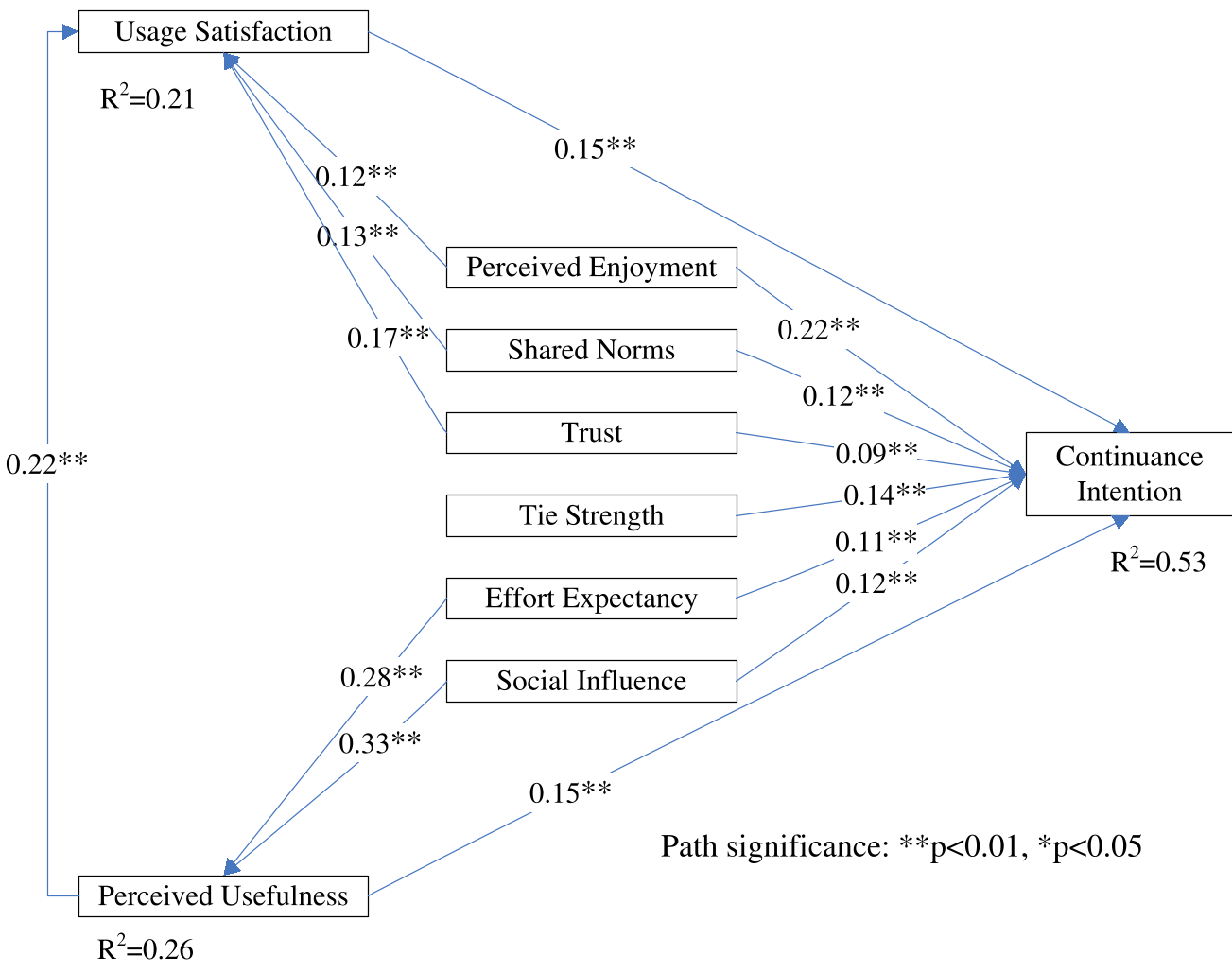
Experimental Evidence
The study utilized PLS-Graph 3.0 to validate the measurement model. The reliability was high, with all Cronbach’s Alpha > 0.70 and Composite Reliability > 0.80.
| Construct | Perceived Usefulness | Usage Satisfaction | Perceived Enjoyment | Continuance Intention |
|---|---|---|---|---|
| Mean | 5.24 | 4.80 | 5.77 | 5.26 |
| Path to CI (β) | 0.15 | 0.15 | 0.22 | - |
(Note: Perceived Enjoyment shows the highest mean and strongest path coefficient to Continuance Intention.)
Critical Analysis & Business Implications
The research offers a vital roadmap for product managers and UX designers:
- Prioritize Hedonics: Don't just optimize for "efficiency." In a social context, "wasting time" enjoyably is a feature, not a bug.
- Facilitate "Guanxi": Features that allow users to discover commonalities (Shared Norms) or deepen existing friendships (Tie Strength) are more valuable for retention than mere feature updates.
- Ease of Use Still Matters: Effort expectancy carries a path coefficient of 0.11. If the interface is clunky, it creates friction that even the best social ties can't always overcome.
Limitations: As the authors note, the study is cross-sectional (a "snapshot" in time) and focused on a young Chinese demographic (71% aged 20-29). In today's landscape of algorithmic feeds (TikTok) and privacy concerns, the role of "Trust" and "Social Influence" likely carries even more weight.
Conclusion
The secret to SNS longevity isn't just being a tool; it's being a destination. By balancing the utilitarian need for information with the hedonic need for play and the human need for connection, platforms can move beyond "adoption" and achieve true "continuance."