
Churn Prediction: Why Your Friends' Inactivity Is the Strongest Predictor of Your Departure
Churn Prediction in a Real Online Social Network Using Local CommunIty Analysis
This paper introduces a churn prediction model for Online Social Networks (OSNs) using a novel overlapping local community detection algorithm called IOLoCo. Evaluated on the Skyrock platform with millions of users, the method demonstrates that features derived from a user's immediate social community significantly improve the accuracy of predicting platform abandonment.
TL;DR
Predicting when a user will stop using a social platform (churn) is a multi-million dollar problem. This paper moves beyond individual profiles to look at local social communities. By introducing the IOLoCo algorithm, the authors prove that the behavior of a user's immediate "inner circle"—an average of just 21 people—is a better predictor of churn than analyzing a user in isolation or looking at massive global network structures.
Background: The Social Contagion of Churn
Churn prediction is a classic data mining task, long mastered by telecom operators. However, in Social Networks, churn is "viral." If your friends leave the party, you are likely to follow. Existing methods usually struggle with two extremes:
- Node-only analysis: Ignoring the social ties entirely.
- Global community detection: Algorithms like Louvain are great for partitioning a whole graph, but they create "mega-communities" that are too large to reflect the personal social circle that actually influences a user.
The Problem & Motivation
Why is this hard? Real social networks like Skyrock (a massive French blog platform) contain millions of nodes and billions of edges. Running global algorithms every time a user’s status changes is computationally impossible.
The authors' insight is simple: Local context matters more. A user is influenced by their overlapping local communities. They set out to build a model that is "light" (examining very few nodes) but "deep" (highly accurate).
Methodology: The IOLoCo Algorithm
The core of the paper is the IOLoCo (Identification of Overlapping Local Communities) algorithm.
How it works:
Instead of looking at the whole graph, IOLoCo starts at a "seed" node and greedily adds neighbors that improve a specific quality function .
- Internal Density (): Favors links closer to the starting user.
- External Density (): Penalizes links that lead away from the local cluster.
- Iterative Overlap: It allows a node to belong to multiple circles by deleting internal links after each pass and repeating the search.
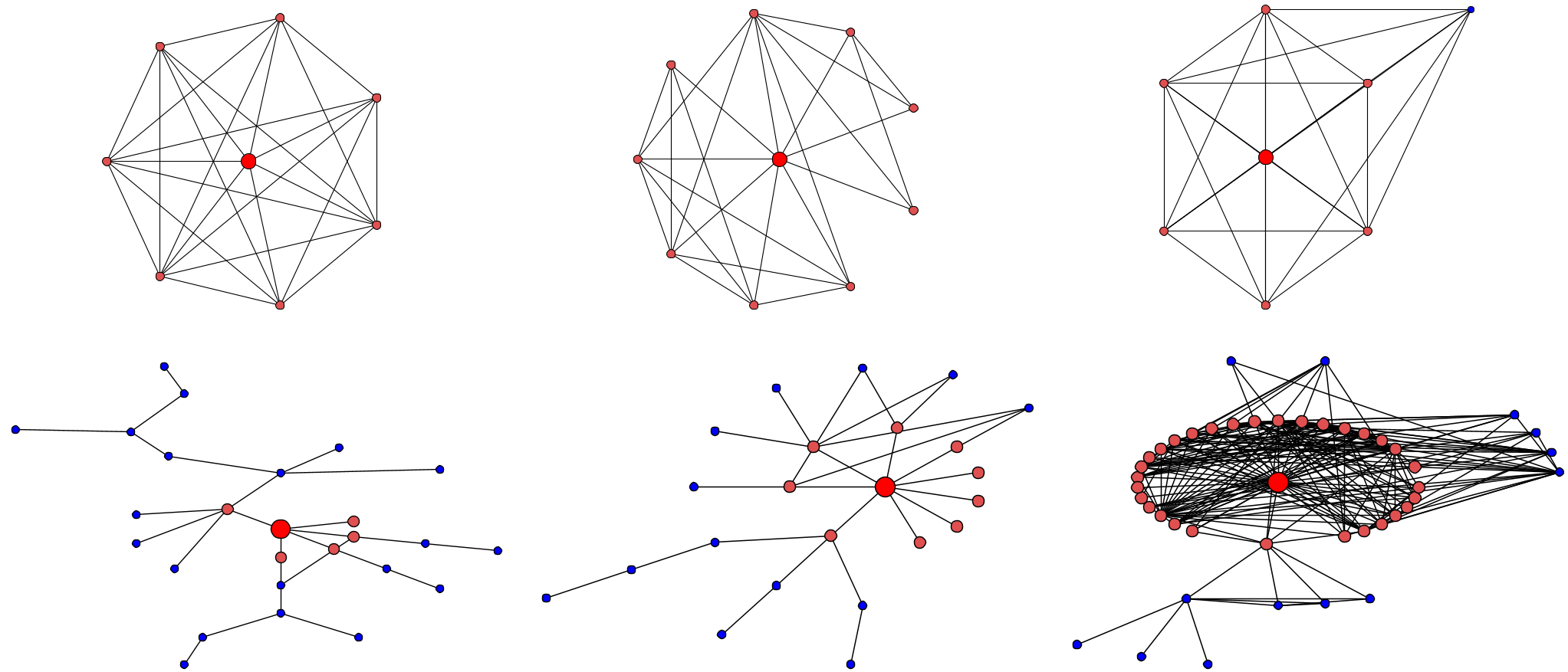 Fig 1: Examples of local communities found in the Skyrock dataset. While most are small, some exhibit larger diameters, precisely capturing the user's specific social reach.
Experimental Results
The authors compared various attribute sets using an SVM classifier. The "Local Community" model was the star performer:
| Attributes Set | Avg Nodes Scanned | Accuracy | AUC |
|---|---|---|---|
| Node Only | 1 | 78.8% | 0.815 |
| Node + Local Community | 21 | 79.0% | 0.832 |
| Node + Global (Louvain) | 359,625 | 78.9% | 0.823 |
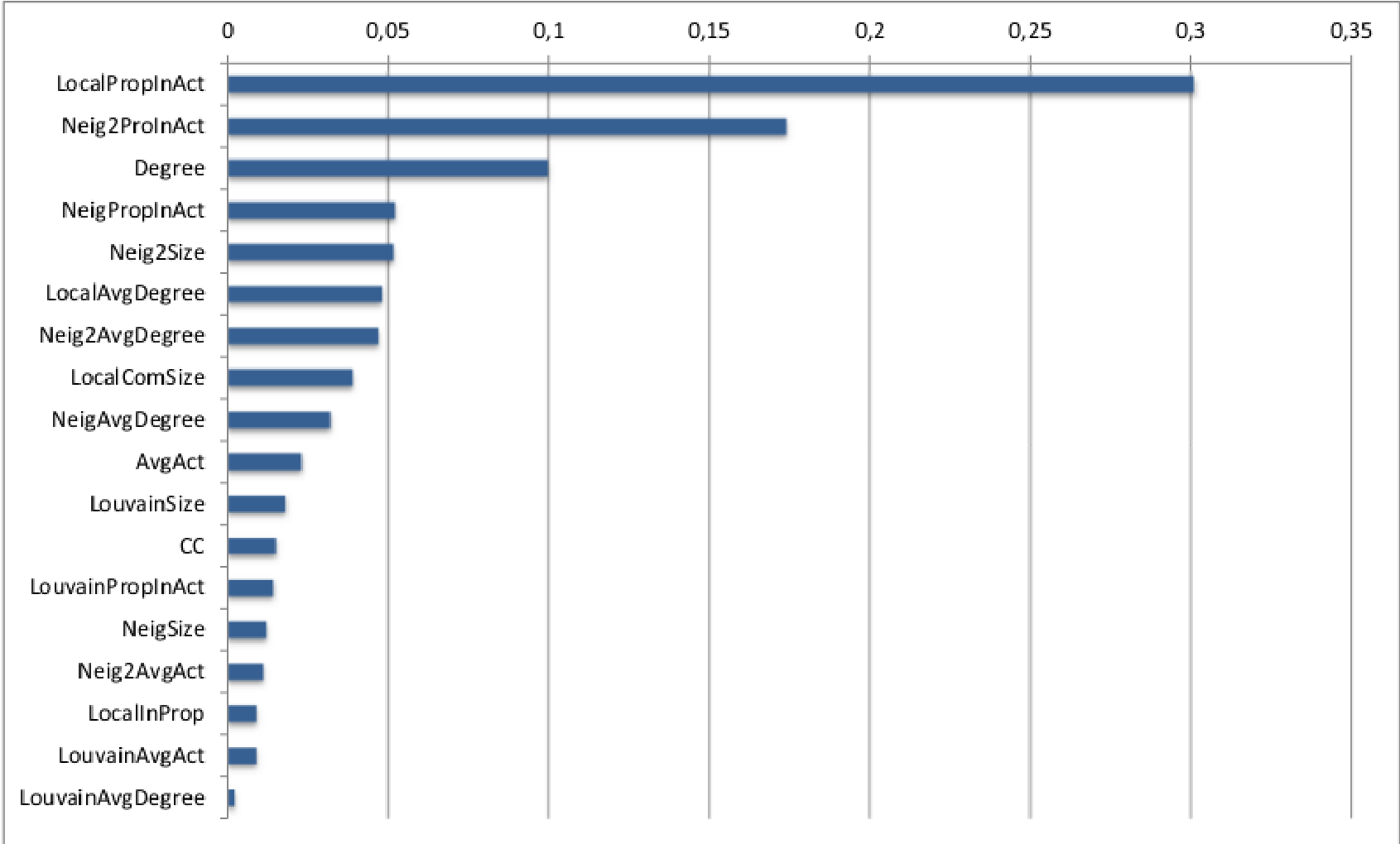 Fig 2: Variable contributions. The "PropInact" (Proportion of Inactive members in the local community) is the single most influential topological feature.
Key Insight from Results:
The model using Local Community features performed better than the Global (Louvain) model while looking at 17,000x fewer nodes. This proves that for behavior prediction, "local" is not just faster—it's more accurate.
Critical Analysis & Conclusion
Takeaway
If you want to keep users on your platform, don't just look at how many times they log in. Look at their local neighborhood. If the "Inactive Proportion" of their local community rises, that user is in the "danger zone," regardless of their personal activity history.
Limitations & Future Work
- Structure vs. Content: This paper focuses purely on the graph (the links). It ignores what users are actually saying.
- Temporal Dynamics: The study uses snapshots. Future work could benefit from analyzing the speed at which a community dissolves.
- Application: The authors are currently integrating user-generated content (likes, posts) with this structural analysis to create an even more robust hybrid prediction system.
The bottom line: In the world of social networks, your destiny is tied to your neighbors. IOLoCo gives us the mathematical lens to see who those neighbors really are.