
CI-Bot: Bridging the Gap Between Chatbot Speed and Human Expertise
CI-Bot: A Hybrid Chatbot Enhanced by Crowdsourcing
This paper introduces CI-Bot, a hybrid intelligent chatbot that combines artificial intelligence (AI) with crowd intelligence (CI/Crowdsourcing) to solve questions beyond local knowledge. By integrating a "Human-in-the-loop" mechanism, CI-Bot leverages expert recommendation and answer integration to expand its corpus, achieving a self-evolving knowledge base.
TL;DR
CI-Bot is a hybrid chatbot framework that solves the "unknown question" problem by intelligently routing queries to human experts. It combines the speed of automated response with the depth of crowd intelligence, using a feedback loop that adds human-verified answers back into the machine's knowledge base.
The "Intelligence Wall" in Traditional Chatbots
Despite the progress in NLP, chatbots often hit a "wall" when faced with professional, niche, or highly contextual questions. Static corpora cannot cover the infinite variety of human curiosity. While Q&A platforms like Quora provide the depth, they lack the immediacy of a chat interface. The authors of CI-Bot identify this trade-off: Accuracy vs. Latency.
Methodology: The Hybrid Architecture
The CI-Bot architecture is divided into two major spheres: the AI Module (for speed) and the CI (Crowd Intelligence) Module (for depth).
1. The AI Layer: First Responder
CI-Bot uses a dual approach for automation:
- Retrieval Method: Efficiently searches for existing Q&A pairs in the corpus.
- Neural Network Method: Uses Multilayer LSTM models to generate conversational responses for casual chat.
2. The CI Layer: The Expert Network
If the AI fails to satisfy the user, the Expert Recommender takes over. This is the "brain" of the crowdsourcing component. It doesn't just broadcast to everyone; it ranks users based on:
- Expertise Fields: Extracted via text mining.
- Credibility: Inferred from historical performance and "prestige" values.
- Motivation: Measured by response time and activity.
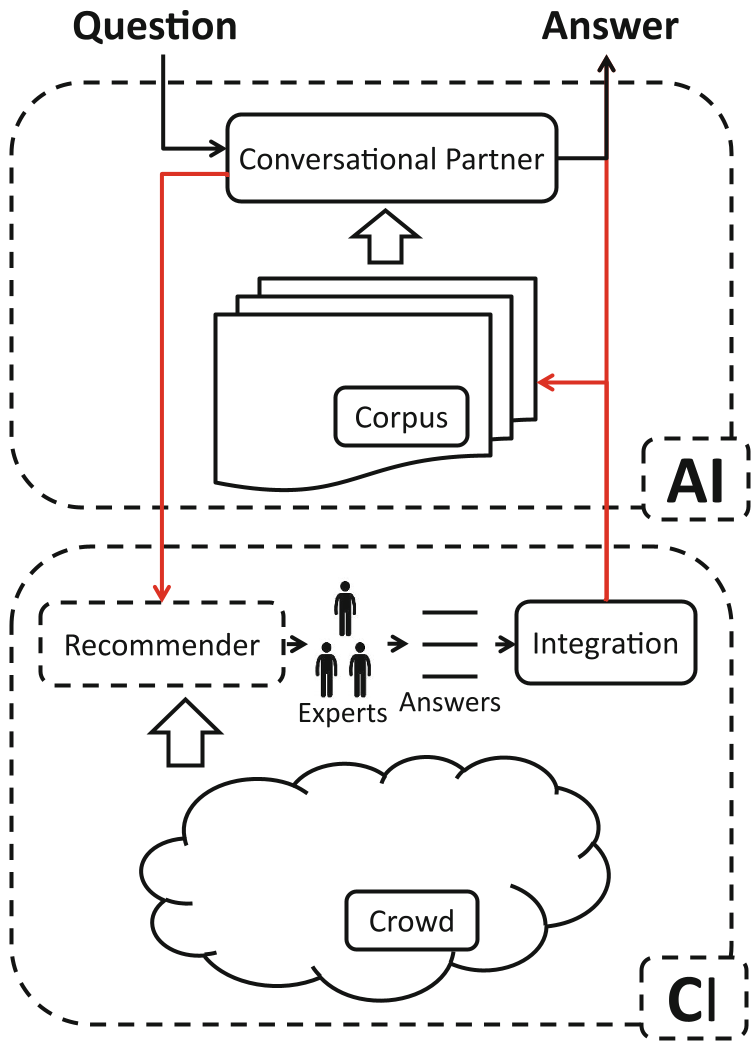
3. Closing the Loop: Answer Integration & Corpus Update
Once multiple experts provide answers, CI-Bot performs Noise Filtering (removing malicious or irrelevant content) and Integration. Numerical questions are averaged, while explanatory ones are selected based on length and response time. These final answers are then added to the AI's corpus, ensuring that the next time the question is asked, it can be answered instantly by the machine.
Experimental Validation
To test the prototype, the researchers deployed CI-Bot on WeChat, integrating an incentive mechanism using "Lucky Money" (digital rewards).
Key Findings:
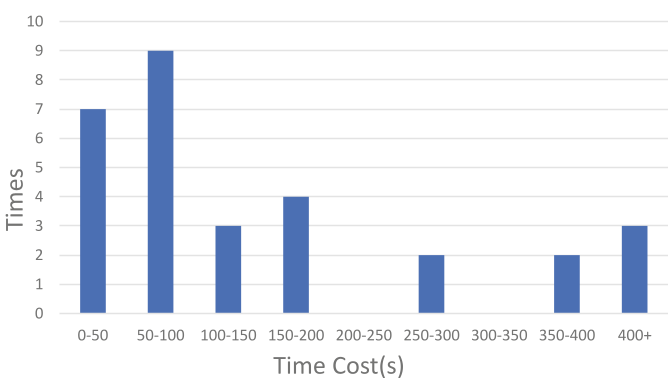
- Response Speed: 40% of questions received a human answer within 50 seconds. This is remarkably faster than traditional web-based forums.
- Quality: 14 of the 16 first-returned answers were accepted by the askers, proving the effectiveness of the expert filtering.
- Knowledge Growth: Every successful human interaction directly increased the AI's future capability.
Critical Insight & Future Outlook
CI-Bot is not just a chatbot; it is a Knowledge Management System. Its real value lies in its "Cold Start" strategy: by relying on humans initially, it builds a high-quality dataset that eventually automates the human out of the loop for repetitive queries.
Limitations: The prototype currently relies on a relatively small pool of volunteers (43 participants). Scaling this to a global level would require more sophisticated incentive mechanisms and more robust noise filtering algorithms to prevent "poisoning" the AI corpus with incorrect crowdsourced data.
Conclusion: As we move into an era of LLMs, CI-Bot's philosophy remains highly relevant. Combining the generative power of models with the grounded truth of human experts is likely the only way to achieve truly "Expert-Level" AI assistants in fields like law, medicine, and engineering.