
CitizenPulse: Transforming Public Opinion into Actionable e-Governance
CitizenPulse: A Text Analytics framework for Proactive e-Governance - A Case Study of Mygov.in
CitizenPulse is a reconfigurable text analytics framework designed for proactive e-Governance, specifically targeting the analysis of unstructured citizen feedback from the MyGov.in portal. It utilizes a modular "Analytics Softcore" approach, integrating off-the-shelf tools like Stanford NLP and Apache Solr into a drag-and-drop pipeline for sentiment and trend analysis.
TL;DR
CitizenPulse is a modular text analytics framework developed to help the Indian government process thousands of unstructured comments on the MyGov.in portal. By turning complex NLP libraries into "drag-and-drop" objects, it allows for the rapid creation of sentiment analysis pipelines.
Academic Positioning: This work serves as a foundational case study in applying modular software engineering principles (abstraction and pipelining) to the domain of proactive e-Governance.
The Motivation: From Passive Collections to Proactive Insights
The Government of India’s MyGov.in initiative created a massive digital town square. However, the sheer volume of free-form text—often a messy mix of English and Hindi—created an information bottleneck. The authors identified that while powerful NLP tools (like Stanford NLP and OpenNLP) existed, they were too fragmented and difficult to configure for rapid government use cases.
The research intuition was simple: Democratize text analytics by abstracting complexity. If a policy analyst can "link" a crawler to a sentiment engine as easily as drawing a flowchart, the barrier to data-driven governance disappears.
Methodology: The "Analytics Softcore" (AS)
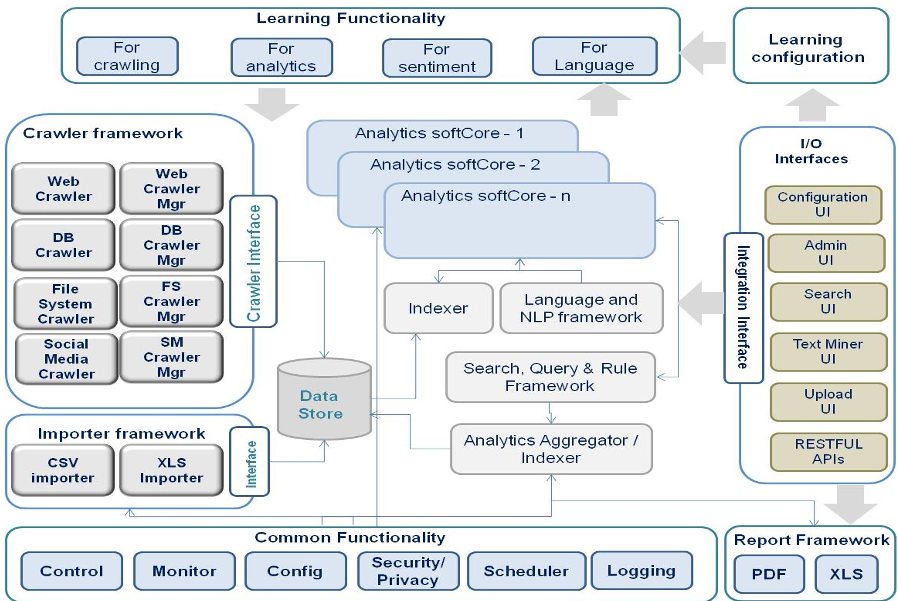
The core innovation of CitizenPulse is the Analytics Softcore. The authors leverage the KNIME framework to wrap heterogeneous tools into a unified visual environment:
- Ingestion: Modified Apache Nutch for intelligent crawling of various document formats.
- Linguistic Processing: A dual-path pipeline using Stanford NLP for English and NLTK for Hindi, handling PoS tagging, NER, and stemming.
- The "Object" Abstraction: Each library is wrapped as a software object with configurable properties, allowing users to build a pipeline without writing code.
Case Study: Cleanliness in Schools
To validate the framework, the authors analyzed over 6,000 posts about "Cleanliness in School Curriculum" from 2014 to 2015.
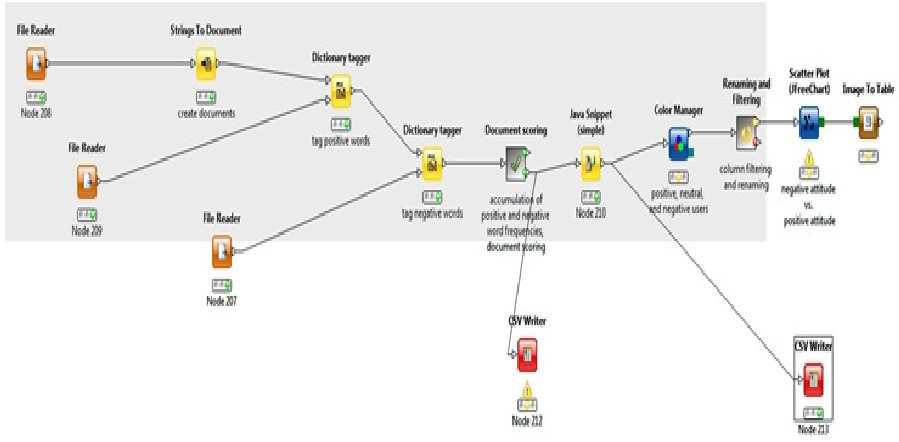
The pipeline specifically:
- Separated Hindi and English corpora.
- Generated Tag Clouds based on TF-IDF to identify "pivot points" (key topics).
- Mapped sentiments (Positive/Negative/Neutral) to these pivot points to see exactly what citizens liked or disliked about the policy.
Critical Analysis & Future Outlook
While CitizenPulse succeeded in making text analytics "reconfigurable," the authors candidly noted a major hurdle: Code-Mixing.
Indian citizens frequently use "Hinglish"—a mixture of Hindi and English in the same sentence. Traditional off-the-shelf tools, which expect a single language at a time, see a drop in accuracy in these scenarios.
Key Takeaways:
- Modularity is King: For large-scale government applications, the ability to "swap" components (e.g., replacing a sentiment engine without rebuilding the crawler) is more valuable than a monolithic specialized model.
- The Multi-lingual Gap: Future work must move beyond "separatist" language processing (English path vs. Hindi path) and toward models that inherently understand code-mixed syntax.
CitizenPulse laid the groundwork for how technology can bridge the gap between a citizen's voice and a policymaker's ear, proving that the future of governance is not just digital, but analytical.