
Beyond Hashtags: Classifying City Events via Social Followee Networks and Wikipedia
City Happenings into Wikipedia Category: Classifying Urban Events by Combining Analyses of Location-based Social Networks and Wikipedia
This paper introduces a novel urban event classification method that combines Location-Based Social Networks (LBSN) analysis with Wikipedia's categorical hierarchy. Instead of traditional text mining, it identifies "common followees" (influencers) followed by event participants and maps these influencers to Wikipedia categories to infer the event's type.
TL;DR
Researchers from Keio University and NTT DOCOMO have developed a way to classify urban events—like sports games or festivals—without reading a single word of what people post. By analyzing the "common followee" (influencers) of people geo-located at an event and cross-referencing those influencers with Wikipedia categories, the system can automatically determine if a crowd is there for a football match, an anime convention, or a political rally.
Background & Motivation: The Problem with Text
For years, "Social Sensing" has relied on text analysis. If people at a stadium tweet #Goal or "What a strike!", we know it's a soccer game. However, this has two major flaws:
- The Silence Problem: Many participants don't tweet about the event; they just tweet normally or stay silent.
- The Noise Problem: General keywords are often too messy to provide a clean classification.
The authors' insight is brilliant in its simplicity: "You are what you follow." If 100 people at a stadium all follow famous soccer players, it’s almost certainly a soccer match, regardless of what they are actually tweeting.
Methodology: The "Followee-to-Wikipedia" Pipeline
The system follows a four-step process to transform raw GPS-tagged tweets into a semantic category:
- Extraction: Identify users posting from the vicinity of an event.
- Weighting (FeatureIndex): It’s not enough to count followers. Famous people like Elon Musk are followed by everyone (noise). The authors use a
FeatureIndexto find influencers who are uniquely popular at that specific location compared to the rest of Twitter. - Wikipedia Mapping: The system finds the Wikipedia page for these top influencers.
- Category Aggregation: Using a breadth-first search (BFS) on Wikipedia’s category tree, it bubbles up specific categories (e.g., "Virtual Singer") to higher-level concepts (e.g., "Music," "Entertainment").
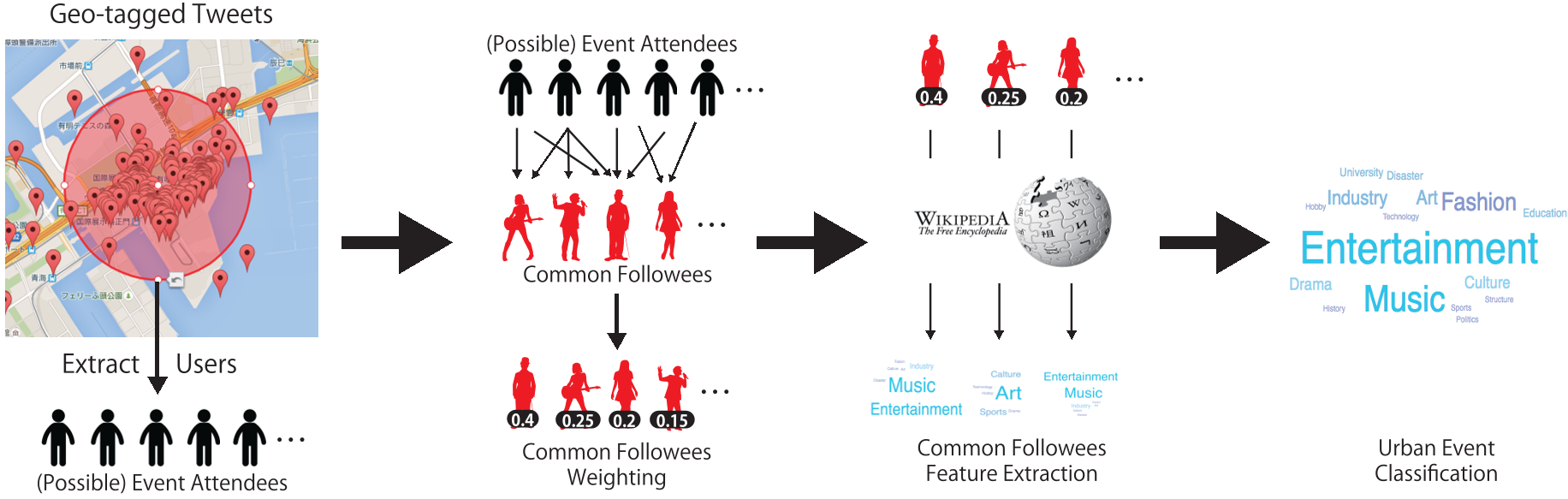 Figure 1: The workflow from raw geo-tweets to Wikipedia-based classification.
Experiments and Results
The researchers tested their method on 16 real-world urban events in Japan and compared the results against a manual questionnaire (Ground Truth).
Where it shines: Niche Interests
Events with a "strong fanbase" showed high cosine similarity to the ground truth.
- Soccer Games: Successfully mapped to "Sports" and "Media."
- Comic Market (Comiket): Strongly associated with "Anime," "Manga," and "illustration."
- Idol Concerts: Corrected mapped to "Music" and "Entertainment."
Where it struggles: Generic Public Events
The method struggled with "Cherry Blossom Festivals" or "Fireworks Displays." Why? Because everyone goes to see cherry blossoms. The crowd's interests are too diverse, making it impossible to find a signature "common followee" profile.
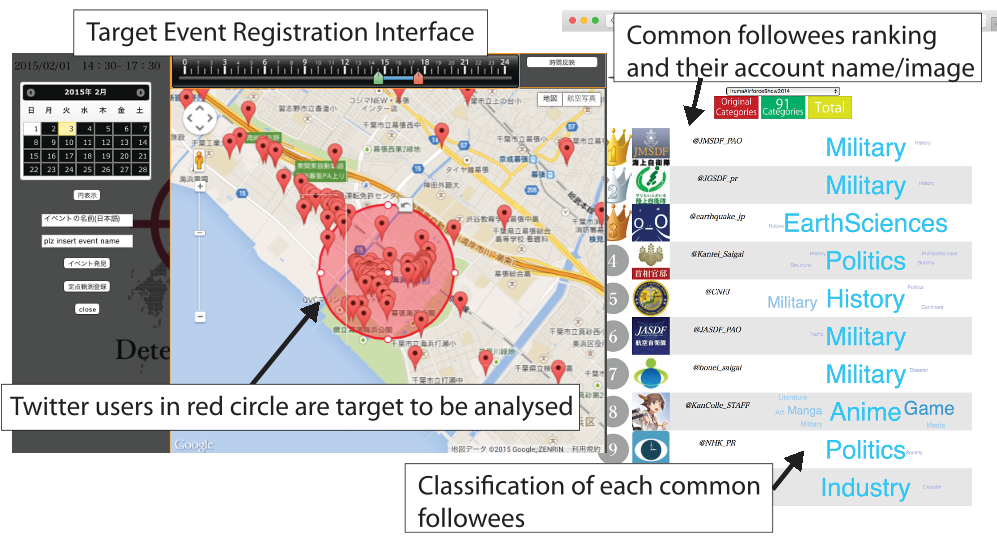 Figure 2: The interactive tool showing real-time event mapping and category word clouds.
Critical Insights & Future Outlook
This work demonstrates that relational metadata (following/follower graphs) can be more descriptive than content metadata (tweets).
Key Takeaways:
- Zero-Shot Potential: This method doesn't need a pre-trained "soccer" classifier; it uses the evolving collective wisdom of Wikipedia.
- Cultural Reflection: Interestingly, at the Sapporo Snow Festival, the system identified "Hatsune Miku" (a virtual idol) as a main category because her fans were the most active Twitter users on-site, illustrating how social media data often reflects the active subculture rather than the general public.
Future Potential: As we move toward smarter cities, combining this "Followee Analysis" with IoT sensor data could allow city planners to understand not just where crowds are, but who they are and why they gathered, enabling better traffic management and emergency response.
Conclusion
By bridging the gap between real-world location data and the structured knowledge of Wikipedia, the authors have provided a robust framework for urban event classification that bypasses the limitations of linguistic analysis.