
Civic Social Network: Breaking the Monopoly of Digital Reality in Urban Spaces
Civic Social Network: A Challenge for Co-production of Contents About Common Urban Entities
The paper introduces a novel Civic Social Network (CSN) framework designed to facilitate content co-production for urban entities. By decoupling entity properties from descriptive content and replacing the "owner" model with a "contributor" model, the system enables multiple, even conflicting, perspectives to coexist within a single digital entry point.
TL;DR
In the digital representation of our cities, who gets to decide what a "school" or a "square" is? Most platforms (like Google Maps or Facebook) give power to a single "owner," leading to fragmented or biased information. This paper proposes a Civic Social Network (CSN) framework that allows multiple, irreconcilable perspectives to live under one digital roof, using a unique multi-layered entity architecture and a shared responsibility model.
Problem & Research Intuition: The "Single Entry" Trap
When a local school is also a historical monument, a sports hub, and a polling station, who is the "legitimate" author of its digital page?
- Wikipedia forces a neutral, consensus-driven "common goal," stripping away personal experiences.
- Facebook/Google assigns an "Owner," creating an asymmetric power dynamic where the owner can censor or ignore dissenting voices.
The authors argue that for a digital platform to be truly Civic, it must reflect the messy, multi-faceted reality of urban life. If the digital space forces a simplification, it doesn't solve conflict—it merely moves it from the street to the screen, or worse, breaks through from the screen back into real-life neighborhood tensions.
Methodology: The Architecture of Plurality
The core technical contribution is the separation of Identity from Perspective.
1. First-Order vs. Second-Order Entities
To prevent the "multiplication of entry points" (where five different people create five different pages for the same park), the system uses:
- First-Order Entities: Objective facts (GPS coordinates, name, valid time). This serves as the "Common Ground."
- Second-Order Entities: Subjective layers (Descriptions, Images, News). Any user can add these without needing permission from the "initiator."
2. Complex Entity Relations
Instead of a flat list, the system allows for recursive relations like "location of," "group from," and "sub-event," enabling the digital entity to grow as complex as its real-world counterpart.
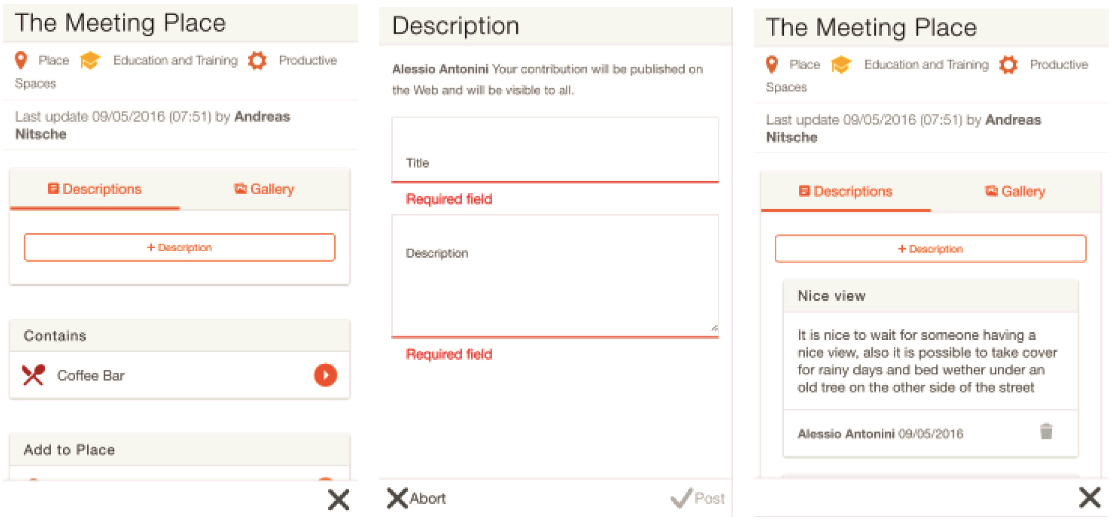 Figure 1: The structure of primary and secondary entities, showing how subjective descriptions are decoupled from the core entity.
From Ownership to Shared Responsibility
The most radical shift is the move away from the "Admin/Owner" role. In this CSN:
- The Initiator is not an Owner: The first person to create a "Place" doesn't get to gatekeep it.
- Collective Moderation: As the entity grows, the "burden of moderation" is shared among all proactive contributors.
- Accountability: Every contribution is tied to a real registered user, ensuring that while perspectives are plural, they are also responsible.
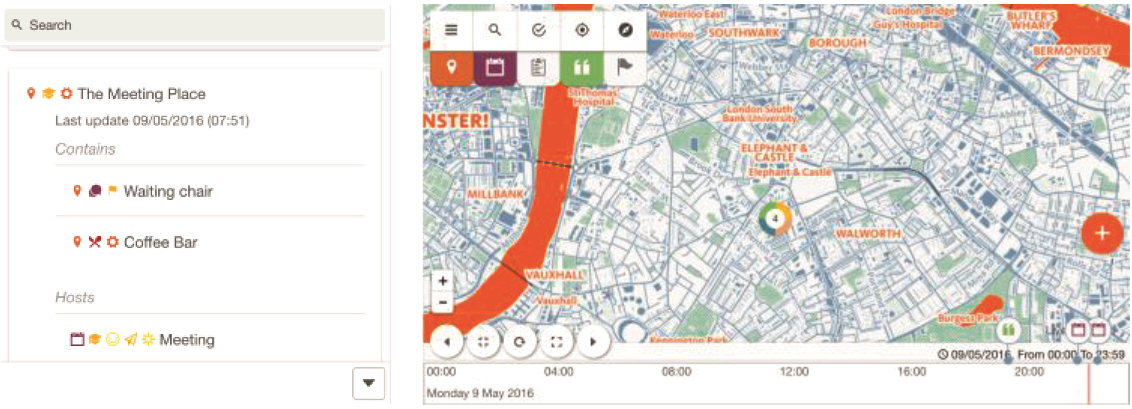 Figure 2: Example of complex urban entities showing relations between places, events, and groups.
Critical Analysis & Takeaways
This paper brilliantly identifies that urban digital conflict is often a design failure of the platforms we use. By providing "semantic accessibility"—the ability to see who said what and from which perspective—the platform moves from a "battle of popularity" to a "repository of context."
Limitations: The system relies heavily on the "proactive nature" of citizens. In neighborhoods with high digital illiteracy or low civic engagement, the "shared responsibility" model might struggle to find enough contributors to effectively self-moderate.
The Future: As we move toward "Smart Cities," this framework provides a blueprint for how we can integrate human, social, and conflicting narratives into the technical "Digital Twin" of a city. It suggests that the future of civic tech isn't about finding one "True" description, but about building a platform where all roles—parents, deans, historians, and neighbors—can coexist.