
CL-SNA: Leveraging Lisp for Deep Social Network Analysis
CL-SNA: social network analysis with Lisp
CL-SNA is a Common Lisp-based toolkit designed for Social Network Analysis (SNA). It provides a comprehensive suite for computing graph metrics, identifying structural subgroups like LS sets, and visualizing complex social relations by integrating with external tools like Graphviz.
Executive Summary
CL-SNA is a specialized toolkit written in Common Lisp designed to bridge the gap between rigid commercial social network analysis (SNA) software and the need for extensible, research-oriented tools. By utilizing Lisp's unique strengths in symbolic manipulation, the authors provide a framework that doesn't just calculate "standard" metrics but allows for deep, metadata-rich exploration of social structures.
From analyzing 16th-century Florentine marriage ties to mapping the massive dependency architecture of the Debian Linux distribution, CL-SNA demonstrates how a flexible API can handle both small-scale sociological data and large-scale technical networks.
The Problem: The Rigidity of Current SNA Tools
Social Network Analysis has moved far beyond simple like/dislike sociograms. Today, it spans across sociology, economics, and even software engineering. However, the authors identify a recurring pain point: Inflexibility.
- Commercial Bottlenecks: Tools like UCINET are closed-source, making it difficult to implement new, experimental metrics.
- Data Silos: Many tools struggle with "metadata"—information about a person or firm that isn't just the relationship itself.
- Computational Trade-offs: Traditional tools often rely solely on matrix algebra, which becomes computationally "explodes" in complexity () for large, sparse real-world networks.
Methodology: Why Lisp?
The choice of Common Lisp is not accidental; it provides a middle ground between high-level abstraction and performance.
1. Symbolic Representation (S-Expressions)
Instead of viewing every network solely as a cold adjacency matrix, CL-SNA represents graphs as S-Expressions. This allows researchers to attach arbitrary metadata (key-value pairs) to nodes and edges, facilitating a more "ethnographic" analysis of the data.
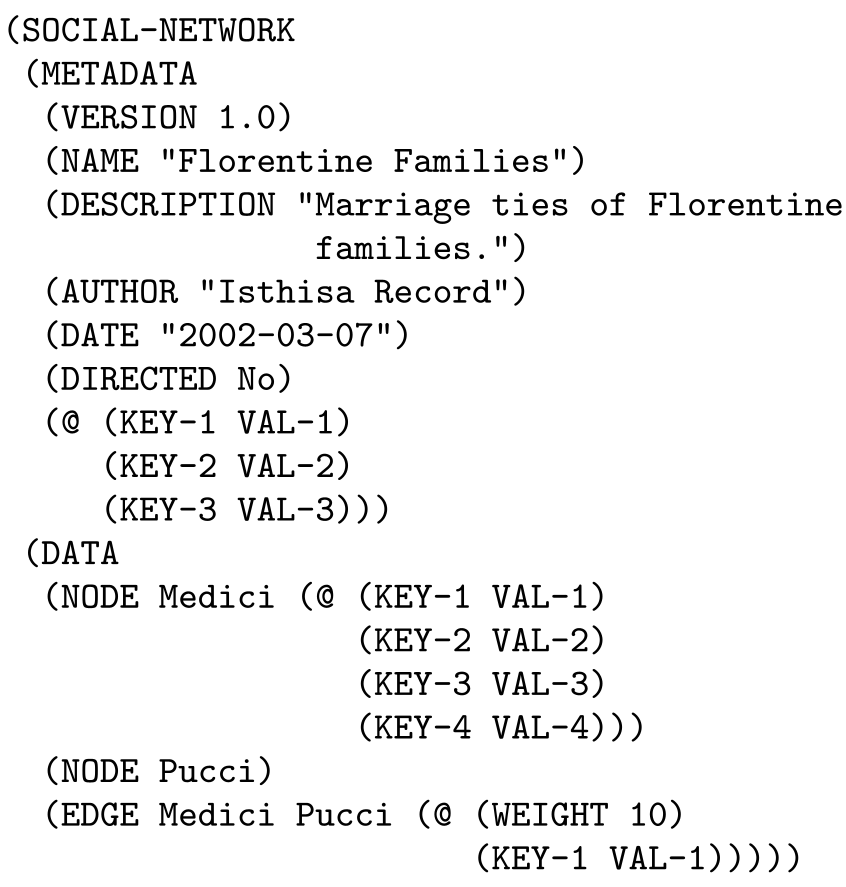 Figure 1: The S-Expression format allows for readable, extensible data input that includes free-form metadata.
2. Multi-Level Analysis
The implementation is organized into three distinct tiers:
- Network Level: Global metrics like density and reachability.
- Actor (Node) Level: Centrality measures (Degree, Betweenness, Closeness) to find "power players."
- Group Level: Identification of cohesive subgroups (cliques, LS sets, and Lambda sets).
The Core Challenge: Identifying Subgroups
One of the most valuable features of CL-SNA is its focus on LS sets. An LS set is a subset of nodes where members have more ties to each other than to any external nodes. Finding these is computationally expensive (), often requiring brute-force searching of subsets. CL-SNA implements heuristics to prune this search space, making it feasible for real-world application.
Experimental Results: From Families to Software
The authors validated CL-SNA through two contrasting case studies:
Case 1: Florentine Families
Using the famous dataset of 15th-century Florence, CL-SNA identified the Medici family as the most central node (degree of 6), effectively visualizing how their marriage ties cemented their political dominance.
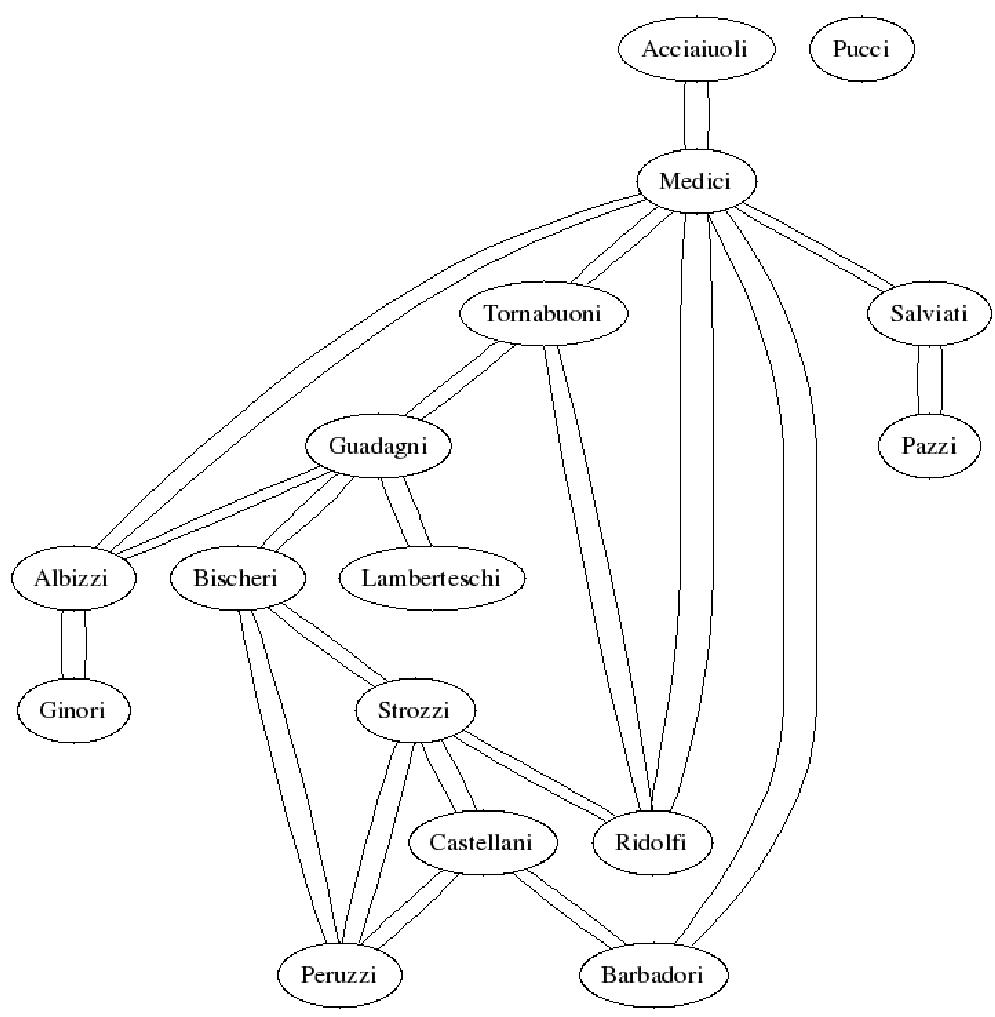 Figure 2: The symmetry of the marriage adjacency matrix processed by CL-SNA.
Case 2: Debian Package Dependencies
To test scalability, the authors analyzed 20,610 software packages. CL-SNA calculated the centrality of the entire network in under 6 minutes, identifying core libraries like LIBC6 and ZLIB1G as the most critical "social" actors in the software ecosystem.
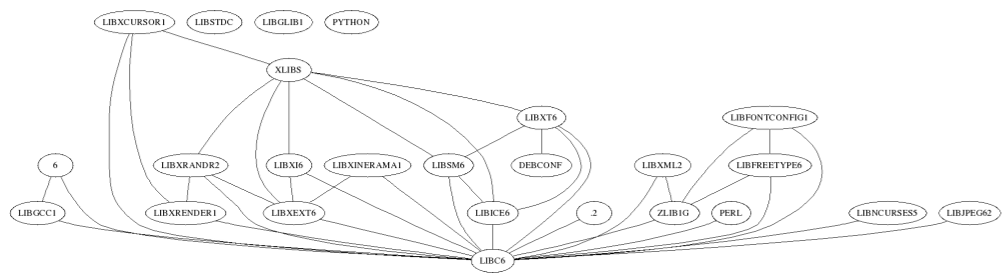 Figure 3: A pruned visualization of the Debian network, focusing on nodes with high centrality.
Critical Insight & Future Outlook
The true value of CL-SNA lies in its API philosophy. Unlike "black-box" software, CL-SNA encourages the user to switch "contexts"—moving from a whole graph to a subgraph and back again—without losing computational state.
Limitations:
- Visual Integration: The tool currently relies on external calls to Graphviz; a more integrated, interactive GUI would enhance usability.
- Dynamics: The current version focuses on static snapshots. Future work needs to address "Longitudinal Analysis"—tracking how networks evolve over time.
Conclusion
CL-SNA is more than just a library; it’s a programmatic environment for social science. By combining the rigorous metrics of Wasserman and Faust with the flexibility of Common Lisp, it offers a robust alternative for researchers who find mainstream SNA tools too restrictive for their complex, data-heavy inquiries.