
Where’s @wally?: Decoding the Geography of Social Ties
Where's @wally?: a classification approach to geolocating users based on their social ties
The paper introduces a classification-based approach to geolocating Twitter users solely using their social ties (followers/friends). By leveraging an SVM classifier with features like city population density and link reciprocity, it achieves city-level accuracy that outperforms previous spatial-probability models.
TL;DR
Can we find where you live just by looking at who you follow? This paper proves that for 50% of Twitter users, the answer is a definitive "yes." By treating geolocation as a classification problem rather than a simple distance-probability task, the researchers from the University of Sheffield developed an SVM-based model that uses city density and "reciprocal friendships" to pinpoint users at a city level—outperforming previous state-of-the-art models by nearly 2x.
Problem & Motivation: The Death of Distance?
In the age of digital nomadism, some argue that geography is dead. However, this paper argues the opposite: Geography is the silent architect of our online networks.
Existing geolocation methods suffer from three major flaws:
- IP Tracking is often inaccurate, expensive, or requires private access.
- Content Analysis (e.g., "you are what you tweet") fails when people talk about global events or purposefully hide their local context.
- Existing Network Models (like the Backstrom model) assume every friendship is equal. They ignore that a link to someone in London (a high-density hub) is far less meaningful than a link to someone in a tiny village.
The authors' insight? Social ties on Twitter are "noisy." Following a celebrity in another country isn't a social tie—it's an interest tie. True geolocation requires filtering this noise by looking at reciprocity and local density.
Methodology: The Classification Core
Instead of calculating a complex global maximum likelihood, the authors simplify the search space. They assume a user likely lives in the same city as at least one of their direct friends.
The Feature Set
- Inverse City Frequency (ICF): Much like TF-IDF in text mining, ICF penalizes cities with massive populations (like London). A friend in a small town is a much stronger signal of a user's location than a friend in a capital city.
- Reciprocity: If User A follows User B and User B follows User A, it’s a high-probability "real-world" friendship.
- Triads: The number of mutual friends (common neighbors) between two users indicates a shared community, which is often geographically bounded.
Model Architecture
The researchers used a Support Vector Machine (SVM) with a Radial Basis Function (RBF) kernel. This allowed them to model the non-linear relationships between population bins and friendship counts.
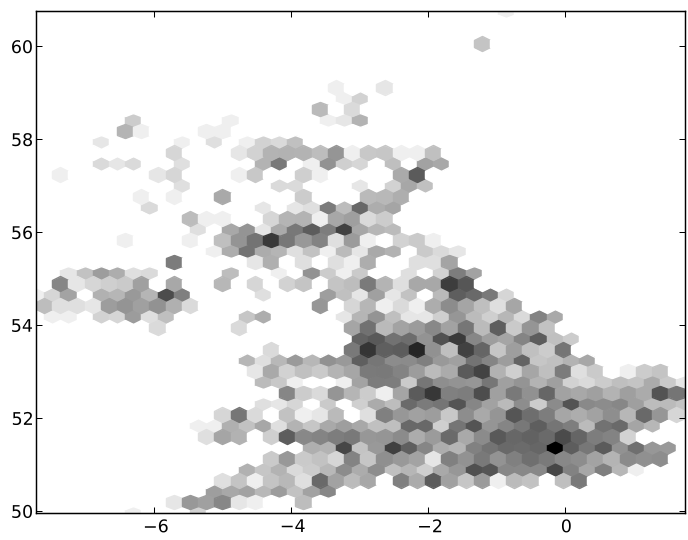 The figure above shows the distribution of friendships vs. distance; note the power-law curve indicating that most ties are local.
Experiments & Results
The study focused on 206,200 Twitter users in the UK. By focusing on a specific country, the authors could test the model in a high-density environment where cities are close together, making differentiation difficult.
Key Performance Wins:
- Baseline (Most Frequent City): 39.18% accuracy.
- Previous SOTA (Backstrom): 25.48% (at 0 miles).
- The "Wally" Model (Full Features): 50.08% accuracy.
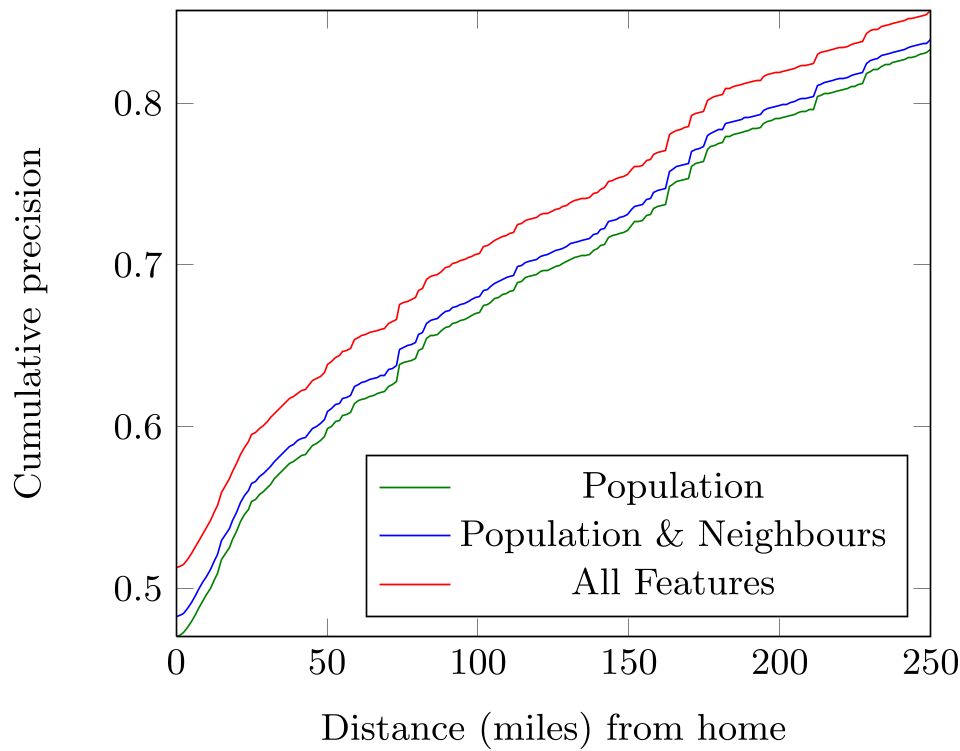 The chart above illustrates how "Population + Neighbours + Reciprocity" features (the top line) significantly outperform simple edge counting and previous methods.
Critical Analysis & Conclusion
The Privacy Paradox
The most striking takeaway is the "Privacy Factor." Even if you never tweet your location and disable GPS, your friends are effectively "snitching" on your coordinates. The study shows that 50% of users can be located with zero data from the user themselves—only their graph metadata.
Limitations
- Cold Start: New users with few friends cannot be easily located.
- Dynamic Shifts: If a user moves (e.g., a student going to university), the social network is "slow" to reflect the new location until new local ties are formed.
Future Outlook
The move from simple statistical models to SVM-based classification paves the way for deeper Graph Neural Networks. Future iterations will likely integrate temporal data (when was the link formed?) and interaction frequency (mentions and retweets) to separate casual followers from actual neighbors.
Takeaway for the industry: Geolocation doesn't need "Big Data" text analysis; it just needs a "Smart Data" look at who we talk to.