
Beyond the Cyborg: Reclassifying Augmentation Technology as a Socio-Technical Phenomenon
Defining a classification system for augmentation technology in socio-technical terms
This paper introduces a socio-technical classification system for augmentation technologies, moving beyond purely technical definitions to categorize them through human-centric, discursive, and rhetorical lenses. It identifies four key subcategories—Cognitive, Sensory, Emotional, and Physical—while highlighting the underlying value systems of enhancement, automation, and efficiency.
TL;DR
Is augmentation about the "hardware" or the "intent"? This paper argues that our current technical definitions of human enhancement are insufficient. By shifting the focus from gadgets (like exoskeletons) to the underlying rhetoric (the drive for efficiency and automation), the authors provide a framework to improve AI literacy and identify ethical risks before technologies reach the mass market.
The "Objective Neutrality" Trap
In many technical circles, "Human Augmentation" is discussed in purely functional terms: faster processors for the brain, stronger motors for the limbs, or higher resolution for the eyes. However, the authors point out a glaring gap: major taxonomies like IEEE and ACM don't even have a consistent category for these technologies.
The danger of this "objective" view is that it masks the socio-ethical trade-offs. When a company markets a wearable as "enhancing productivity," they are using a rhetorical strategy to justify the collection of intimate biometric data. The authors argue we must move toward Public Interest Technology (PIT), which prioritizes citizen rights and human needs over corporate "futurism."
Methodology: Reading Between the Lines
The researchers didn't just look at what these technologies do; they looked at how they are sold and justified. Using Discourse Analysis, they sampled texts from:
- Academic Repositories: To see how researchers define "Human Enhancement."
- Corporate Websites: To identify the persuasive language (rhetoric) used to market innovations.
- Industry Analysts (Gartner): To understand how "Hype Cycles" shape public perception.
The Four Pillars of Human Augmentation
The core contribution of the paper is a taxonomy that classifies augmentation into four subcategories based on human goals rather than just technical specs.
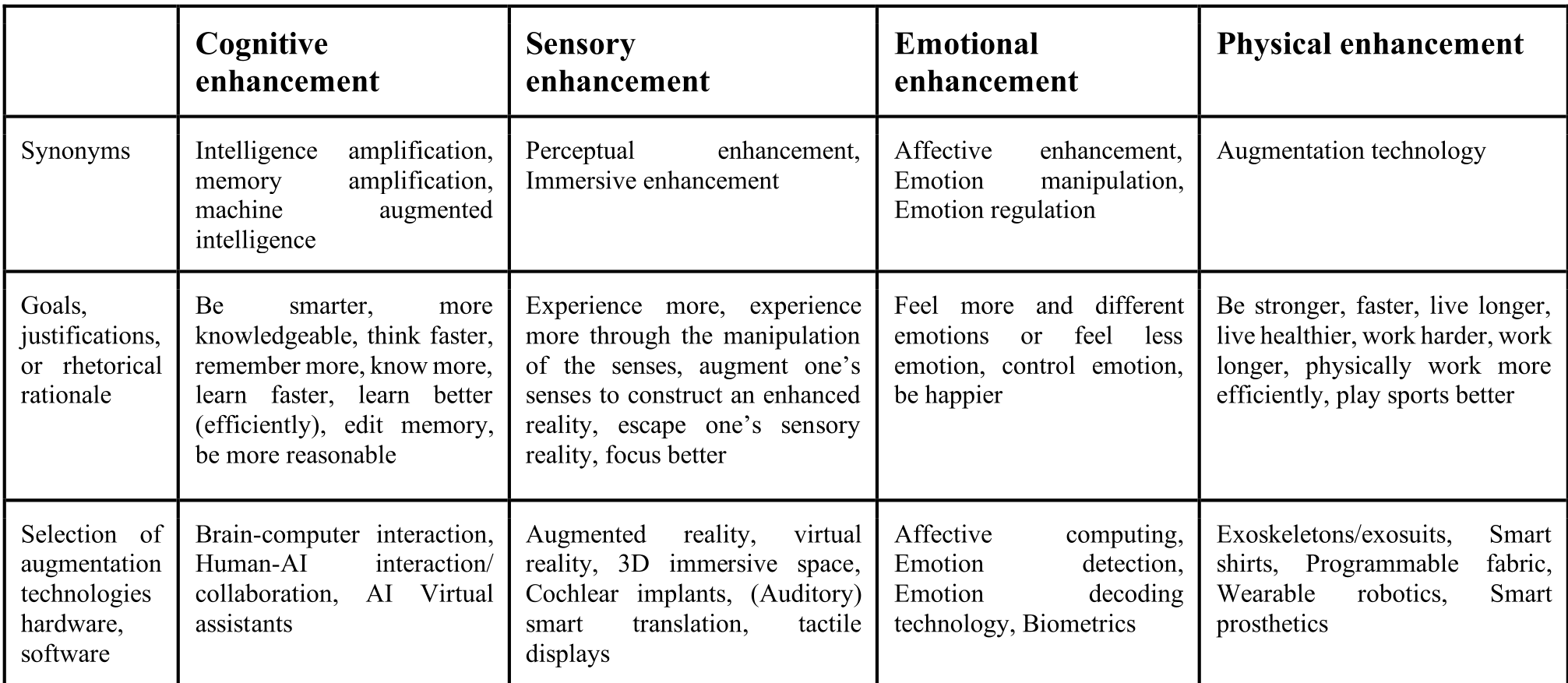
1. Cognitive Enhancement
Focuses on "Intelligence Amplification." The goal isn't just to have an AI do the work, but to create a "human-centered partnership."
- The Rhetoric: "Be smarter, remember more, learn faster."
- The Tech: Brain-computer interfaces, AI virtual assistants.
2. Sensory Enhancement
Involves "Immersive Technologies" that reconstruct or overlay digital data onto our reality.
- The Rhetoric: "Experience more, focus better."
- The Tech: AR/VR, "Silent speech" devices like AlterEgo.
3. Emotional Enhancement
This is perhaps the most controversial area. It involves "Affective Computing"—machines that claim to detect or influence human feelings.
- The Rhetoric: "Control emotions, feel more fulfilled."
- The Insight: The authors warn that there is often a lack of scientific evidence that these automated systems actually work, yet they are being deployed for surveillance.
4. Physical Enhancement
The most visible form of augmentation, often dealing with "body-worn" or "embodied" computing.
- The Rhetoric: "Be stronger, live longer, work harder."
- The Tech: Exoskeletons, programmable "smart" fabrics.
Deep Insight: The Three Hidden Value Systems
The paper uncovers three values that drive the "Augmentation" discourse, regardless of the specific technology:
- Enhancement: The explicit promise of improvement.
- Automation: An invisible logic where we assume AI should take over tasks, rarely questioned by the user.
- Efficiency: Reconceptualizing the human body and mind as a resource to be optimized (avoiding "wasting" time or energy).
Critical Analysis & Conclusion
This work serves as a critical wake-up call for the AI and tech community. We are moving from technologies that we use to technologies that embody us.
The Takeaway: If we define augmentation only by its mechanical power, we miss the "complex sociotechnical tradeoffs"—like the loss of data privacy for the sake of a marginal gain in physical efficiency. For developers and technical communicators, the challenge is to move toward AI Literacy: being able to articulate the human benefits and risks of these systems during the design phase, not as an afterthought.
Future Outlook: The authors are building a "Humane Futures" research repository to continue tracking how these discursive categories evolve as "The Future Human" becomes a present reality.