
Identifying At-Risk Students: The Power of Trace Data and Decision Trees in Learning Analytics
12970_Analysis of classifiers in a predictive model of academic success or failure for institutional and trace data.
This paper presents a comparative study of machine learning classifiers (Logistic Regression, Naive Bayes, SVM, and J48/C4.5) for predicting student academic success or failure. By leveraging the Open University Learning Analytics Dataset (OULAD), the study identifies J48 (Decision Tree) as a top performer in accuracy, and highlights the critical role of Trace Data over demographic metadata in predictive performance.
TL;DR
Predicting student success is moving away from "who the student is" (demographics) to "what the student does" (behavior). This study benchmarks four major machine learning algorithms across seven university courses, revealing that J48 Decision Trees and SVMs leveraging Virtual Learning Environment (VLE) interaction logs—known as Trace Data—achieve nearly 90% accuracy, far surpassing models built on demographic data alone.
The Core Challenge: Static vs. Dynamic Data
In higher education, identifying students who might fail is critical for timely intervention. Historically, institutions relied on Institutional Data (ID)—age, gender, and socio-economic status. However, these factors are static. The researchers argue that Trace Data (TD)—the digital breadcrumbs left behind in forums, quizzes, and wikis—provides a far more accurate "pulse" of student engagement.
Methodology: A Multi-Classifier Showdown
The authors didn't just test one model; they ran a comprehensive benchmark using:
- Logistic Regression: The traditional statistical baseline.
- Naive Bayes: A probabilistic approach assuming feature independence.
- Support Vector Machine (SVM): A robust classifier that finds optimal hyperplanes.
- J48 (C4.5): A Decision Tree algorithm that produces human-readable rules.
Data Configuration
Students from seven courses (labeled AAA to GGG) were analyzed using three datasets:
- DS1: Demographics/Institutional data only.
- DS2: Interaction/Trace data only.
- DS3: Combined features.
Note: Visualizing the shift from Institutional features to Trace features.
Why Trace Data Reigns Supreme
The findings were stark. Models using only demographics (DS1) hovered around 60-70% accuracy. Once Trace Data (DS2) was introduced, accuracy jumped significantly.
Key Experimental Results:
| Classifier | DS1 Accuracy (%) | DS2 Accuracy (%) | DS3 Accuracy (%) |
|---|---|---|---|
| Logistic Regression | 60.84 | 86.78 | 87.76 |
| Naive Bayes | 59.65 | 79.59 | 79.82 |
| SVM | 59.96 | 87.88 | 88.55 |
| J48 (Decision Tree) | 60.41 | 89.65 | 89.45 |
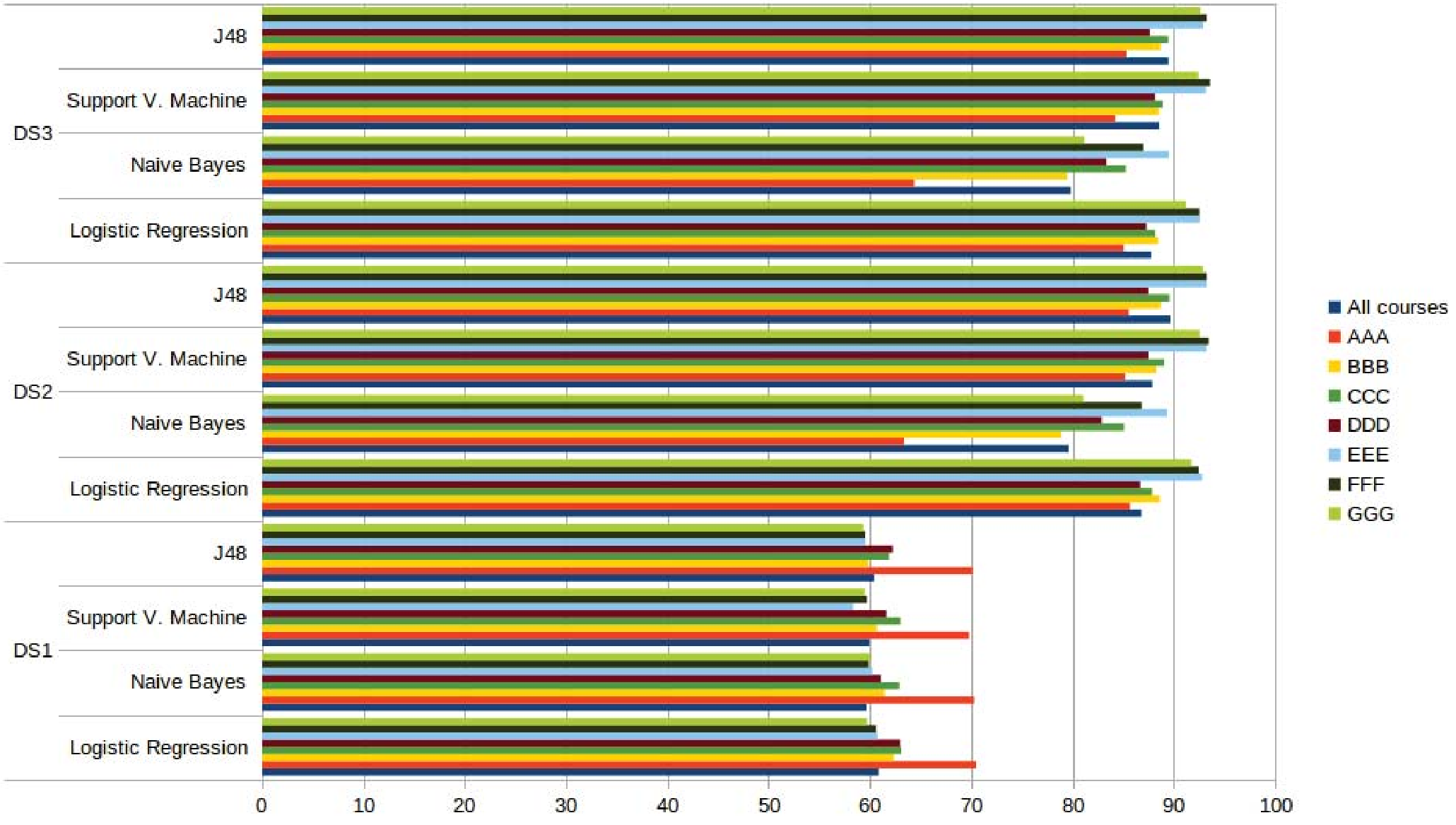 Figure 1: Comparison of the four classifiers across the three datasets. The massive leap in DS2 and DS3 highlights the predictive power of interaction logs.
The "Winner": J48 Decision Trees
While SVM provides excellent results, the authors recommend J48 for real-world deployment. Why?
- Transparency: Decision trees provide "rules" that educators can understand (e.g., "If forum posts < 5 and quiz score < 60, then At-Risk").
- Efficiency: As shown in the study's timing reports, SVM can be computationally expensive (taking thousands of seconds on large datasets), whereas J48 finishes in a fraction of the time.
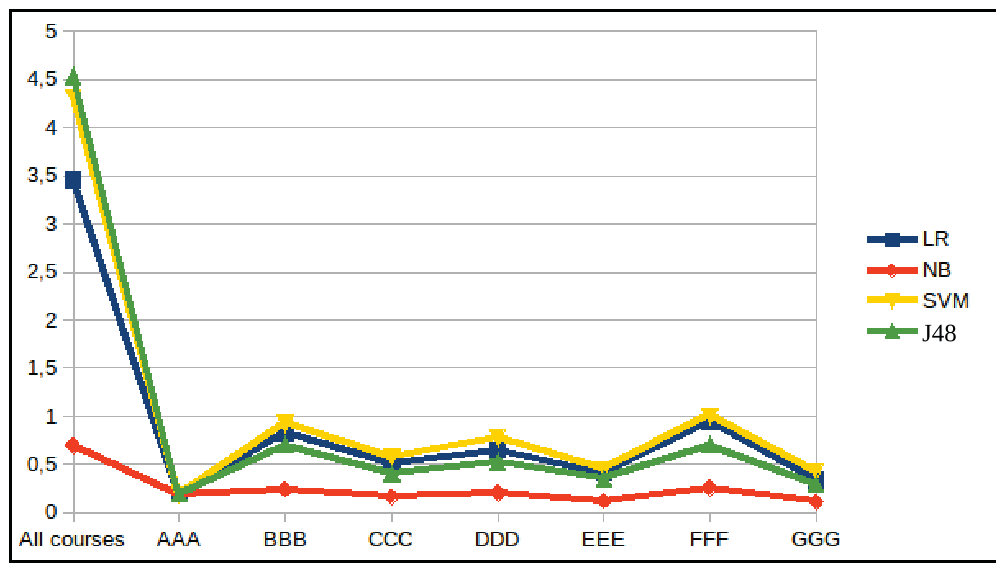 Figure 2: Execution time analysis. SVM represents a significant bottleneck as data scales, while J48 and Naive Bayes remain highly efficient.
Critical Insight & Future Outlook
The study proves that student behavior in the VLE is the single best predictor of success. However, it also notes that adding demographic data to activity data (DS3) offers negligible gains (less than 1%).
The Takeaway: Educational institutions should focus their engineering efforts on capturing high-quality interaction logs (quiz attempts, forum engagement, resource downloads) rather than deep-diving into demographic profiles if the goal is purely predictive accuracy.
Limitations: The study treats "Success" as a binary (Pass/Fail) and does not account for the content of forum posts (natural language processing), which could be a lucrative area for future research.
Conclusion
This research confirms that the "Digital Pulse" of a student—available via VLE Trace Data—is sufficient for building highly accurate early-warning systems. Among the tools available, the J48 Decision Tree offers the most practical combination of speed, clarity, and performance for modern educators.