
SVM and Political Arabic Classification: Decoding Orientations with Machine Learning
Classifying Political Arabic Articles Using Support Vector Machine with Different Feature Extraction
This paper presents a supervised machine learning framework for classifying Arabic political articles into three categories: Reform, Conservative, or Revolutionary. It utilizes Support Vector Machines (SVM) combined with TF and TF-IDF feature extraction, achieving a peak accuracy of 95.161% using a Linear kernel with TF-IDF.
TL;DR
Determining whether a political article serves a Reform, Conservative, or Revolutionary agenda is a complex task for AI, especially in the morphologically rich Arabic language. This paper demonstrates that by using a combination of TF-IDF feature extraction and a Linear Support Vector Machine (SVM), we can reach an impressive 95.161% accuracy in classifying these political orientations from web logs and newspapers.
Background & Positioning
In the landscape of Sentiment Analysis, most research focuses on binary "Positive vs. Negative" classifications for commercial products. This study moves into the more nuanced territory of Political Orientation Classification. It positions itself as a specialized application of supervised learning within the Arabic NLP domain, focusing on document-level classification rather than just word or sentence sentiment.
The "Arabic" Problem: Why Political NLP is Hard
Classifying political regimes isn't just about finding "happy" or "sad" words. It’s about identifying the underlying ideology. Arabic web logs add layers of difficulty:
- Conversational Style: Bloggers use non-professional, informal language.
- Morphology: A single Arabic root can produce dozens of surface forms, making "Total Word Count" a deceptive metric without pre-processing.
- Ambiguity: Political terms like "Reform" (إصلاح) can have different connotations depending on the regime being discussed.
Methodology: The Fine Art of Pre-processing
The authors emphasize that the results are only as good as the data cleaning. Their pipeline includes:
- Normalization: Removing diacritics and standardizing character variations (e.g., Alif shapes).
- Light Stemming: Reducing words to their stalks without the aggressive stripping seen in root-based stemmers, which preserves more semantic meaning for classification.
- Feature Weighting: Comparing Term Frequency (TF), which simply counts occurrences, against TF-IDF, which penalizes common "stop words" to highlight the unique vocabulary of a specific political stance.
 Figure 1: The proposed methodology workflow from data collection to classification.
Why the Linear Kernel Rules
SVMs work by finding a "hyperplane" that separates data classes in a high-dimensional space. While many researchers instinctively reach for non-linear "kernels" (like RBF or Polynomial) to handle complex data, this study found that Linear SVM was the clear winner.
Performance Comparison:
| Kernel | Accuracy (TF-IDF) |
|---|---|
| Linear | 95.161% |
| RBF | 40.322% |
| Polynomial | 40.322% |
| Sigmoid | 40.322% |
The drastic failure of non-linear kernels in the TF-IDF test (all hitting ~40%) suggests that the TF-IDF transformation creates a high-dimensional space where classes are already well-separated linearly. Overcomplicating the model with non-linear mapping essentially introduced noise or caused the model to collapse on the most frequent class.
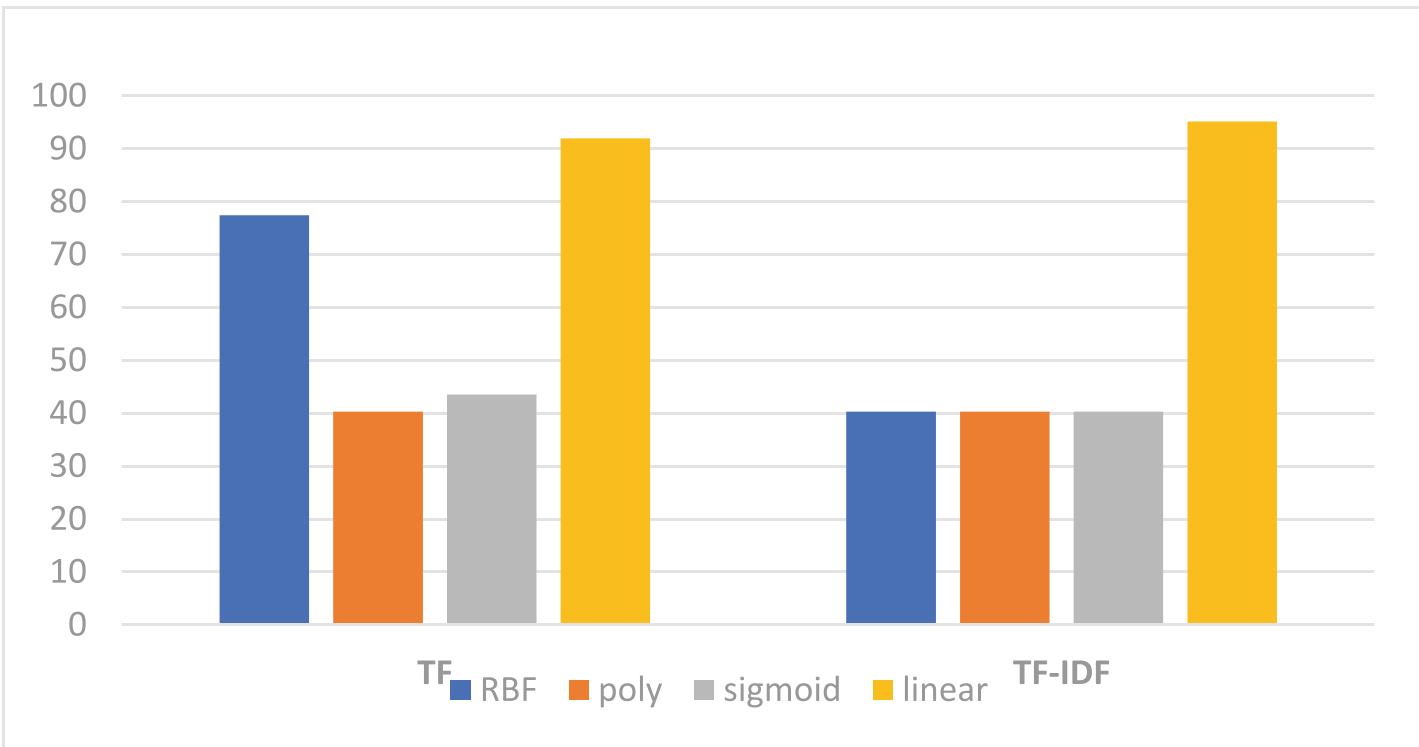 Figure 5: Model accuracy across different kernels and feature extraction methods.
Critical Insight: TF vs. TF-IDF
The experiment highlights a crucial NLP intuition: Context matters.
- Using TF (Term Frequency) with RBF achieved 77.4%.
- Using TF-IDF with RBF dropped to 40.3%.
Why? TF-IDF scales down common words. For some kernels, these "common" words actually provided structural hints about the political writing style. However, for the Linear Kernel, TF-IDF provided the "cleanest" signal, allowing it to jump from 91.9% to 95.1%.
Conclusion & Future Outlook
The study concludes that for Arabic political classification, a refined Linear SVM remains a SOTA-competitor, provided the pre-processing (Stemming/Normalization) is handled correctly.
Future Work: The authors suggest that the next frontier is Feature Selection—not just weighting words, but actively choosing the most "politically charged" tokens to reduce vector size and improve inference speed. This could pave the way for real-time monitoring of political trends in the Arabic-speaking blogosphere.