
AMCOSOP: Bridging the Digital Generational Gap via Ambient Social presence
Building a Client-Server Social Network Application for Elders and Safety Net
The paper presents the design and implementation of AMCOSOP, a client-server social networking platform specifically tailored for the elderly (Primary Users). It integrates a touch-screen Home Terminal with web and mobile applications for family (Secondary Users) and caregivers (Tertiary Users), utilizing XMPP and REST protocols to provide a continuous "sense of presence."
TL;DR
The AMCOSOP system is a tailored social networking platform designed to combat loneliness among the elderly. By replacing complex PC interfaces with a dedicated touch-based "Home Terminal" and connecting it to a robust XMPP/REST server, the project enables seniors to stay connected with relatives who use modern web and mobile apps.
The "Digital Exclusion" Problem
As society shifts toward online interaction, the "old-old" generation (those living independently with minimal tech skills) is increasingly marginalized. Standard interfaces—reliant on mice, keyboards, and complex menu hierarchies—represent a significant barrier. Furthermore, the motivation gap is real: elders fear privacy breaches or lack a perceived benefit, while busy relatives find it cumbersome to jump between different tools to check on their parents.
Methodology: A Multi-Tier Connectivity Engine
The researchers' core insight was that the solution must be asymmetrical:
- For Elders: A dedicated, always-on Home Terminal (All-in-One PC) running a simplified JavaFX touch interface.
- For Relatives: A multi-platform web/mobile app (built with ASP.NET and jQuery Mobile) that fits into their daily smartphone usage.
Technical Architecture
The system relies on a central Service Platform that manages the "state" of the social network.
- XMPP (Extensible Messaging and Presence Protocol): Chosen for its efficiency in real-time "instant messaging" and status updates. It provides that critical "Sense of Presence"—knowing a loved one is "online" or "active" without a formal call.
- RESTful JSON API: Used for heavy data lifting like profile management and service subscriptions.
- Security: All traffic is wrapped in SSL, ensuring that private family interactions remain within the "Safety Net."
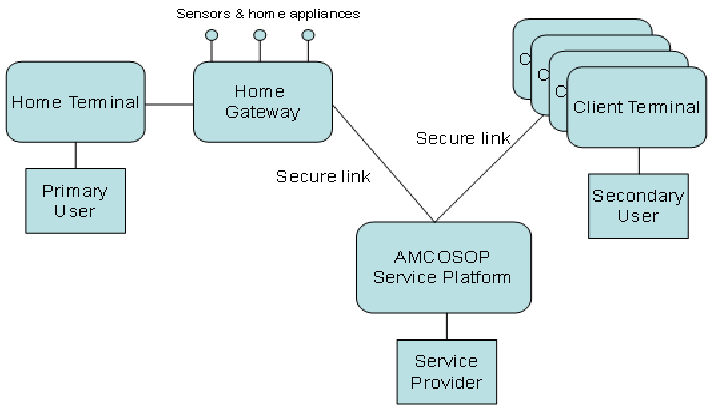
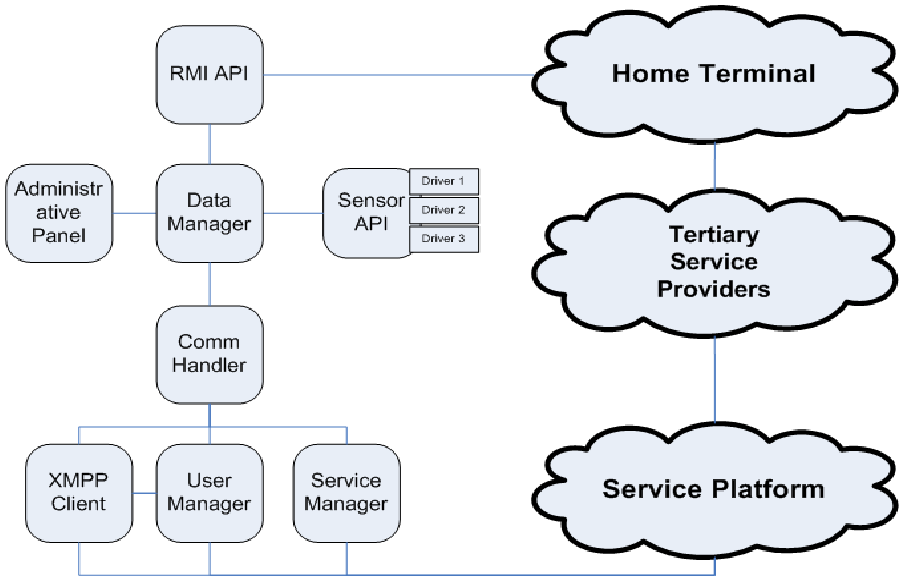
The Home Gateway (shown below) acts as the bridge, decoupling the UI from the networking logic via RMI (Remote Method Invocation). This allows the UI to stay responsive even if the network fluctuates—a crucial design choice for maintaining a "friendly" user experience.
Real-World Validation: Trials in Finland and Austria
The system wasn't just a lab prototype; it underwent multi-month field trials.
- Seniors' Feedback: Highly positive. The touch interface removed the "fear" of technology. It was seen as an "ambient" device rather than a "computer."
- Contextual Awareness: The use of smart-phone GPS (via the MobSOP client) allowed relatives to automatically share status updates, providing peace of mind to the elders without requiring active typing.
Critical Insight: The Integration Paradox
One major takeaway from the results is the Integration Paradox. While the seniors loved the dedicated silo of AMCOSOP, the secondary users (the children/grandchildren) found it difficult to maintain usage because it was yet another app to check.
Future SOTA in this field will likely move toward "invisible" integration—where the elder uses a dedicated device, but the relative interacts purely via a WhatsApp bot or a Facebook plugin, reducing the "interaction tax" for the younger generation.
Summary
AMCOSOP successfully demonstrates that a high-tech backend (XMPP + REST) combined with a low-tech frontend (Touch UI) can effectively foster social inclusion. While the technology (Symbian, JavaFX) reflects its 2013 publication date, the architectural philosophy—prioritizing "Sense of Presence" over "Information Density"—remains a gold standard for elderly-centric design today.